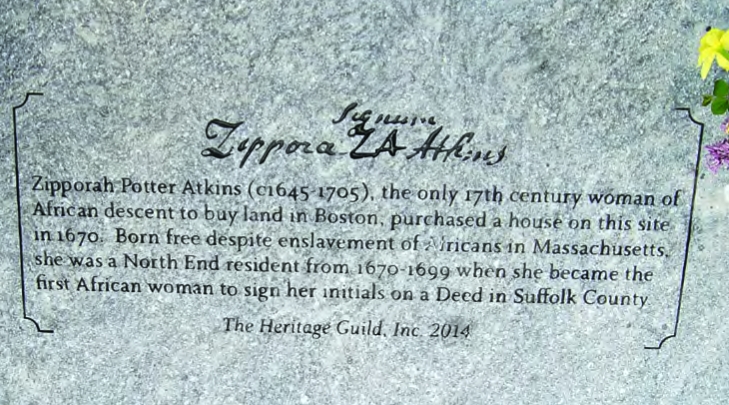
A marker at home site of Zipporah Potter Atkins, the first African American to own land in the city of Boston.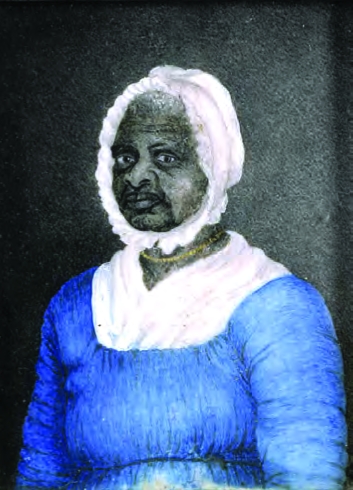
Mum Bett, an enslaved woman later known as Elizabeth Freeman, successfully sued for her freedom in Massachusetts.

Visitors walking Boston’s Freedom Trail pass familiar landmarks—Beacon Hill, the Old North Church, King’s Chapel, and the streets where revolutionary leaders debated liberty. Yet long before the American Revolution, another story of courage and leadership was unfolding in those same neighborhoods.
Colonial Boston was shaped not only by governors, ministers, and revolutionary patriots, but also by Black women whose courage, labor, intellect, and resistance helped define the city. Many were enslaved, others free. Some left only faint traces in church records, probate inventories, or court petitions. Yet together their lives form one of the richest collections of documented Black women’s biographies from colonial New England.
Their stories reveal something essential:
Black women were not merely witnesses to Boston’s early history—they were active participants in shaping it.
Early presence: Black women in the foundations of New England
One of the earliest known figures is Dorcas “ye Blackmore,” believed to be the first named African woman recorded in New England. In 1641 she stood before the congregation of the First Parish Church in Dorchester and testified publicly to her Christian faith. Governor John Winthrop wrote that she demonstrated deep knowledge of scripture and strong moral character. Even while enslaved, Dorcas became a respected member of the church and helped convert Native American servants to Christianity.
Another early figure remembered simply as “Queen” arrived in Boston aboard the slave ship Desire in 1638. Once a royal leader in her homeland, she resisted attempts by her enslaver to force her into reproductive servitude, fiercely defending her bodily autonomy. Her resistance stands as one of the earliest recorded challenges to slavery in colonial America.
These stories remind us that Black women were present in Boston’s spiritual and social life from the beginning.
Resistance and survival
Other women appear in the historical record through acts of resistance.
Hagar Blackmore testified in Middlesex County court that she had been stolen from her husband and child in Africa—one of the rare moments when an enslaved woman’s own understanding of slavery was preserved in colonial records.
Another woman, Maria, enslaved in Roxbury, resisted so fiercely that colonial authorities executed her for arson in 1681. Her case illustrates the extreme punishments used to suppress resistance.
Even under brutal conditions, Black women challenged the institution that sought to silence them.
Freedom through the courts
As Boston developed into a colonial city, Black women increasingly used the law itself as a tool for freedom.
Joan Jackson became the first enslaved woman in New England to win her freedom in court in 1716, establishing a precedent others would follow.
Jenny Slew later secured her freedom in a jury trial after being kidnapped and enslaved in 1762.
Other women also petitioned colonial courts for liberty, including Abigail Johnson, Abigail Prince, Margaret “Peggy” Johnson, Rose Baker, Ruth Black, Sarah Peters, Maria Hammond, Phillis Boston, and Dina Ganson.
These cases demonstrate that the struggle for freedom in Massachusetts did not begin with famous abolitionists. It began with enslaved individuals—many of them women—asserting their humanity before the law.
Economic independence and property ownership
Black women also shaped Boston’s economic life.
In the North End, Zipporah Potter Atkins became the first known Black landowner in what would become the United States when she purchased property in 1670. At a time when women’s property rights were limited and Black ownership was rare, Atkins maintained legal control of her land even after marriage.
Other women demonstrated similar independence.
Flora Maranday, a Black widow in Charlestown, owned property and maintained a stable household.
Catherine Cornwell, a free Black woman in Boston, drafted a will in 1752 naming her children and safeguarding her estate—an extraordinary assertion of legal agency in colonial Massachusetts.
Through property ownership and economic management, these women helped shape Boston’s early Black middle class.
Intellectual and cultural leadership
Black women also helped shape Boston’s intellectual life.
Phillis Wheatley, enslaved as a child and brought to Boston in 1761, became one of the most celebrated poets of the eighteenth century. Her poetry, published in Boston and London, demonstrated extraordinary literary skill and challenged prevailing assumptions about the intellectual capacity of Africans. Abolitionists cited her work as evidence that enslaved people possessed equal intellectual ability.
Another remarkable figure, Lucy Terry Prince, composed what is widely considered the first known poem by an African American. She later gained recognition as a powerful public speaker and once argued a land dispute before the Vermont Supreme Court, where a judge reportedly praised her argument as one of the best he had ever heard.
Through poetry, speech, and scholarship, Black women helped shape the intellectual landscape of early America.
Faith and community leadership
Churches were often the center of Black communal life, and women played key roles within them.
At King’s Chapel and Old North Church, figures such as Elizabeth Humphries, Mary Cranky, Peggy Scott, Judith, and Jane Weston helped sustain Boston’s early Black religious communities. Weston even corresponded with white clergy, demonstrating the theological engagement of Black women in colonial religious life.
Another important figure was Chloe Spear, once enslaved in Boston. She later became known for her Christian testimony and for operating a boarding house that hosted interracial religious gatherings. Through faith and leadership, she became a beloved figure in Boston’s spiritual life.
Other women navigated family life under the harsh constraints of slavery.
Margaret Hill, enslaved yet married to a free Black man, raised children baptized at King’s Chapel while maintaining a family within Boston’s early African American community.
Keturah fought to secure baptism for herself and her daughters despite resistance from enslavers, asserting her family’s place within the church.
Everyday survival and quiet strength
Daily life required extraordinary endurance.
Flora, enslaved in Menotomy (now Arlington), gave birth to six children while laboring for her enslavers.
Kate, baptized as an infant in 1754, lived within the Russell household during the turbulent years leading up to the American Revolution.
Dinah Dinah, enslaved at age eleven, endured sixty years of bondage before dying in Boston in 1803.
Some women seized moments of upheaval to pursue freedom.
Nell escaped during the chaotic British evacuation of Boston in March 1776, carrying clothing and supplies as she fled toward possible freedom.
Sarah Seheter, enslaved by several New England households, also escaped during the turmoil surrounding the Siege of Boston.
Others contributed directly to the Revolutionary cause.
Margaret Thomas worked with George Washington’s Continental Army, traveling with soldiers from Cambridge to Valley Forge and supporting them as a laundress and laborer.
Traces in the historical record
Even when their voices were rarely recorded, Black women’s presence remains visible through fragments of history.
Gravestones in Cambridge preserve the names of Cicely and Jane, two enslaved girls buried in the Old Burying Ground near Harvard Square. These stones— among the earliest memorials for enslaved individuals in New England—stand as quiet witnesses to lives that history nearly erased.
Other women appear only briefly in church and court records—Celia, Charity Clarke, Dinah, Lydia, Hagar, Moll Pitcher, Phillis, Phoebe, Violet, and many others. Yet even these fleeting references remind us that Black women were present in every corner of colonial Boston’s society.
Recovering their names
I came to learn about many of these women through my work on the Black Women Lead project, an effort to recover and document the lives of Black women who shaped Boston long before the Civil War or the modern civil rights movement.
The deeper we searched the archives— church registers, probate records, court petitions—the clearer it became that these women were everywhere in colonial Boston, even if their stories were rarely told.
These stories emerge from church records, probate inventories, court petitions, and early colonial archives—documents where Black women appear only in fragments, yet together reveal a remarkable history.
Taken together, the lives of Belinda Sutton, Chloe Spear, Elizabeth Freeman, Lucy Terry Prince, Phillis Wheatley, Zipporah Potter Atkins, Abigail Johnson, Abigail Prince, Ann Arnold, Catherine Cornwell, Celia, Charity Clarke, Cicely, Daphne Demah, Daphne of the Hancock household, Dina Ganson, Dinah, Dinah Dinah, Dorcas the Servant, Dorcas ye Blackmore, Elizabeth Humphries, Elsey Marsh Middleton, Flora, Flora Maranday, Hagar Blackmore, Hagar, Jane, Jane Weston, Janes Eames, Jenny Slew, Joan Jackson, Judith, Kate, Keturah, Lucy Pernam, Lydia, Margaret Hill, Margaret Johnson, Margaret Thomas, Maria, Maria Hammond, Mary Cranky, Moll Pitcher, Nell, Obour Tanner, Peggy Scott, Phillis Boston, Phillis, Phoebe, Queen, Rhoda Hall, Rose Baker, Ruth Black, Sarah Peters, Sarah Seheter, Violet, and Zilpah White represent one of the largest collections of documented Black women’s biographies from colonial Boston.
And yet most Americans have never heard their names.
The stories we teach
In early American history classes, students often learn about women such as Betsy Ross, Abigail Adams, Martha Washington, Mercy Otis Warren, Molly Pitcher, Anne Bradstreet, Deborah Sampson, and Mary Katherine Goddard.
These women rightly hold a place in the story of early America.
But the Black women who lived and struggled in colonial Boston are rarely included in that story.
Completing the story of Boston
Every year millions of visitors walk the Freedom Trail, stopping at places like King’s Chapel and climbing Beacon Hill to learn about the American Revolution. They hear stories of patriots, governors, and founding fathers.
Few realize that enslaved and free Black women were living and working in those same spaces.
Recognizing these women does not diminish the stories already told along Boston’s Freedom Trail.
It completes them.
Long before Boston’s Freedom Trail was marked with red bricks, these women were already walking the path toward freedom.
Remembering their names today ensures that their leadership—and their legacy—will never be forgotten.
Ed Gaskin is the Greater Grove Hall Main Streets executive director and a graduate of MIT’s Sloan School of Management.