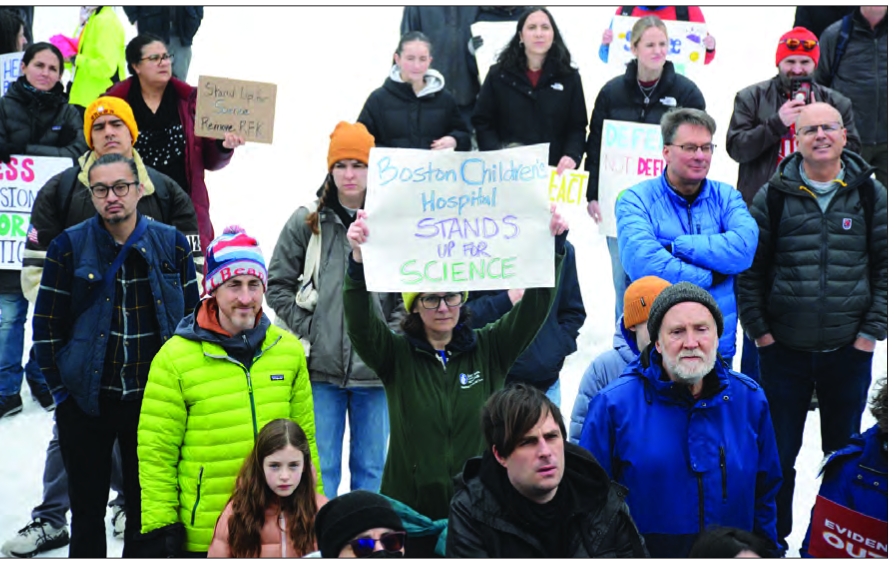
The group Stand Up For Science organized a rally on Boston Common to protest the Trump administration’s anti-science policies.A crowd of hundreds gathered on a recent cold Saturday afternoon on Boston Common waving signs and banners and chanting calls to action. The group of concerned students, scientists teachers, policymakers and many others had come together in the name of scientific reason, and reason itself.
“What do we want?” the organizers prompted.
“Logic!” the enthusiastic assembly responded.
“When do we want it?” “NOW!” The “Take Back Our Science” rally was an effort to stand up against what some say is the systematic removal of scientific fact from governmental, academic and medical practice and policy.
The rally was organized by the grassroots nonprofit organization Stand Up for Science (SUFS), which was founded in Washington, D.C., in February 2025 in response to several Trump administration executive orders and actions by the former Department of Government Efficiency (DOGE) that led to the termination of hundreds of federal positions at science agencies.
SUFS’ goals include ending what it sees as censorship and political interference in science, securing and expanding scientific funding, and defending and supporting groups that offer opportunities to participate in scientific research.
“We are scientists, educators, students, and workers who are concerned about the suppression of science and the disengagement of policy from scientific fact that is being propagated by administrative policies that are of dire consequences to our country and the world,” event co-organizer Dr. Thomas Michel said before the event.
Michel is a professor of medicine and biochemistry at Harvard Medical School.
“Our goal is to share our concern and to come up with a plan for action to try to resist the undermining of science, which is an ongoing and growing crisis.”
In March 2025, a little over a month after President Trump took office, SUFS mobilized over 50,000 people at nearly 200 events across the country, including thousands in Boston, as part of its first National Day of Action.
“It has been a year since the last rally,” noted Massachusetts SUFS co-lead Katie Blair, who is also director of Massachusetts Families for Vaccines, in her introductory remarks at the event, “and we have seen the damage that has been done.”
According to MIT neuroscience professor Nancy Kanwisher, that damage has included $1.4 billion in frozen grants, including previously approved grants that had become subject to political whims before they could be released.
Since that first rally, many scientists from several agencies and organizations, including the Environmental Protection Agency, Federal Emergency Management Agency, National Aeronautics and Space Administration and the National Institutes of Health, have chosen SUFS as the platform for their dissent.
At the rally, observers from the National Lawyers Guild and representatives from such groups as Mass 50501 and the Union of Concerned Scientists were on hand to distribute literature about other costs of the abandonment of science, such as threats to public health and safety, and to show support.
Demonstrating the import that the support of science has, four Boston-area Nobel laureates also addressed the gathered crowd: Eric Maskin (economics 2007) and medicine or physiology laureates William Kaelin (2019), Michael Rosbash (2017) and Gary Ruvkun (2024).
“The rule of law means minimal top-down interference,” said Rosbach, adding that “science should pick who gets funding, not the administration.”
Maskin explained how scientific research is beneficial, not just in terms of health and welfare, but also in terms of money: for every dollar invested in science, we get three in return, he said.
“That’s a good investment,” he said, noting how in science centers like Boston the additional benefits of infrastructure and human capital investment make the return even more impressive.
“Putting money into basic science is the best investment the U.S. government has made in the last 80 years,” he concluded.
Remarks made at the event also acknowledged how some in the sciences are dealing with more than just the threat to their professional lives. Kaelin recalled how a colleague from outside the United States recently came to him crying, fearful of being captured by Immigration and Customs Enforcement.
Others shared similar concerns. “The administration is throwing sand into the gears of development,” said Kanwisher, noting how many scientists who once flocked to the United States are now being discouraged by a lack of funding and the threat of deportation.
By way of example, UMass Chan Medical School researcher and MA Runs on Research representative Karthika Nagalekshmi, who is from India, told the crowd, “I have been scrambling to deal with my immigration status instead of doing my research.”
There were also members of the state Legislature, including Will Brownsberger, who is president pro tempore of the Senate. “In the 20th century, science earned respect through its achievements,” Brownsberger recalled. “Massachusetts has sustained this progress on many fronts…[but] that great enterprise is now under assault…not just by lack of funding but by lack of reason.”
As evidence, Brownsberger cited the stress on both the research and health care systems in Massachusetts and across the country. “Science and the rule of law are both under assault,” he maintained, “But in this commonwealth, we are committed to both.”
As the three-hour event drew to a close, speakers exhorted the crowd to continue the fight.
“Today is just the beginning,” concluded SUFS co-leader Tori Votaw, encouraging participants to join the represented groups and petition their political representatives. “We need to take action.”