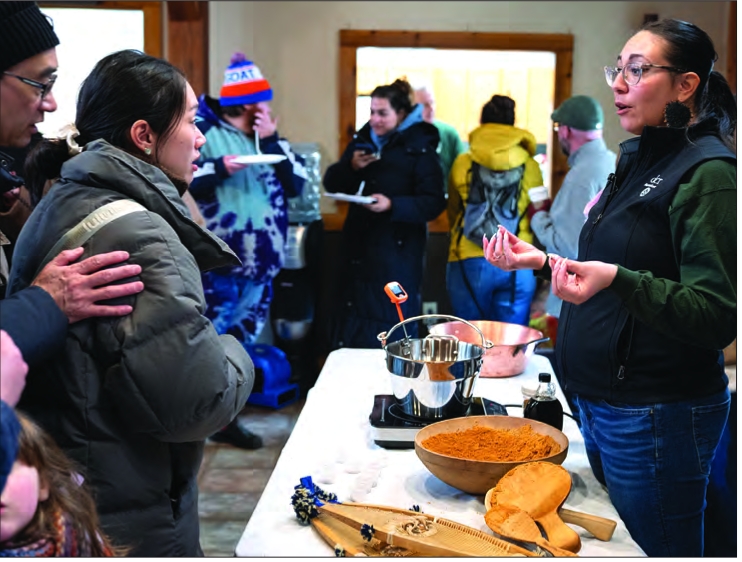
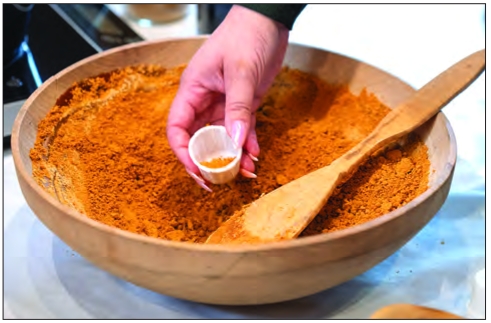
(Above) Leah Hopkins explains the process of making maple sugar to visitors. (Below) Hopkins scoops a sample of maple sugar.
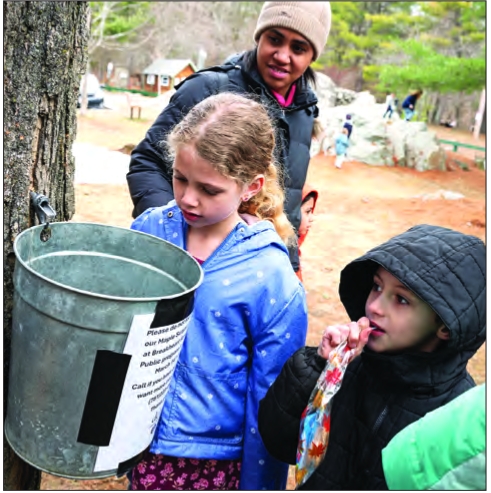
A child looks over the edge of a sap bucket as a DCR employee explains how to identify sugar maples from other types of trees.
On a recent partly sunny day in Saugus, a small crowd of people huddled around a table in the Breakheart Reservation’s visitor center. One by one, they took turns peering into a shiny steel bucket sitting on a hot plate. Within was maple syrup that had been simmering for over two hours.
Leah Hopkins, a citizen of the Narragansett tribe of Rhode Island, was behind the table, stirring the sticky, sweet liquid and monitoring a thermometer that was clipped to the side of the bucket.
When the probe showed 250 degrees Fahrenheit, she carefully poured the melted sugar into a wide wooden bowl. With a large flat spoon, she kneaded the hot liquid as it slowly underwent a transformation, first into a gelatinous, stretchy paste and then into fluffy, powdery, brown maple sugar.
Hopkins quickly began scooping small samples of the sugar for the hungry onlookers.
“I enjoy it in my coffee. I bake with it. So, every year my family makes enough sugar to stock our pantries,” said Hopkins.
The demonstration was part of the 38th annual Maple Sugarin’ day, held March 14 by the Massachusetts Department of Conservation and Recreation (DCR). Despite the chilly weather, hundreds of people filtered in and out of the reservation grounds and visitor center to learn about the process of transforming sugar maple tree sap into thick syrup, then sugar.
Hopkins was there in her capacity as the DCR’s Indigenous Peoples Partnership coordinator and was particularly focused on emphasizing the connection between maple products and her people.
“Native people invented tapping maple trees, invented maple syrup, invented maple sugar. Without Indigenous people, we would not have this wonderful, sweet that we have today,” she said.
Throughout the four-hour event, attendees stopped at one of five stations along the self-guided tour to learn about identifying and tapping sugar maple trees and turning that tapped sap into syrup, along with some of the history, science and precolonial tools and techniques involved.
Visitors learned, for instance, that sugar maple sap can only be collected when the temperature is above freezing during the day but below freezing at night. In Massachusetts, those days are most common in fall and spring.
Jared Powell of Medford, who attended the event with his wife and two sons, emphasized how his children were captivated by the connection between nature and making maple syrup.
“They’re very into the nature piece of it and understanding where the syrup comes from and how that’s something that is just in so many of these trees,” said Powell. “Getting to eat the end product is pretty appealing to them, too.”
That’s because along with demonstrations like the one Hopkins gave, the visitor center offered people a chance to grab sweet treats like pancakes and syrup-covered popcorn.
The sugaring station seemed to be a hit. “I love this whole maple sugar station,” said visitor Beatrice Duvert of Saugus, who attended the event with her daughter Astor. “I had no idea that you could just boil down maple syrup and then make it into your own sugar by whipping it.”
Hopkins showed wooden tree taps and clay bowls, tools Indigenous peoples used for making maple syrup and sugar.
“Traditionally it was done with wooden taps. These were funneled into basins that would sit on the ground. Then you’d send your kids out to go collect them,” said Hopkins. “We would also use clay cooking vessels… to boil off and evaporate that water content in order to have the syrup and sugar.”
As part of her role with DCR, Hopkins also oversees the First Peoples First Stewards Partnership, an initiative aimed at building relationships with tribal governments and others in Indigenous communities to help them feel welcome in DCR parks and forests.
“Native people have been living here for over 12,000 years and have a very unique and inextricable relationship with this homeland.
We’re working hard to connect and work alongside the Native community in order to take care of these lands in the way that they should be taken care of,” said Hopkins.
Developing relationships with DCR through that partnership is a slow, delicate balance, Hopkins says.
“You have to move at the speed of trust. You have to build that trust. This is not something where we can come in and the next day or the next week or the next month say, ‘Oh, we have a partner,’” she said. “You have to move carefully and understand that tribes are going to move at the pace that they need to move.”
Beyond being part of her work, events like these hold special meaning for Hopkins, given the opportunity she has to represent and educate.
“For some people, this is the first time they’re ever meeting an Indigenous person. I’m not only representing DCR, I’m representing my community.
I’m representing the Native community,” said Hopkins. “If I can just connect with one person today, I’ve done a good job.”