
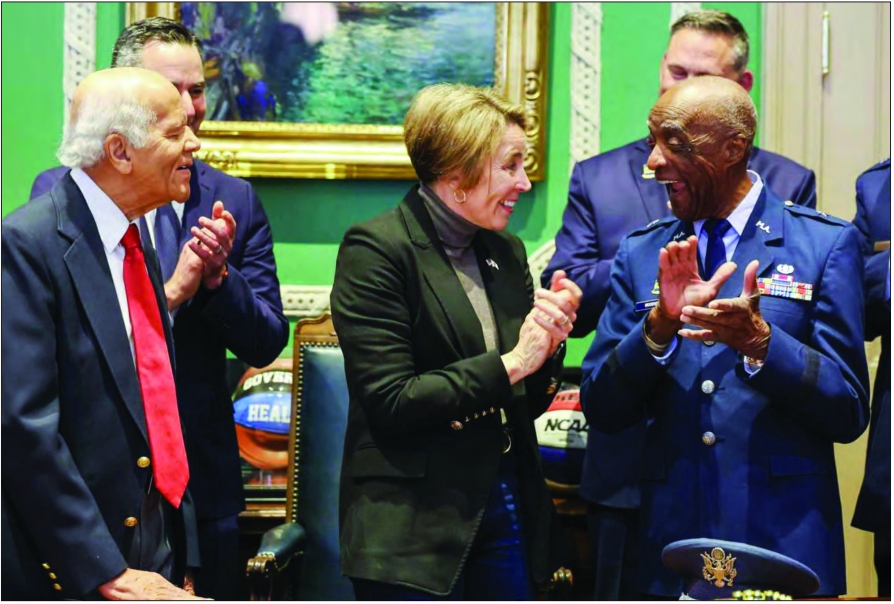
Gov. Healy shares a laugh with Tuskegee Airmen Dr. Harold May (left) and Brigadier General Enoch “Woody“ Woodhouse.
During World War II, the first African American military aviators in U.S. history, known as the Tuskegee Airmen, took to the skies in segregated units and helped reshape both the outcome of the war and respect for Black service members. Their discipline and contributions in combat not only helped defeat Nazi forces in Europe but also helped dismantle deeply entrenched racist assumptions within the U.S. military.
Now, eight decades after their historic service, Massachusetts has established a permanent day to honor their legacy. Beginning this year, the fourth Thursday of March will be recognized statewide as Tuskegee Airmen Commemoration Day, an observance intended to recognize the pilots and the thousands of personnel who supported them. Alabama, Florida, North Carolina and Ohio have passed similar legislation in recent years.
“The Tuskegee Airmen served our country with extraordinary courage and skill at a time when they were still denied equal treatment at home,” Gov. Maura Healey told the Banner via email. “Establishing Tuskegee Airmen Commemoration Day ensures their service and sacrifice are recognized and remembered. Their legacy helped change our military and our nation for the better, and it’s important that Massachusetts continue to learn from and honor their example.”
The Tuskegee Airmen were trained beginning in 1941 at Tuskegee Army Airfield in Alabama, where the Army Air Corps launched a segregated program to test whether Black pilots could successfully fly combat aircrafts. At the time, many military leaders held racist beliefs that African Americans lacked the intelligence, discipline and technical skill necessary for aviation.
The Airmen proved them wrong.
“The Tuskegee Airmen broke barriers and proved their excellence in the face of discrimination,” said Lt. Gov. Kim Driscoll in an email.
Between 1941 and 1946, nearly 1,000 Black pilots graduated from the program while more than 14,000 men and women served as navigators, mechanics, bombardiers, instructors and support personnel attached to the units.
They earned the moniker “Red Tails” after flying aircraft marked by red painted tails. The fighter pilots escorted Allied bombers through some of the most dangerous airspace over Europe and North Africa.
Their performance quickly earned respect among bomber crews, who often requested the Tuskegee Airmen for escort missions because of their discipline and tactical precision.
Over 1,500 combat missions, Tuskegee Airmen destroyed 108 enemy aircraft in aerial combat during World War II. Their valor also earned significant military recognition, including 744 Air Medals, 150 Distinguished Flying Crosses, 14 Bronze Stars and one Silver Star, according to multiple historical accounts, including the Smithsonian National Air and Space Museum.
Reflecting on his time serving in the all-Black unit, 99-year-old Roxbury native and Brig. Gen. Enoch “Woody” Woodhouse told GBH, “I felt fine because I was with the finest men I’ve known in life no matter what their race [was].”
Yet when the war ended, many of the decorated veterans returned home to a segregated America that often ignored their service. Despite their heroism abroad, Black servicemen still faced discrimination in housing, employment and public life in the United States. Their achievements went widely underrecognized for decades.
Military finance officer Woodhouse attended Yale after his service, graduating in 1952 after being widely ignored on campus. Occasionally, people slipped “unwelcoming notes” under his door, according to a Yale Alumni Magazine feature. He didn’t get angry; he would tear up the notes and laugh.
“You didn’t like it, but what could you do about it? Suck it up and keep moving,” he remarked when discussing racism and his career during a WCBV interview.
Woodhouse ultimately became a lawyer, fighting the injustices he was intimately familiar with and advocating for clients, one of whom was former Celtics player Bill Russell.
Still, their success played a crucial role in reshaping military policy. Historians widely credit the Tuskegee Airmen’s exemplary record as one of the forces that led to President Harry Truman’s 1948 decision to desegregate the U.S. armed forces.
Massachusetts’ new commemorative day seeks to ensure that the Tuskegee Airmen’s legacy continues to be recognized.
“Recognizing a day in their honor is a way to acknowledge both their military achievements and the broader impact they had on expanding opportunity in America. Their story is an important part of our history and deserves to be remembered,” said Driscoll.
Healey ceremonially signed the legislation on Feb. 26 alongside lawmakers, veterans’ advocates, Woodhouse and Dr. Harold “Doc” May, another surviving Tuskegee Airman with Massachusetts ties.
“Be proud, stay educated and above all, the few words, do the right thing,” Woodhouse said at the signing ceremony.
Under the legislation, the governor will issue an annual proclamation encouraging residents to reflect on the Tuskegee Airmen’s service and their role in advancing equality in the armed forces.
The bill was sponsored by state Sen. Cindy Friedman and state Rep. Michelle Ciccolo, who said the effort came at an important moment in the national conversation about preserving Black history.
In January 2025 a presidential executive order suspended diversity, equity, inclusion and accessibility initiatives. This resulted in the removal of the Tuskegee Airmen story in the Air Force’s training modules. However, following backlash, the Air Force quickly reversed its decision and announced it would continue to teach the history of the Tuskegee Airmen in basic training.
Ciccolo added that she became involved after learning about the idea from her constituent Sean Osborne, a Lexington veteran and member of the New England Chapter of the Tuskegee Airmen.
“As we see the federal government consistently try to erase Black history generally, and the history of the Tuskegee Airmen in particular, I felt strongly that this was the exact right time to reaffirm the commonwealth’s commitment to acknowledging the full story of our history,” Ciccolo said in an email, “uplifting those heroes who overcame segregation and discrimination to serve our nation.”
She said the bill also received strong support from the New England chapter of the Tuskegee Airmen organization, whose members helped testify at legislative hearings and gather support among lawmakers.
The first public celebration of the new commemoration day will include a community event hosted by the New England Chapter of the Tuskegee Airmen at the Bedford Library on March 26.
For Rep. Joe McGonagle, chair of the Legislature’s Joint Committee on Veterans and Federal Affairs, the bill represents an important opportunity to honor military service and preserve historical memory. The son of a Korean War veteran, McGonagle said his lifelong respect for veterans influenced his support for the measure.
“Any time that I can honor any veteran, I will,” he said during an interview with the Banner. “I was brought up with certain values, and I was certainly brought up to respect the men and women who serve.”
While the legislation has been widely welcomed among veterans’ groups and lawmakers, McGonagle acknowledged that public awareness of the new commemoration day is still growing.
“Around the State House it’s welcomed tremendously,” he said. “But I don’t know too many people that actually know about it. We’ve got to do a better job promoting it.”
That effort may become even more urgent as the number of surviving Tuskegee Airmen continues to decline. Today, historians estimate that fewer than a dozen original Airmen reside nationwide. Among them are May and Woodhouse.
As McGonagle put it, honoring the Tuskegee Airmen is ultimately about recognizing what true patriotism looks like.