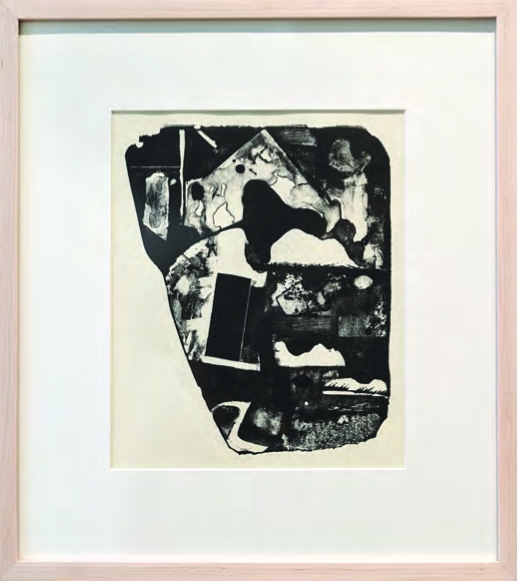
Robert Blackburn, Untitled (aka Broken Stone), 1960s-1971. Uneditioned. Courtesy Estate of Robert Blackburn. 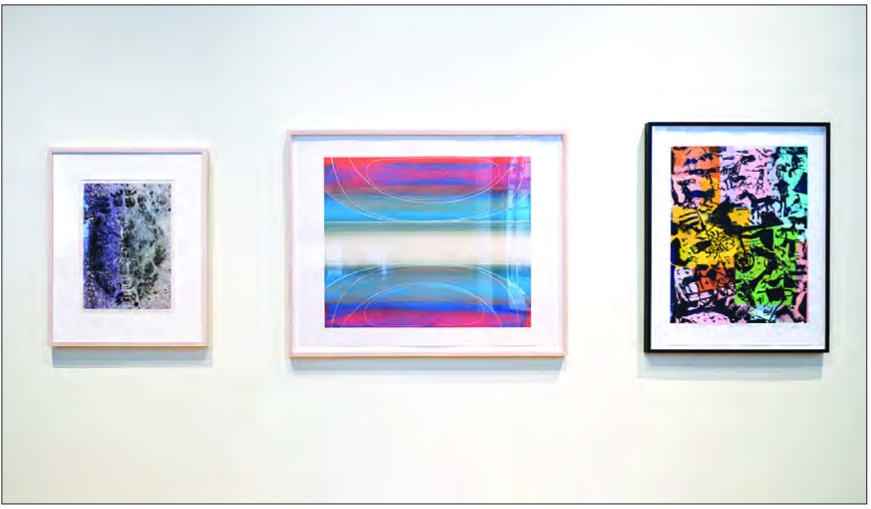
Press
& Pull: Two Decades at Robert Blackburn Printmaking Workshop,
installation view: The James Gallery CUNY Graduate Center.
Master printer Robert Blackburn was ahead of his time. When he established the Robert Blackburn Printmaking Workshop out of his apartment in the Chelsea neighborhood of New York City in 1947, it was a picture of a more equitable world. The space was designed to provide access and foster creativity for artists of all backgrounds and particularly served Black artists and women. In a moment of deep racial segregation and gender bias, Blackburn created an artistic utopia that persists to this day.
The legacy of this enterprise is explored in “Press & Pull: Two Decades at the Robert Blackburn Printmaking Workshop” at the MassArt Art Museum (MAAM) on Huntington Avenue. Thirty-three artists are represented in the galleries. The exhibition showcases works by Blackburn as well as pieces produced at the workshop from its inception through 2025.
Shameekia Shantel Johnson, a New York-based writer and curator, curated the exhibition and developed it with Essye Klempner and Jazmine Catasús from the Robert Blackburn Printmaking Workshop.
Many of the works center on the 1970s, a decade when artmaking
was reflecting political shifts and activist movements alongside
personal exploration. Camille Billops’ 1973 etching “I am Black, I am
Black, I am Dangerously Black” depicts female bodies and body parts
emerging from a surrealist landscape, a reflection of the othering that
Black artists were experiencing.
It’s
clear that creativity and pushing boundaries are hallmarks of the
workshop. The pieces in “Press & Pull” test the limits of what a
print can be, particularly through material and texture.
Faith
Ringgold, a multimedia artist best known for her narrative quilts,
prints with an intaglio process on canvas to create lines of ink that
look like stitches on the firm fabric. Renee Cox layers and mounts
prints on top of each other to create a three-dimensional sculpture
emerging from a flat surface in “Liberating Insight in Fuschia,” the
faces of Black women spiral in a circular pattern and then extend from
the wall toward the viewer. Maren Hassinger’s “Fragile Vessels I” is a
fiber flocked lithograph printed on silk organza that gently sways away
from its mounting like an ethereal ghost.
In
addition to the political and artistic boundaries explored, the
exhibition showcases historical memorabilia from the Blackburn
Printmaking Workshop, including photos of Blackburn working with other
artists and an article about Blackburn written for American Visions
magazine by Boston-area curator and art expert Edmund Barry Gaither. In a
video projection, past and present artists meditate on Blackburn’s
legacy.
That legacy is
very much still active. In 2002 Blackburn relocated the workshop to the
Elizabeth Foundation for the Arts in Midtown Manhattan where it
continues to run classes, programs and a fellowship.
In
a time when diversity and inclusion funding is continually slashed,
it’s powerful to witness this early example of a more equitable arts
space.
“Press &
Pull: Two Decades at the Robert Blackburn Printmaking Workshop” is on
view at MAAM through May 31. The museum is free and open to all.
ON THE WEB
Learn more at maam.massart.edu/exhibitions