(Top)
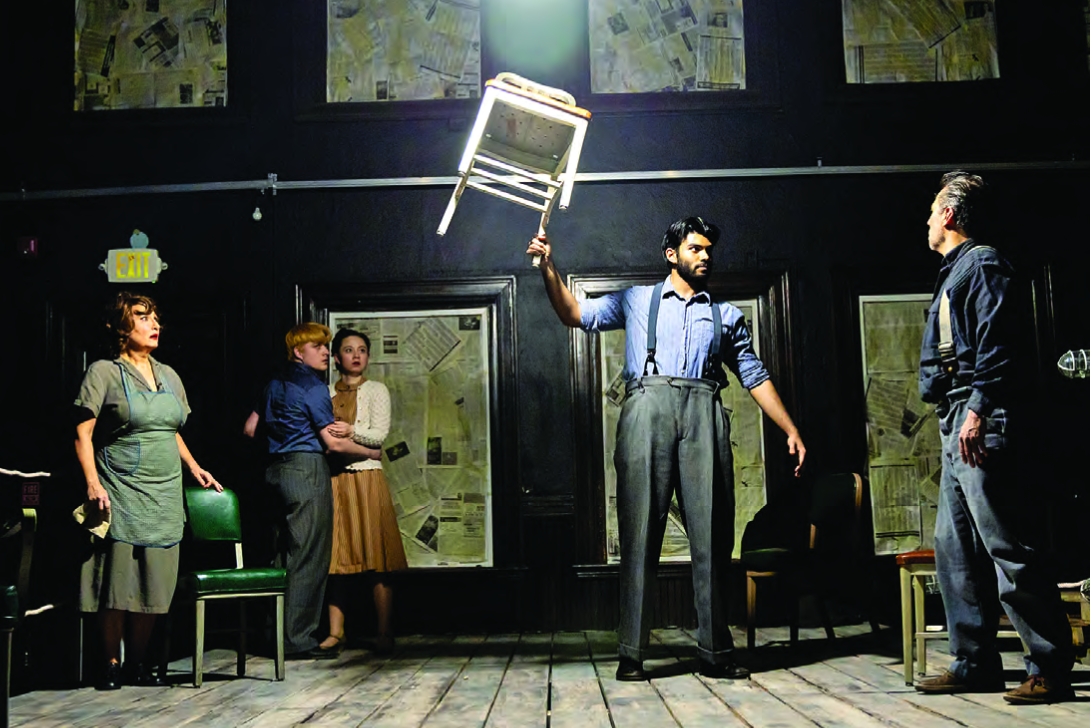
Sehnaz Dirik as Beatrice, Andres Molano Sotomayor as Rodolpho, Naomi
Kim as Catherine, Rohan Misra as Marco and Jorge Rubio as Eddie in
Apollinaire Theatre’s production of “A View from the Bridge.” (Above)
Sehnaz Dirik, Jorge Rubio and Naomi Kim. Performed with passion, the Apollinaire Theatre production of Arthur Miller’s 1955 play “A View from the Bridge,” at Chelsea Theatre Works through March 22, opens with a scene not in Miller’s script. Evoking the multicultural world within and beyond Chelsea, a chorus of actors fills the stage, each addressing the audience in a different language and ardently gesturing to stress their words. But like the people at the biblical Tower of Babel, all speak but none understand one another.
Directed by David R. Gammons, a three-time recipient of the Elliot Norton Award for Outstanding Director, this production conveys the turbulent inner states of its characters through the intense performances of its multinational cast as well as the strong visual language conjured by Joseph Lark-Riley’s sets, Kevin Fulton’s lighting and Elizabeth Rocha’s expressive costumes.
Unfolding in two acts over two-anda-half hours with one 15-minute intermission, Miller sets his story of immigrants in the Red Hook neighborhood of Brooklyn, today a hip artists’ enclave but in the 1950s, the time of the play, a tight-knit Italian American community with unwritten laws of loyalty and honor that are at times at odds with those of city and state.
Introducing and navigating
both worlds is Dev Luthra’s somber Alfieri, an Italian American attorney
who, like the Greek chorus in a tragedy, observes and comments on the
story. He also participates in it, as the lawyer with whom the
protagonist, Eddie Carbone, most openly bares his increasingly
distressed soul. When, helpless to quell Eddie’s downward spiral,
Alfieri seeks advice from a wise elderly neighbor, she says, “Pray for
him.”
The stage set, a
platform of wooden planks bordered by ropes, serves as the living room
in the modest home of the Carbone family and suggests the dock where he
works and, at times, a wrestling ring.
Jorge
Rubio is a searing Eddie, a longshoreman who is an archetype of many a
mid-1950s Italian American husband and father who had to earn a living
rather than a high school diploma. He is imperious, affectionate,
protective and possessive, and aspires to upward mobility for his
family, working hard to
feed and educate them so they can move beyond the immigrant
neighborhood that sustains them, and as they leave, saying, “Don’t trust
nobody.”
Unease is
evident from the start as the family gathers at home at the end of the
day. As apron-clad Beatrice, Eddie’s loving, long-suffering wife and the
devoted mother of Catherine, her orphaned niece, Sehnaz Dirik renders
her character’s increasingly conflicting roles and her gradual growth.
Here, she prepares Catherine, now 17, to tell Eddie that she has been
chosen for a well-paying job. Catherine seeks his blessing for her first
step into adulthood.
Eddie
and Catherine adore one another with an intensity that Beatrice
observes with increasing wariness. As Eddie returns from work, Naomi
Kim’s nubile Catherine leaps into his arms like a child. Eddie tells her
she has the beauty of a Madonna but objects to her form-fitting garb.
When she breaks the news, Eddie objects and then, to Catherine’s joy and
Beatrice’s relief, gives his consent.
Eddie
has news of his own — Beatrice’s two cousins have arrived from Italy.
Undocumented immigrants, the two brothers will stay with the Carbones
and join Eddie working at the docks. Marco will send money to his
starving family and plans to return in a few years. His younger brother
Rodolfo wants to become an American citizen. Rohan Misra’s swarthy Marco
exudes dignity and strength. Andrés Molano Sotomayor’s Rodolpho is an
ebullient and earnest young man with platinum blond hair.
As
the days pass, Eddie observes the growing bond between Catherine and
Rodolfo. An artful scene of hypernaturalism expresses his unease. Eddie
faces the audience flanked by two fellow longshoremen Louis (David J.
Kim) and Mike (Andre Meservey). Mike says, “That older one, boy, he’s a
regular bull. …They leave him alone he woulda load the whole ship by
himself.”
All they say
about Rodolfo is that he has an odd way of making everyone laugh. Their
faces harshly spotlit, the three laugh long and hard in unison, like
wound-up robots.
In
the home, the brothers’ interactions with Eddie become power plays and
even a meal turns into a test of wills. Increasingly visceral scenes
express these heightening tensions as well as Eddie’s deepening
awareness of what he stands to lose in Catherine’s attachment to
Rodolfo.
Seeing the red fabric that will become her wedding dress spread out on the floor, Eddie rolls himself in it.
In
the second act, people around Eddie are taking charge of their lives.
An apron-free Beatrice is smartly attired and ready to attend the
wedding of Catherine, who, aglow in her red dress, joins her in
imploring Eddie to join them. With such high stakes, why do they not let
go of this hope?
Although
Miller’s modern-day tragedy is about Eddie, and not a larger story
about the immigrant experience evoked in its prelude, this compelling
production shows how all are terribly tied together in one man’s
downward spiral.
ON THE WEB
Learn more at apollinairetheatre.com