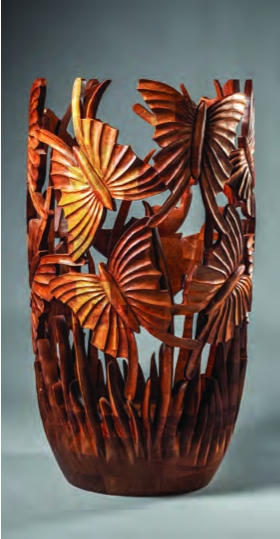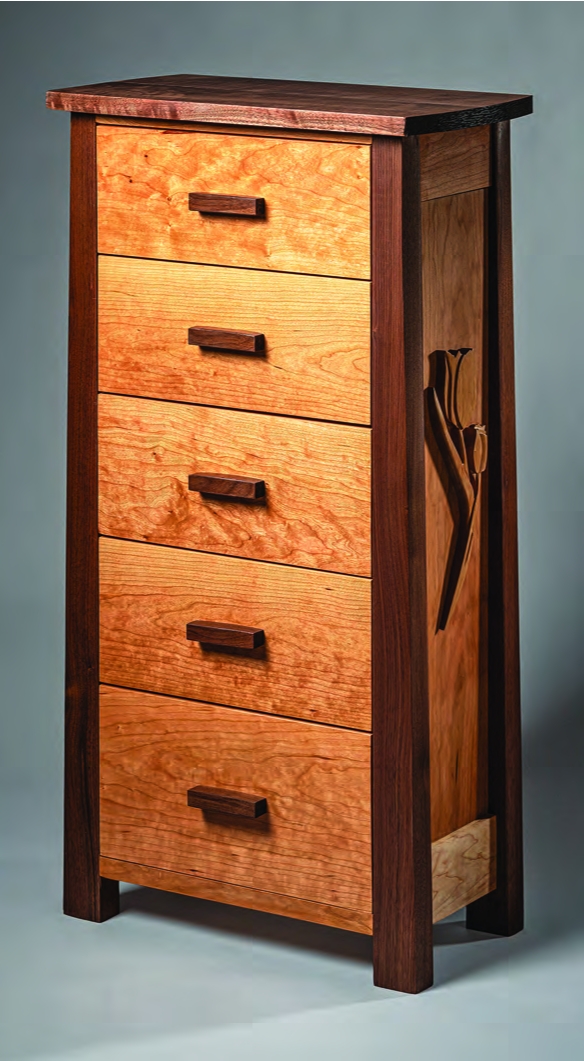
(Above) Jeff C., Tulip Chest of Drawers, 2025, walnut and cherry. (Left) Charlie J., Butterfly Vase, 2023, Mahogany.
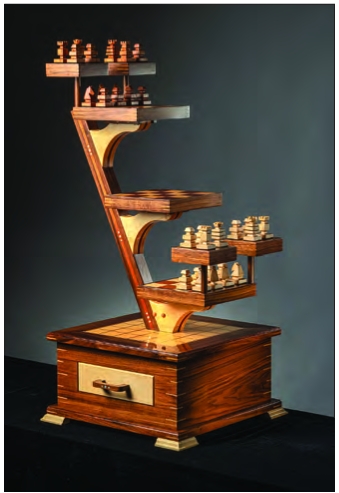
Mike H., 3-D Chess set, 2025, walnut, maple, and mahogany.Prison woodworking program shapes inmate experience
“Shaping Futures: The Prison Outreach Program of New Hampshire Furniture Masters,” on view through June 7 at Fuller Craft Museum in Brockton, presents 17 works created by participants in the New Hampshire Furniture Masters’ Prison Outreach Program.
Housed in a handsome
mid-century modern building overlooking a pond, Fuller Craft is New
England’s foremost museum dedicated to contemporary craft and one of
only seven such museums in the nation.
“This
exhibition showcases not only the extraordinary skills being taught in
carceral settings,” said Artistic Director and Chief Curator Beth
McLaughlin, “but also shows the power of craft to foster agency,
learning and resilience in underserved populations.”
Based
in Concord, New Hampshire, the Furniture Masters program was
established in 1993 to preserve and advance high standards of artistry
in fine furniture making. Members earn the title of Furniture Master by
submitting works to a rigorous, peer-reviewed jury process.
Founded
in 1999 at New Hampshire State Prison for Men in Concord, its Prison
Outreach Program was launched in 2012 at the Maine State Prison in
Warren and in 2021 it was introduced at the New Hampshire Women’s
Correctional Facility in Concord.
In
1999, New Hampshire Superior Court Justice Kathleen Mc- Guire, now
retired, brought several Furniture Masters to the New Hampshire State
Prison for Men. The wife and daughter of woodworkers, McGuire had toured
the prison and noticed its wellequipped woodworking shop and the
absence of training resources.
“I returned with several
Furniture Masters,” said McGuire in a telephone interview. “One prisoner
said that when turning bowls, they cracked even when he made them
thicker. A
Furniture Master told him, ‘Make them thinner, and use a veneer.’ A
light bulb went off with this productive one-minute conversation.
Two Furniture Masters, Tom McLaughlin and Terry Moore, really got into it, giving lectures and hands-on lessons.”
Moore,
who six years earlier had founded the New Hampshire Furniture Masters,
recalls the Prison Outreach Program’s start in a new book edited by
Furniture Master Richard Oedel, “Joined Together: 30 Years of The
Furniture Masters.” Moore writes, “[O] ne of the hallmarks of
craftsmanship in a piece of fine furniture is hand-cut dovetails. …It is
hard, demanding work with a long learning curve. Lots of mistakes were
made. …We were teaching our bodies to develop muscle memory of this
particular task of hand craftsmanship.
“When
I returned two weeks later, everyone was confidently cutting dovetails
by hand and mentoring one another when things were off the mark. As they
worked the wood, the wood was working them. Each was learning valuable
lessons in discipline, problem solving, and patience. The Prison
Outreach Program was off and running.”
The healing power of art
Inmates
with two years of good behavior can take part in the program, and over
the program’s 27 years not one participant has returned to incarceration
upon release.
While
in prison, participants earn income from the sale of their works or
choose to keep them or give them to family and friends. In New Hampshire
prisons, 25 percent of the proceeds support the program and the balance
goes to the maker. In Maine, proceeds are split evenly among the
program, the maker and prison industries. Some works at Fuller Craft are
for sale and others will be available in a summer show at the New Hampshire Furniture Masters Gallery in Concord.
The
17 works on view at the Fuller, hand wrought in such natural materials
as ceramic, fiber, wood, glass and metal, include objects of utility
such as chests and stools as well as sculptural and conceptually driven
creations. While varying in complexity, all demonstrate artisanry in the
maker’s choices and crafting of wood.
A
trio of three-legged stools, including one in cherry by Jeff C.,
presents treatments of an object that often comes early in an artisan’s
practice as a medium to learn turning, lathing and joinery.
Another
three-legged work, a table in walnut by Furniture Master Howard Hatch, a
teacher in the program, features a kidney-shaped tabletop polished to a
fine sheen that shows off its rich swirls of walnut burl.
Combining
utility and sculpture, Jeff C.’s “Tulip Chest of Drawers” (2025)
handsomely contrasts cherry and walnut woods in its structure and on its
side, the sinuous shapes of a tulip.
Charlie
J.’s three-foot high “Butterfly Vase” (2023) carves shadows in mahogany
to create art nouveau images of intertwined butterflies. Nearby, an
untitled semi-abstract sculpture in ash by Leah Woods, a founder of the
Women’s Prison Outreach Program, evokes plant life.
Phil G.’s “Blanket Chest” (2025) is elegantly simple with its impeccable dovetailing and blend of cherry and aromatic cedar.
“Not
only are they learning woodworking techniques that allow them to make a
living and gain self-esteem and a sense of accomplishment. They grow,
too, by intimate contact with Furniture Masters who volunteer their
time,” said McGuire. “A lot of these men didn’t have anybody like that
in their lives. In this program, they work closely with men who are
great role models.”
Demonstrating
their maker’s mastery are two historically informed dressers, Al E.’s
“Chest of Drawers” (2008) in figured cherry; and his ornate “Chippendale
Oxbow Bureau” (2006). Each is a showcase of astonishing alignment of
wood grain across adjacent surfaces, as if separate drawers were a
single, uninterrupted surface. In the latter work, a stylized,
18th-century New England Chippendale piece in russet mahogany, each
sculpted foot shows a bird’s talons gripping a sphere.
Equally
eye-catching even in its small size is “Cribbage Board” (1995), an
intricately crafted maple piece with finely made finger joints and
borders in contrasting purpleheart wood. The piece is an early work by
Furniture Master Eric Grant, elected to membership in the New Hampshire
Furniture Masters in 2016, the year of his release.
“The
N.H. Prison Outreach Program changed my life in many ways,” Grant wrote
in an e-mail. “The program helped build my self-confidence, unlocked my
artistic expression and taught me patience and perseverance. My
participation has opened doors that would never have been open to me,
including employment opportunities and an overall feeling of acceptance
into society.”
ON THE WEB
Learn more at fullercraft.org