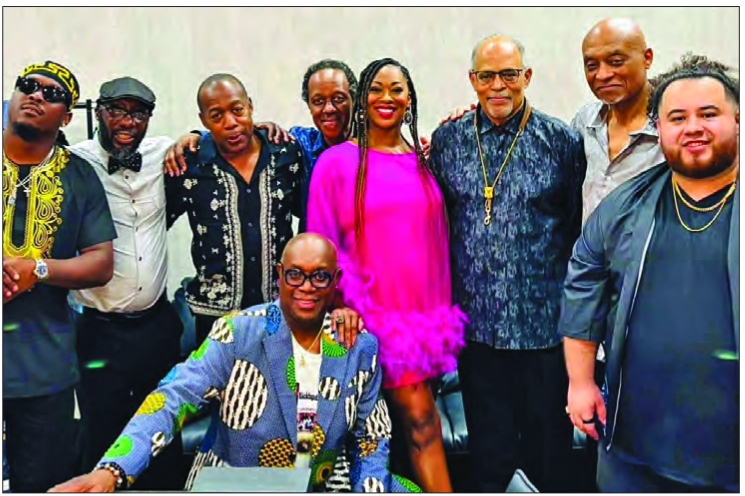
The current members of The Blackbyrds The Blackbyrds keep mixing sounds successfully 50 years on
While many bands continue to tour decades after they were formed, most of them seem satisfied to revisit old hits and cater to their original fans with no view toward the future.
Not so with The Blackbyrds.
While many of their biggest hits came about in the 1970s, the band continues to tour and to write and record new songs. They have also been embraced by many newer artists as well.
Having first formed at Howard University under the tutelage of legendary horn player Dr. Donald Byrd, The Blackbyrds have taken Byrd’s jazz roots and influences and added a wide range of sounds and styles to make music that is both reminiscent and revolutionary, even all these years later.
When asked who else inspired him (other than Byrd), founding drummer Keith Killgo cites such diverse talents as Jimi Hendrix, Miles Davis, Stevie Wonder, Igor Stravinsky, the Beatles, Smokey Robinson and Johnny Cash, and admits that he had “one heck of a time” mastering the reggae beat popularized in the United States by Bob Marley.
Killgo also credits fellow founding member Kevin Toney with bringing a classical sense to the sound.
“He could also write and orchestrate,” Killgo recalled, “and Joe Hall and I had been playing since highschool. ... Everybody came from someplace different musically.”
As
the musicians who would become the Blackbyrds were studying at Howard,
self-titled “son of Roxbury” Topper Carew was making artistic moves in
the D.C. area as well.
“After attending Howard University’s Architectural School,” Carew said, “I founded the New Thing Art and Architectural Center.”
Eventually, the center expanded into five buildings, becoming the epicenter of the Capital region art scene.
“Among
our activities were a series of public New Thing Jazz Workshop
concerts,” Carew said. “One of the featured groups was led by Harry
Killgo. His drummer was his 12-year-old son, Keith…. I have known Keith
ever since.”
The younger Killgo eventually formed the New Thing Jazz Quintet, which migrated to Howard’s jazz department.
“The core of the New Thing group eventually became … The Blackbyrds,” Carew said.
Soon after their debut performance with Byrd at the Montreux Jazz Festival in 1973, the band found themselves in Boston.
“We
started at the Jazz Workshop,” Killgo recalls, reminiscing about the
late Fred Taylor’s legendary listening room. “We finally moved to Paul’s
Mall … [and] that is where superstars got to come see us, and we built a
fan base in Boston.”
Combining their diverse
musical backgrounds, the band not only reached a wide audience in D.C.,
Boston and internationally, but came to define what was then a new term:
“crossover artists.”
“We
didn’t know what ‘crossover’ meant,” Killgo demurred. “We wrote what we
were feeling at the time … [and] used all of these influences to create
our music.”
The
Blackbyrds were also cited among the pioneers of such new genres as
“urban contemporary” and “easy listening,” but Killgo dismisses these
terms as well.
“[They
are] just labels created by radio stations and record labels to sell
records,” he said, “and to diminish the amount of money they spend on
advertising.”
One term that Killgo does appreciate is one that his father coined: “pedestrian vocals.”
“Pedestrian
vocals is a name that my father, Harry W, Killgo, used to describe how
the Blackbyrds vocals sounded,” Killgo explained. “In other words,
anybody could sing our songs!”
This
populist appeal was demonstrated by the chart-topping positions of such
Blackbyrds hits as “Happy Music,” “Walking in Rhythm,” “Rock Creek
Park,” and the Grammy-nominated “Unfinished Business.” Many Blackbyrds
songs have also been sampled and featured in performances by other
artists, keeping their musical spirit alive and well.
“The
Blackbyrds have had an enormous influence on the world of … music,”
Killgo asserted, noting that the band has been sampled by such lyrical
legends as Tupac Shakur, Queen Latifa and most recently Jeezy and DJ
Drama.
While he
appreciates the longevity and success his band has had, Killgo is eager
to pay tribute to those Blackbyrds who have flown away.
“We
lost Allan Barnes in 2015 and Kevin in 2024,” Killgo lamented, noting
how difficult it has been to replace his musical brothers.
Even
so, Killgo is proud of the current lineup, which includes Hall, Paul
Spires (whom Killgo taught in high school) and Toney’s daughter,
Dominique, on vocals, along with saxophonist Marshall Keys, trumpeter
Thad Wilson, keyboardist Roberto Villeda, percussionist Sean Anthony and
guitarist Charles Wright.
When
asked what other changes he has observed in the music industry, Killgo
suggests that technology has freed artists from the expectations and
challenges of the music industry.
“Artists
are no longer dependent on record labels to promote their product,” he
said. “Artists have more independence and control over their careers.”
With
his roots in Donald Byrd’s tutelage and his finger firmly on the pulse
of today’s music, Killgo looks forward to bringing the Blackbyrds’ music
to more fans around the world.
“In
Black music, to have a group that has lasted 50 years is a feat,” Carew
said, “and they are continuing the legacy of the music. ...They are
history, and they are the longest-living D.C. band, and they are still
going forward.”