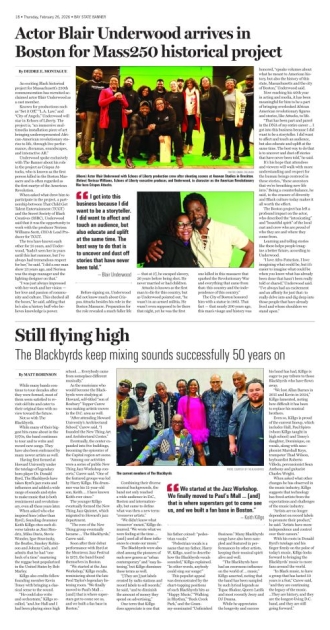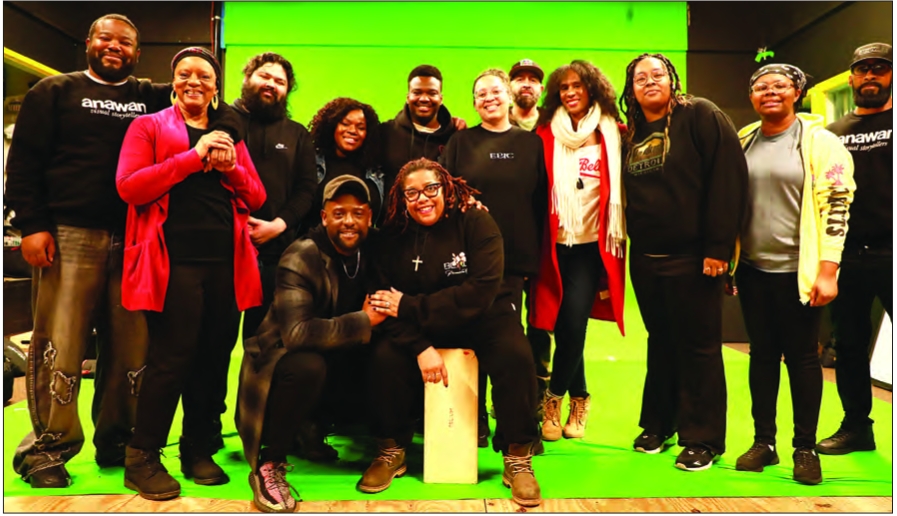
(Above)
Actor Blair Underwood with Echoes of Liberty production crew after
shooting scenes at Anawan Studios in Brockton. (Below) Nerissa Williams,
Echoes of Liberty executive producer, and Underwood, in character as
the American Revolutionary War hero Crispus Attucks. 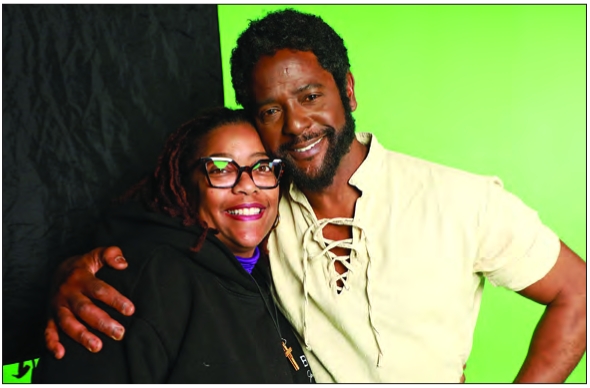
An exciting Black historical project for Massachusett’s 250th commemoration has recruited acclaimed actor Blair Underwood as a cast member.
Known for productions such as “Set it Off,” “L.A. Law,” and “City of Angels,” Underwood will star in Echoes of Liberty. The project is, “an immersive multimedia installation piece of art bringing underrepresented African-American revolutionary stories to life, through live performance, dioramas, soundscapes, and interactive AR.”
Underwood spoke exclusively with The Banner about his role in the project as Crispus Attucks, who is known as the first person killed in the Boston Massacre and is often regarded as the first martyr of the American Revolution.
When asked what drew him to participate in the project, a partnership between That Child Got Talent Entertainment (TCGT) and the Secret Society of Black Creatives (SSBC), Underwood said that it was the opportunity to work with the producer Nerissa Williams Scott, CEO & Lead Producer for TCGT.
The two have known each other for 25 years, and Underwood, “hadn’t seen her in years until this last summer, but I’ve always had tremendous respect for her,” he said. “I did a one man show 23 years ago, and Nerissa was the stage manager and the lighting designer on that.”
“I was just always impressed with her work and her vision — her love and passion of community and culture. This checked all the boxes,” he said, adding that he’s also a history buff who believes knowledge is power.
Before signing on,
Underwood did not know much about Crispus Attucks besides his role in
the Boston Massacre. Preparation for the role revealed a much fuller
life — that at 27, he escaped slavery, 20 years before being shot. He
never married or had children.
Attucks
is known as the first man to die for this country, but as Underwood
pointed out, “he wasn’t in an armed militia. He wasn’t even supposed to
be there that night, yet he was the first one killed in this massacre
that sparked the Revolutionary War and everything that came from that:
this country and the independence of this country.”
The
City of Boston honored him with a statue in 1863. That fact — that
nearly 200 years ago, this man’s visage and history was honored, “speaks
volumes
about what he meant to American history, but also the history of this
state, Massachusetts and the city of Boston,” Underwood said.
Now
reaching his 40th year in acting and media, it has been meaningful for
him to be a part of bringing overlooked African American revolutionary
figures and stories, like Attucks, to life.
“That
has been part and parcel in the DNA of my entire career … I got into
this business because I did want to be a storyteller. I did want to
affect and touch an audience, but also educate and uplift at the same
time. The best way to do that is to uncover and dust off stories that
have never been told,” he said.
It’s
his hope that attendees and viewers will walk with more understanding
and respect for the human beings centered in these stories, “these
ancestors that we’re breathing new life into.” Being a counterbalance,
he said, to the erasure of diversity and Black culture today makes it
all worth the effort.
The
Boston project has left a profound impact on the actor, who described
the “intoxicating” and “beautiful spirit” of the local cast and crew who
are proud of who they are and where they come from.
Learning and telling stories like these helps people imagine a better future, according to Underwood.
“I
love Afro-Futurism. I love imagining what could be, but it’s easier to
imagine what could be when you know what has already been done that
hasn’t been really told or shared,” Underwood said. “I’ve always had an
excitement and an affinity for just that: to really delve into and dig
deep into those people that have already lived and whose shoulders we
stand upon.”