Author
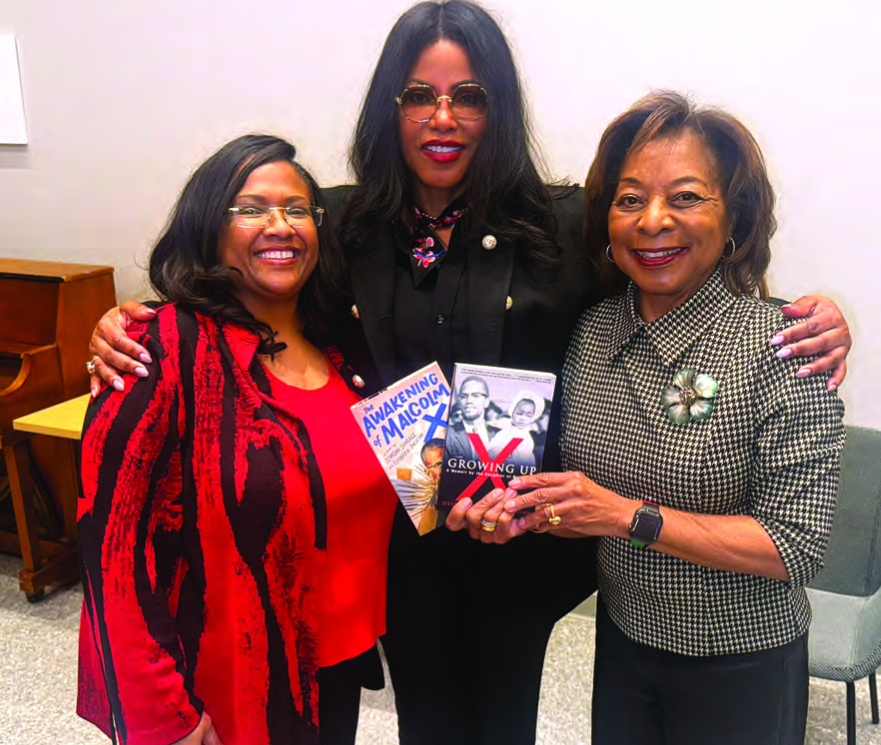
Ilyasah Shabazz is flanked by Dr. Noelle Trent, president and CEO of
the Museum of African American History, Boston |Nantucket, and Priscilla
H. Douglass, member of the Board of Trustees of the Boston Public
Library. On a frigid February night at the Shaw Roxbury Branch of the Boston Public Library, I and about 125 library patrons attended an open conversation between Dr. Ilyasah Shabazz (author, social activist, community organizer and the third daughter of civil rights icons Malcolm X and Dr. Betty Shabazz) and Dr. Noelle Trent, president and CEO of the Museum of African American History, Boston/Nantucket.
Like many of those in attendance, I came with expectations.
How do I meet this dark political moment? How can I become a revolutionary daughter? The shift in my understanding began with being reminded that Malcolm was born in 1925 and died in 1965 (four months shy of 40 years of age). He’s been frozen in my imagination as a counterweight to Rev. Martin Luther King, who believed Black Americans were entitled to secure their rights “by any means necessary” — up to and including the use of violence.
Shabazz reminded us that Malcolm X wasn’t led by anger but was filled with faith, love and compassion, and that these are the keys to advancing revolution. An octogenarian audience member recalled the relationship between her father and Malcolm as she played underfoot. The Boston community was working with him to establish Mosque No. 11, Masjid Al Quaran, on Intervale Street in Roxbury.
While retracing his footsteps on her pilgrimage, or Hajj, to Mecca, Shabazz said she attained a greater understanding: that her father brought human rights to the forefront of the Civil Rights Movement. Today she is among those entrusted to preserve her parents’ legacy through the Malcolm X and Dr. Betty
Shabazz Memorial and Educational Center, removing the stain of his Feb.
21, 1965, assassination at the New York City Audubon Ballroom by housing
the center there.
Speaking
passionately, Shabazz shared stories including what it was like to
differentiate the mythology of Brother Malcolm as a political icon from
the man she knew as “Daddy.” She recounted the story of seeing her
father slaughtered by 21 gunshots, at not yet three years of age with no
conscious memory of the trauma. She and her five sisters got to know
their father through their mother’s recollections — which were so vivid
that she grew up feeling his love.
“I
can still recall the boom of his voice (some 60 years after his death)
when he lovingly summoned me with: ‘eel-YAH-sa!’” she said during the
Feb. 9 conversation. Through the alchemy of shared reminiscences, she
weaved stories for her younger twin sisters born after Malcolm X’s
death. Through them, her sisters came to know him well.
Shabazz
said her mother raised her six girls in a “bubble of love.” Betty
Shabazz was a force of nature who reanimated Malcolm in a way that made
their family feel whole.
Ilyasah
Shabazz described her childhood as idyllic, optimistic, beautiful and
sheltered. She rode horses, spent lazy summers in rural Vermont,
attended elite private schools that grew her self-esteem and nourished
her intellect.
Her
younger self was politically unaware, originally shaken by the
expectation of her college mates to be a Black activist. She sang often
with a neighborhood friend, Lisa, whom the family counted as a seventh
daughter. Lisa’s mother, the incomparable Nina Simone, sang and played
piano along with them. “Young, Gifted and Black” resonated musically and
ideologically in the Shabazz household.
Shabazz
came of age during a time when “Black is Beautiful” was an emerging
concept. “We didn’t talk about ‘natural’ hair then,” she said, rising
from her seat pointing toward a young man’s large afro that was
spiraling upwards in multiple directions. “Natural hair bridges us to
the celestial world.”
Through
her storytelling, Shabazz was gifted with yet another woven memory,
Sankofa [from the Akan language of Ghana], which means looking back to
go forward. As I waited to have my book signed, two Roxbury natives told
me how important it was for them to hear a conversation about the
resilience of Black family in their neighborhood library.
Audience
members were surprised to realize that Dr. Betty was perhaps the real
MVP in the Shabazz story. She preserved her sanity. She raised six girls
who became her and Malcolm’s legacy. She created a blueprint for other
young mothers. She and her daughters have preserved Malcolm X’s memory
and teachings, now symbolizing perseverance through the power of love.