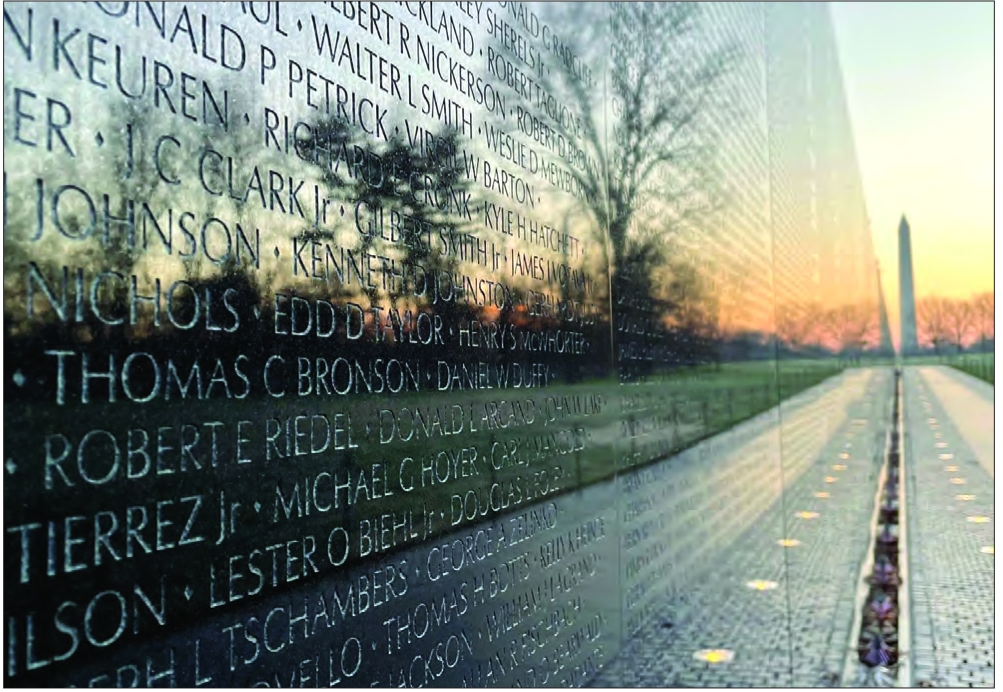
A view of names etched into the granite face of the Vietnam Veterans Memorial in Washington, D.C. There has never been a defining chapter in American military history in which Black service members did not stand on the front lines. From the Revolutionary and Civil War to World Wars I and II, and through the Korean and Vietnam conflicts and the Gulf War, their contributions have profoundly shaped the nation’s present identity.
Nowhere is this testament more vivid than in robust cities like Boston, home to some Tuskegee Airmen, the revered all- Black squadron during World War II, and where the 54th Massachusetts Regiment assembled before heading South to battle in the Civil War. This heritage is not distant memory, but rather a legacy celebrated each February during Black History Month.
However, veterans’ advocates attest that action must go beyond tribute ceremonies, particularly since thousands of African Americans still face persistent disparities in health care, housing and economic opportunities long after their service. These concerns are even more urgent today, given that institutional attention to equity-focused programs and identity-centered initiatives has shifted, leaving some of the city’s most vulnerable veterans at risk of being overlooked.
A persistent burden
To fulfill the demands of military service,
enlisted personnel rigorously prepare for dangerous situations, such as
high-risk combat missions. However, even as these individuals train for
extended periods, many are still caught off guard by the hidden
physical, mental and environmental hazards that emerge during active
duty.
Service members
have frequently encountered toxic exposures because of the armed forces’
heavy reliance on perilous substances during World War II. For
instance, Hanscom Air Force Base, located roughly 30 miles outside
Boston, has detected alarming asbestos concentrations in its five
demolished buildings. Fort Devens-Sudbury Training Annex, situated
approximately 20 miles west of Boston, was also designated a Superfund
Site due to elevated levels of toxic heavy metals and PFAS, which
reached over 27,200 parts per trillion.
These
findings suggest that service members deployed at these locations may
have been exposed to serious contaminants without adequate protection.
The repercussions of these circumstances do not stop at contact — they
often trigger a host of life-threatening illnesses, which have
disproportionately impacted people of color.
In
addition to these physical risks, numerous Black veterans in Boston and
across the country also contend with mental health challenges. Research
reveals that such personnel are more likely to endure post-traumatic
stress disorder and face poorer treatment outcomes than their white
counterparts, due to long-standing systemic barriers like racism,
segregation, and economic strain.
Financial
pressure, in particular, has driven many to the brink of housing
instability; national data indicate that African Americans now account
for over a third of homeless veterans in the country. As challenges
persist, advocates have sounded the alarm to advance initiatives
challenging racial disparities for Black veterans.
For years, the Department of Veterans Affairs (VA)
has sought to improve outcomes for historically underserved populations
by implementing diversity, equity and inclusion (DEI) initiatives.
Efforts
promoted culturally competent care, targeted outreach and systemic
tracking of disparities to ensure that no veteran’s needs were
sidelined. Over time, however, such programs were concluded, thereby
restructuring the framework through which critical endeavors were
delivered.
During this
process, the Department of Defense announced that it would not use
official resources to support identity-centered commemorations like
Black History Month, though service members still have discretion to
observe the event individually. At the same time, some content featuring
Black veterans was also briefly removed from government websites and
later restored after stringent review. Although these initial changes
were accordingly part of the transition and aligned with the overall
intention to streamline priorities and maintain institutional cohesion,
these federal decisions have raised questions about how inequities will
be monitored and addressed.
In
cities like Boston, where military history involving people of color
runs deep, there remains opportunity to hone programs and practices that
address disparities in health, housing and economic opportunity while
strengthening culturally competent outreach and services. Black History
Month, for many, serves both as a time of remembrance but also as a call
to sustain attention, reallocate resources and implement measures that
help guarantee veterans receive the care and support they need
throughout their lives.