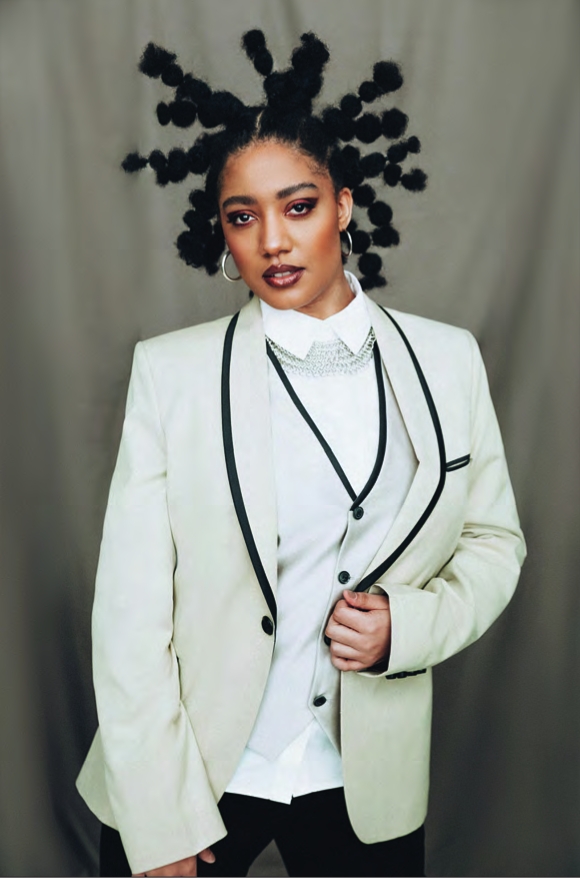
Boston-based musician-activist Zakiyyah.Musician, activist and urbane intellectual Zakiyyah is busy putting her vision of art into action.
Her new album, “African Import,” came out on Feb. 6. Her production company, Black and Bold, has projects in place.
As a hip-hop musician and an opera singer, Zakiyyah calls some of what she does “Hip-Hopera.” But surpassing categories, she’s attentive to the world’s challenges, and those specific to being a creative artist. The result is a very positive energy that can draw you in, and lead to creative acts that are implicitly about social change. She is one of the new artists who is expanding the role that art can play in America during this time of crisis.
Schooled at the Boston Arts Academy, Zakiyyah went on to graduate from Wellesley College, worked in the offices of City Councilor Tito Jackson and later Suffolk County Sheriff Steven Tompkins, where she created Defensive Aids in Situations of Help (DASH), a self-defense program for women, and developed and refined her artistic and political visions through the diversity of those experiences.
The Banner caught up with Zakiyyah recently.
Banner: How would you describe the upcoming album?
Zakiyyah: “African Import” is both a love letter to the Black diaspora, and to music — its past, present and future. The album pays homage to the days when music was meant to be experienced and savored, and I use the power of that music to explore the beauty and complexities of the Black diaspora. …This album is a journey that invites you to revel in the nostalgia of the past, while also calling you to step into an imaginative future worth being excited about.
Who is on the album performing with you?
I am very honored to have some heavy hitters featured on this album, including Boston’s own Billy Dean Thomas, Red Shaydez and Tim Hall. I was also fortunate to work with the Grammy-nominated group Explosión Negra and artist Gerleanis Rodriguez while I was staying in Colombia. Each of these featured artists embody a different facet of Black identity and expression that made their contributions truly invaluable to the project.
How does the album fit into your trajectory — inclusive of matters of social justice and aesthetics?
For me it was very important to establish early on that I cannot be confined to a box. I’m
an artist that’s constantly experimenting and exploring, so I want to
have the freedom to express the full breadth of my artistry and voice
without compromising myself. I see this album as not only an artistic
experience, but the birth of a liberatory movement, where our capacity for growth and advancement is endless.
What was it like to be a social activist at Wellesley College?
Being
at Wellesley was an experience I’m grateful for, including being a
challenging time for me. As someone very much into social justice and
activism, I noticed that there wasn’t a lot of racial and class
consciousness there, or consciousness around gender identity, in
general. What that meant was that it left room for growth. It was a time
at Wellesley when certain conversations around race and class were not
taking place: I graduated in 2012. So, it also felt quite debilitating;
still, I realized why I need to do what I do, and who I need to be. I’d
come to Wellesley as a graduate of the Boston Arts Academy, a
predominantly Black and brown setting, and I was aware of the need for
racial justice.
Black and Bold, your production company — what is that about?
Black
and Bold was created in order to center on narratives that are
oftentimes unseen and unheard through media, particularly visual media.
Stories that are left behind. The company is a way to produce my own
musical videos and live events. Black and Boldwill produce the upcoming
show.
Your music
cannot be categorized — opera, hip-hop, neo-soul; it seems to come from a
deeper, personal, original place — tell us about that evolution.
I
think as an artist it is my responsibility to reflect back what I see
in the world, and also bring new meaning and imagination to what could
be. Placing boxes on myself, on which type of music or medium, does not
honor that mission.
ON THE WEB
Learn more at zakiyyahofficial.com