
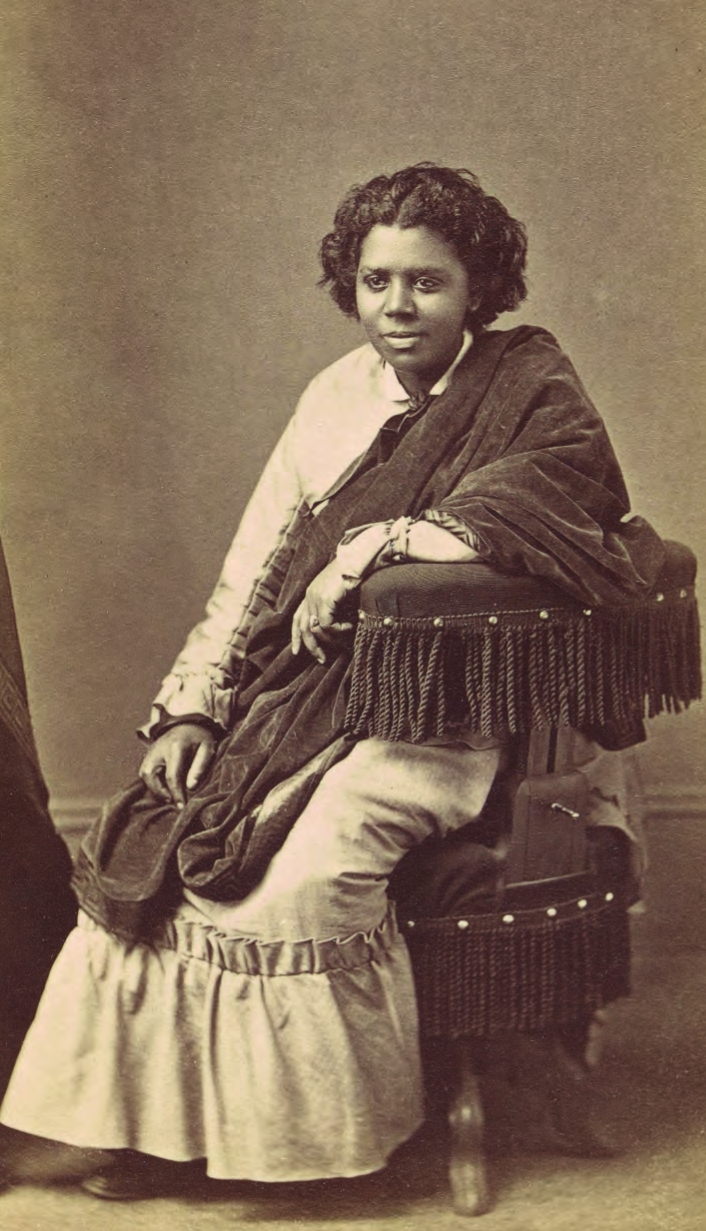
Edmonia Lewis, photographed by Henry Rocher, about 1870. Albumen silver print on card.
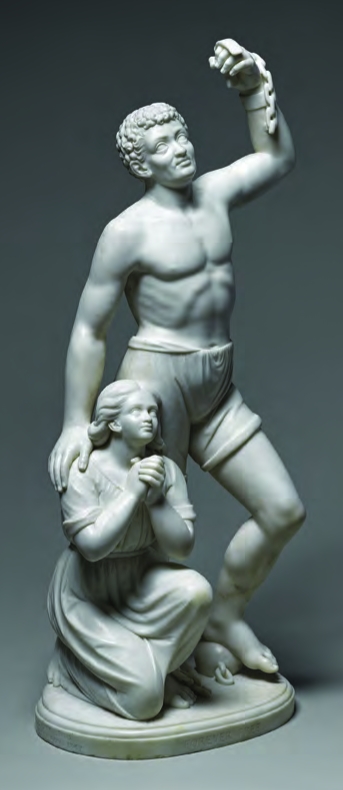
Edmonia Lewis, “Forever Free,” 1867. Carrara marble. Howard University Gallery of Art.
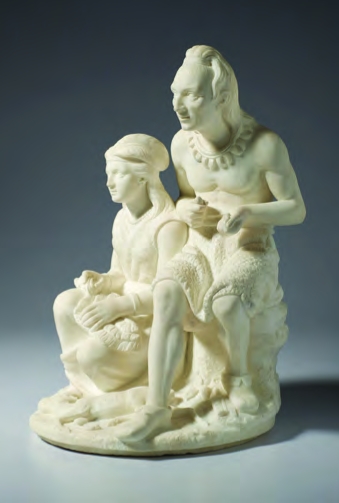
Edmonia
Lewis, “The Old Indian Arrow Maker and His Daughter,” modeled 1866,
carved 1867. Marble. Gift of Marilyn Jacobs Preyer, North Carolina
Museum of Art, Raleigh.
Edmonia Lewis was the first Black and Indigenous sculptor to achieve international acclaim. She was so popular in the 1860s and 1870s that her studio was listed in guidebooks and she maintained close friendships with public figures like Frederick Douglass and sculptor Harriet Hosmer. So how did an artist with such talent, connections and commercial savvy end up in an unmarked grave decades later? And where has her work been since?
These are the questions explored in “Edmonia Lewis: Said in Stone” at the Peabody Essex Museum in Salem. It’s the first ever retrospective of Lewis’ work and the largest gathering of her sculptures on record anywhere.
“She kind of pops in and out of popular awareness,” said Jeffrey Richmond-Moll who co-curated the exhibition with Shawnya L. Harris of the Georgia Museum of Art. “She had a postage stamp, she had a Google Doodle, but we wanted something that could really be an enduring record of her work.”
Lewis’ mother was a member of the Mississaugas of the Credit First Nation, an Anishinaabe Nation in present-day Ontario; her father was a free Black man of Afro-Caribbean descent. Lewis was orphaned as a child and was raised by her maternal aunts in heavily Indigenous communities in upstate New York.
An impactful gallery early in the exhibition explores how Lewis’ childhood among Indigenous craftspeople influenced her own artistry. Her mother was recognized for her beadwork and Lewis would have grown up around woodworkers, weavers and other artists. The gallery contains objects she would have been familiar with as well as several of her related sculptures.
“The Old Indian Arrow Maker and His Daughter” is a tender portrait of a father and daughter sitting together. She is working on a weaving spread across her lap while he sharpens an arrow. Both wear intricate jewelry. Here, Lewis is not only paying homage to her heritage, she’s pushing back against the racist imagery of Native Americans that was prevalent at this time.
Lewis spent only two years living and working in Boston, but they were important. She operated in a world where art and activism were intertwined and many artists were using their art to advocate for emancipation. She also made valuable connections. Once Lewis arrived in Rome, Abigail and Elizabeth Williams, two sisters from Salem, helped set her up with a place to live and a studio.
In Rome, Lewis’ career took off. She began to work in marble and created some of her most famous works, including “Forever Free,” a piece depicting two enslaved individuals who have broken their own bonds. A woman kneels on the ground, looking toward the sky with her hands clasped in thanks or prayer. A man stands with one hand on her shoulder and the other raised upwards, showing a broken chain on his wrist.
This piece is another example of Lewis subverting commonly held narratives about people of color. Many statues celebrating emancipation show a benevolent white leader, often Abraham Lincoln, with previously enslaved people kneeling before him.
The Emancipation Memorial by Thomas Ball, which stood in Boston’s Park Square until 2020, is one such example. In Lewis’ statue, the enslaved people stand alone, having freed themselves.
A collection of sculptures in one of the final galleries showcases the influence of feminism and religion on Lewis’ work. She repeatedly depicts strong female characters and stories of enslaved biblical figures who triumph, like Hagar and Moses.
The exhibition also pulls the curtain back on the reality of a working artist in this period. A gallery inspired by Lewis’ studio showcases the process of making plasters and casting sculptures. Lewis would create a design that she knew would sell and then cast many copies. Like Frederick Douglass, she was also intentional about using images and storytelling to craft her public persona. In a series of promotional photos, she wears the garb and hat traditional to sculptors, firmly naming herself as an artist first.
“Lewis early on really had to assert for herself, her own skill, her own artistry,” said Richmond-Moll. “She had to be really resourceful.”
“Edmonia Lewis: Said in Stone,” is on view at the Peabody Essex Museum through June 7. The exhibition was co-organized by the Georgia Museum of Art at the University of Georgia, where it will travel next, then it will be shown at the North Carolina Museum of Art.
The exhibition is the result of 10 years of scholarship and what comes down to good old-fashioned detective work. Richmond-Moll estimates that five pieces were located or discovered in this process, including a plaster bust of Robert Gould Shaw that was found at the Massachusetts Air National Guard Historical Association in Concord through a Facebook post. Six other works are on view for the first time.
Where many artist retrospectives work to present a new angle on a lifetime of artmaking, Lewis’ story feels very much in progress. Many of the artists and scholars dedicated to her speak as though her spirit was guiding them.
London-based interdisciplinary artist Gisela Torres was surprised to learn that the cemetery where she regularly took walks is the final resting place of Edmonia Lewis; the sculptor died in London in 1907. The more Torres learned about Lewis’ life, the more spellbound she became.
In her collection of work “Looking for Edmonia (Self-Portrait),” of which two pieces are on display in the PEM exhibition, Torres literally walks in Lewis’ footsteps and channels her in film and photographic pieces.
“She was my muse, she inspired me,” said Torres. “What surprised me was her passion and her endurance and her resistance to being boxed in as a woman of color. She wanted to be known as an artist.”
And now, once again, she will be.
ON THE WEB
Learn more at pem.org/exhibitions/edmonia-lewis-said-in-stone