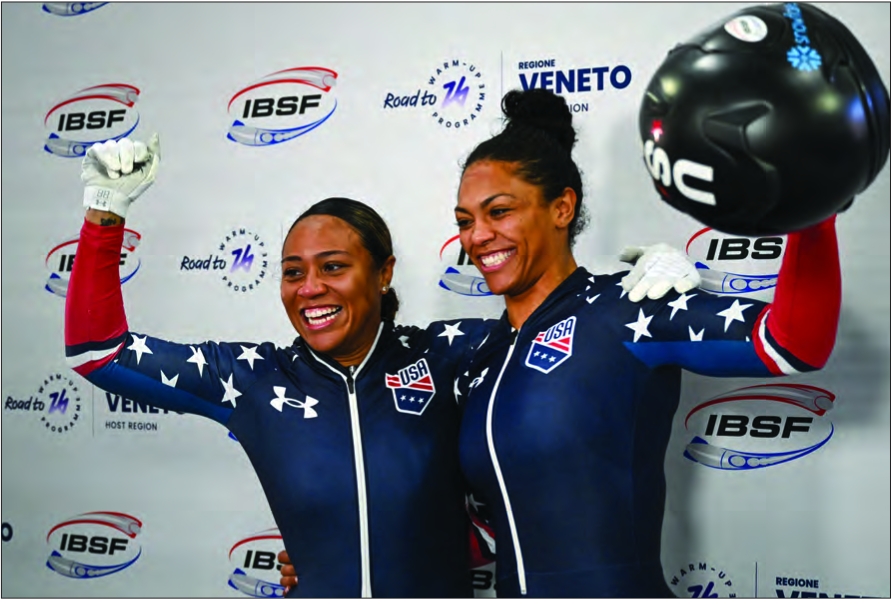
Bobsled teammates Azaria Hill and Kaysha Love, who met in college on the UNLV track team.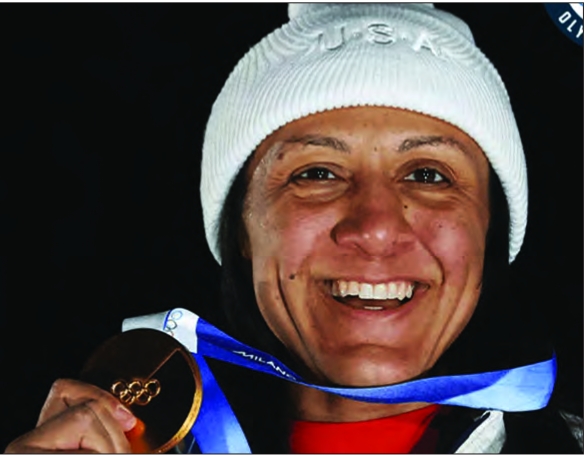
With her gold medal win on Monday, Elana Meyers Taylor became the most decorated U.S. female bobsledder, winning 6 total medals.
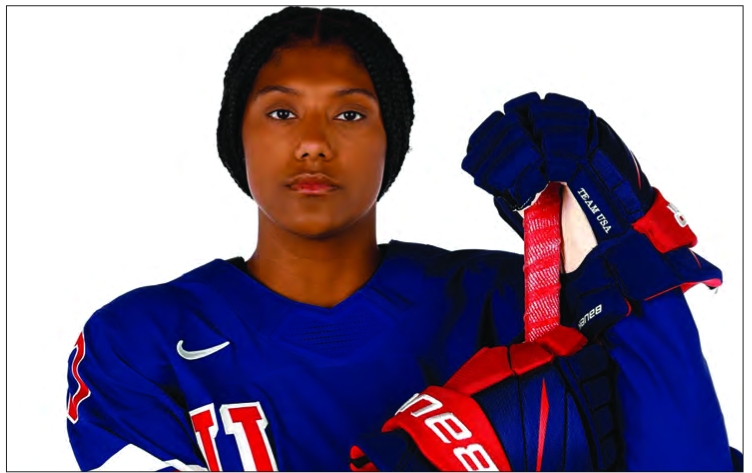
Wisconsin Badger forward Laila Edwards, has scored two goals for Team USA in the Olympics so far.
Growing up in the 1950s and ’60s, my first memory of the Winter Olympics was seeing mostly white athletes in unfamiliar sports, rarely discussed in Black communities like mine. Without access to skis, skates or even sleds, we had little interest in winter sports.
My passion for the Winter Olympics grew through my work in sports broadcasting, where I enjoyed events like bobsledding, skiing, ice hockey and speed skating, and gradually developed an interest in curling.
Covering the Winter Games was part of my job, but at the time, few Black athletes competed there. Instead, Black communities followed the Summer Olympics, inspired by heroes like Jesse Owens, whose 1936 victories in Berlin shattered myths of Aryan supremacy. Learning about Owens made me wonder: “Why are there no Blacks in the Winter Olympics?”
Today, the answer to that question is evident. Several American Black athletes now display their talents on the world stage at the Olympics. Leading the way is Erin Jackson, the 33-year-old speed skating sensation from Ocala, Florida, who is competing in her third Winter Olympic Games. Jackson holds the distinction of being the first Black American woman to win an individual Winter Olympic gold medal, in the 500-meter speed skating event in Beijing, China, in 2022. The speed skater made history again this year when she became the first Black woman to bear the U.S. flag at an Opening Ceremony.
During these Games in Milan-Cortina, Italy, she attempted to defend her title,
finishing fifth behind 25-year-old Femke Kok of the Netherlands. Kok set
a new Olympic Games record with a time of 36.49 seconds, finishing
66/100ths of a second ahead of Jackson, marking the largest margin of
victory in this event since the 1972 Olympics.
For
Jackson, being bested by Kok — eight years her junior, the reigning
three-time World Champion and current world record holder (36.09 seconds
on Nov. 16, 2025) in the 500-meter speed skating event — is no shame.
Afterward, the American spoke about her loss: “In the back stretch, my
feet got away from me a little bit,” Jackson said. “I had a little
stumble going into the second corner, and then I just finished as strong
as I could.”
One
of the most notable African American athletes include Elana Meyers
Taylor, competing in her fifth Winter Olympic Games and currently the
most decorated Black athlete in Winter Olympics history. Across four
Olympic appearances, she has secured sixmedals, including three silver
and two bronze. She won a gold medal this year in the monobob event.
What makes her story so captivating is her transition into the sport.
After
falling short of her dream to play Olympic softball, Meyers Taylor
didn’t retreat; she redirected her power into the bobsled push track.
Within years, she was not just competing — she was dominating. She was
instrumental in breaking the “ice ceiling” by becoming one of the first
women to pilot a four-member bobsled in mixed-gender competition.
Furthermore,
her advocacy for mothers in sports — balancing elite training with the
demands of parenthood — has reshaped how governing bodies support female
athletes. Meyers Taylor didn’t just win medals; she built a faster,
more inclusive track for everyone following in her wake.
Azaria
Hill, a bobsled brakeman on the USA two-woman team, is the daughter of
Olympic sprint medalist Denean Howard-Hill and Olympic boxer Virgil Hill
Sr. Her aunt, Sherri Howard, won a gold medal in Los Angeles and a
silver medal in Seoul. She, like Meyers Taylor, transitioned to
bobsledding from another sport following a successful career as a track
and field sprinter at Long Beach State and the University of Nevada-Las
Vegas.
This athletic pivot proved seamless;
within a short period, she established herself as a top-tier push
athlete, securing a fourth-place finish at the 2024 IBSF World
Championships. The 2026 brakeman said, “I’ve dreamed of being an
Olympian since I could understand the meaning of the Olympics, since I
knew my parents and my aunt were Olympians.”
Hill
met her bobsled teammate and pilot Kaysha Love at UNLV, where both were
on the Runnin’ Rebels relay track team. Love, originally from West
Jordan, Utah, was the 2016 Gatorade State Girls Track and Field Athlete
of the Year. Upon arrival at UNLV, she became a Second Team All-American
as a sprinter. They have worked well together and have a pre-race
ritual that they execute before every slide. It’s called the “Team Love
snap,” which ends with the athletes striking a model-like pose.
“Kaysha
has her signature snap,” Hill said. “So, before we slide, we do our
little handshake and then the snap. So, sometimes we’ll see on the sides
that people are doing the snap with us.”
USA Bobsled-Skeleton (USABS) has encouraged track athletes to try bobsledding to extend their careers.
And listening to Hill, there are a lot of opportunities to excel.
“Bobsled
can be a new sport for Black athletes,” Hill said. “We have a few on
our team already on both the men’s and women’s side, and even on other
teams, too. It’s just nice to see that diversity.”
Following
in their footsteps is Bryan Sosoo, a Ghanaian American, who also
transitioned from running to join the U.S. men’s bobsled team. He’ll be
one of six “push” athletes who made the trip along with two drivers.
Sosoo was a three-time Metro Atlantic Athletic Conference (MAAC) indoor
champion in the 60-meter dash, posting a Monmouth school record of 6.71
seconds in 2016. The Maryland native is the Hawks’ first winter Olympian
and first male Olympian.
Former
college heptathlete and skeleton world champion Mystique Ro is known
for her prowess in skeleton. The skeleton is a thin sled that
competitors head down a frozen track face-first. Unlike the luge (where
athletes sit on a larger sled) or bobsleigh (where they sit inside a
cabin), a skeleton sled is essentially a thin, heavy metal plate with
two runners. It has no steering mechanism or brakes. Athletes steer by
using subtle shifts in body weight and dragging their toes on the ice.
Ro
has earned three medals in this event, claiming gold and silver at the
World Championships and gold at the Pan American Championships. She said
in earlier interviews: “I heard of bobsled from the famous ‘Cool
Runnings’ and I had watched Vancouver 2010,” so she thought, “Let’s see
what happens.”
However,
when coaches explained that bobsled racing might be a stretch given her
small frame, she moved onto the skeleton with trepidation.
“I
was kind of hesitant because skeleton is a crazy sport. You kind of
have to trick yourself into saying, ‘It’s a game. It’s more fun as you
get better because you’re not hitting stuff!’ So over time, I realized
it is actually fun. And I found I had an aptitude for the start, which
is very advantageous, so I’ve been doing it ever since.”
Darryl
Payne Jr. is the first African American man to represent the United
States in the Olympic skeleton event. The Temple, Texas, native has
recently talked about gaining a spot on the skeleton team: “Achieving
that would not only fulfill my dream but allow me to serve as a role
model for younger minority generations who may not see themselves in
this sport — or even know it exists,” he said. “Becoming a pioneer and a
source of inspiration for my community would be one of the greatest
honors of all.”
The
name of Laila Edwards will be front and center in communities of color
if the United States wins the gold medal in Olympic Women’s Hockey.
Edwards, a defender from Cleveland Heights, Ohio, is the first Black
woman to play for the U.S. Olympic Women’s Ice Hockey team.
With the U.S. Women’s team showing impressive early wins over Czechia (5-1), Finland (5-0), Switzerland (5-0), Canada (5-0) and
Italy (6-0) in 2026, Edwards has the chance to place her name in United
States Olympic Ice Hockey history alongside the members of the 1960 and
1980 (“Miracle on Ice”) gold medal-winning teams — an achievement of
epic proportions.
Whether
she or any Black athletes from the 2026 U.S. Olympic contingent win
medals, their stories are already etched in gold. They have set the
stage for the next generation of young Black Americans to pursue their
dreams of glory in international Winter Olympic competition.
From
Jesse Owens, who made history in the Summer Olympics at a time when
there were no Black competitors in the Winter Games, to bobsledder
Vonetta Flowers, the first African American and the first Black athlete
from any country to win a gold medal at a Winter Olympics, today’s Black
American winter athletes can see that much has changed. History has
progressed as each current Black American Winter Olympian writes their
name in the record books.