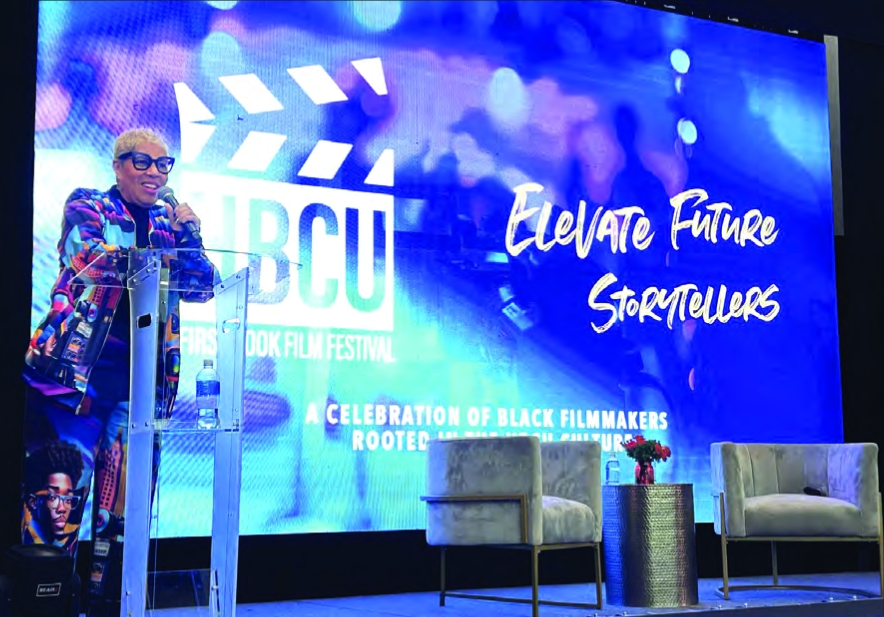
Howard
University alum Sheila Eldridge, CEO of Miles Ahead Entertainment,
announced the new partnership with streaming platform Tubi during the
2025 HBCU First Look Film Festival. The free streaming platform Tubi has recently launched a new streaming channel exclusively for HBCU filmmakers.
The new channel called “HBCU First Look,” will showcase more than 100 films by students and alumni from historically Black colleges and universities, according to Eurweb.com.
The Banner spoke to three local experts in the filmmaking and media space about how they feel about the new channel and why representation matters in streaming spaces.
Rev. Chris Hope is the founder of The Loop Lab, where he helps young people of color start their careers in the media and AV field.
He said that the new streaming channel could not come at a more critical time, as we are watching a coordinated effort to erase Black history from our schools, our museums, and our national story.
“The Smithsonian’s being gutted. Books are being banned and in the middle of all that, Tubi says: we’re going to amplify HBCU filmmakers. That’s not just business—that’s resistance through culture,” he said.
In his work at The Loop Lab, Hope said that he works with young people daily who are desperate to tell these stories, because they have seen the consequences when they are not told.
“They understand that if we’re not the ones holding the camera, someone else will tell our story for us—or worse, act like we were never here. This platform gives them something we can’t afford to lose right now: proof that our voices, our histories, our excellence still matter. Honestly, we need that more than ever,” he said.
Nerissa Williams Scott is the CEO/Lead Creative Producer of That Child Got Talent Entertainment, a film, video, and live event production and production management company.
She said that she believes that this new streaming channel is wonderful, especially being an HBCU alumni herself.
“I am overly ecstatic that this is something that those who are in college or who even may have gone to an HBCU will be able to go maybe go back to their alma mater, maybe be able to do things that … give the HBCU a voice,” she said.
Rui Lopes is the co-founder/CEO of Anawan Studios, a film and production company “that has team members from different cultural backgrounds to bring their multifaceted perspectives that help to bring their client’s vision to life.”
He said that as an independent Black filmmaker, the Tubi
platform has been discussed by himself and his professional associates
in an interesting way, as they are a part of the Fox Corporation
network, which has a fraught history with some people of color, due to
their political ideologies.
Yet,
Lopes said that the Tubi platform has been intentional with investing
in Black filmmaking in the past few years, especially from an
independent standpoint, as they have a huge audience of people of color.
“It’s
just [the question of] what are you willing to live with depending on
the art you want to make versus your beliefs,, so the matter is
interesting. We’ve looked at it, because we’ve wanted to be able to find
a sort of partnership with them,” he said.
He
also looks at this new HBCU channel on the platform as a positive along
with Hope and Scott, as he says that there are not a lot of platforms
willing to invest in Black stories and find young up and coming
filmmakers of color to tell these stories — crediting the platform for
investing in Black filmmaking before this recent announcement.
“I
think it’s a beautiful thing that they’re giving those opportunities,
because you can never measure intent … I have to look at the outcome.
Them doing this, regardless of their intent, can only be positive for
the future of Black and brown filmmaking in this country. So I think
it’s a beautiful thing.”
The experts also talked about the importance of having representation, especially in spaces like Tubi and streaming overall.
Hope said that the importance is because memory is power and right now, there is a fight over who gets to control.
“When
they’re trying to remove Black history from the Smithsonian, ban our
books, tell our kids that slavery was a ‘skills program’— [the] media
becomes the frontline. Streaming platforms aren’t neutral. They’re
either part of the erasure or part of the record,” he said.
He
also said that is why he works to train young people to be filmmakers,
editors, and producers — so they can shape what gets remembered.
“Here’s
the truth: if Black folks aren’t in the room where those decisions get
made, we disappear. Not just from the screen, but from the archive, from
the cultural memory,” he said.
“Tubi
and platforms like it aren’t doing us a favor by showcasing Black
creators — they’re investing in the truth. They’re making sure that 50
years from now, when someone wants to know what life was really like for
us in 2025, they’ll have our version. Not someone else’s. Ours. In this
moment — that’s everything,” Scott said that she would not call it just
important — but necessary to have representation in streaming,
especially since anyone can make a movie and put it online.
“For
forever, Black and brown filmmakers have had no real platform…Tubi
comes to the table with infrastructure and to be quite honest, that’s
really what the industry people bring to the table that nobody else
brings to the table,” she said.
“That’s
the reason they’re successful is because of their infrastructure. But
when you are an independent filmmaker and you figure out how to master
that infrastructure and build your product according to that
infrastructure, that’s when you start to cut those people out.”
She
also said that she hopes that Tubi is breaking down the business side
of this process to the HBCU student filmmakers, as they can be taken
advantage of or find themselves burning out in the industry as novices.
“All
of a sudden, you’re thrust into this world of figuring out [how to] not
just be the creator, the director, the writer, the actor, or the
production designer, but also [into] this world where producers have to
navigate and negotiate how to get through the waters of marketing,
public relations, and distribution,” she said.
“Where
does [your work] go when it leaves your hands? Is it only going to be
in the U.S. market? Are you trying to go overseas and what areas are you
trying to go [to]? So, I really hope and pray that Tubi is breaking
down the actual business side for the students so that they get a full
picture of what it is that the industry is actually all about.”
Lopes
said that this goes to an even bigger conversation, as marketing is a
big part of where this country is right now — as it comes in many
different shapes.
“It’s
somebody going outside and kind of putting their ideologies out there
and influencing people, but I think film, television, [and] music has
always been a way that you [are] able to sway people and force people to
feel a certain way,” he said.
He
adds that for people who have racist ideologies, they can use these
mediums to suppress and oppress other people through marketing, which
has been happening over centuries since the invention of film.
“The
way [we can] … combat that is to be able to make sure that Black folks
have the ability, the willingness, and the ability to be able to put our
stories out there … you [may be] able to portray us however you want
through your propaganda, [but] if we have the ability to do the same, we
can be able to fight that,” he said.
Lopes
said that he had always looked at film as a way to be able to combat
the negative stereotypes of people of color, which gives Black and brown
filmmakers the opportunity to tell more authentic stories.
“It’s
amazing that places like Tubi are giving these opportunities for us to
be able to make sure that our stories are told the right way, because a
lot of times our films are told, but they’re told through other lenses,”
he said.
“You might
have folks of color in front of the camera, but the directors, the
writers, the producers are not necessarily people of color. So these
stories aren’t going to be as authentic, so I think the fact that folks
are wanting to invest and let us tell our stories the way that we want
to say it.…I think it goes a long way in fixing a lot of societal issues
that we face.”


