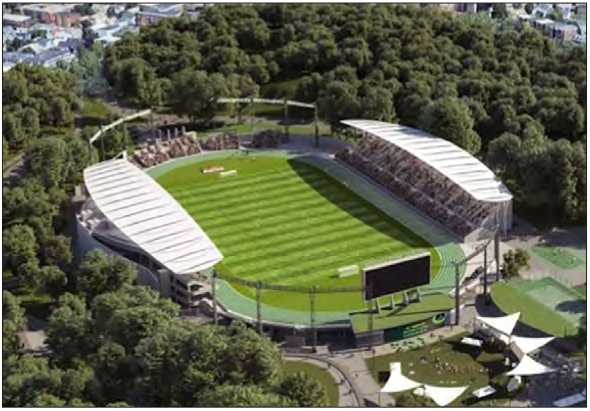
Artist’s rendition of the Legacy FC stadium in Franklin Park.Boston’s share of costs for renovating White Stadium for professional women’s soccer and community use has risen to $135 million, Boston Mayor Michelle Wu has said.
The Boston Legacy’s share now stands at $190 million, bringing total costs of renovating the city-owned stadium in Franklin Park to roughly $325 million — significantly more than first planned.
Boston’s share alone has nearly tripled from an initial estimate of $50 million, and later $91 million. Before the city pitched its plan, the Legacy said in 2023 that renovations could cost the city only $30 million.
Wu’s updated cost figures had been anticipated since before she won reelection last November. Wu said Friday that only more recently did the city receive complete procurement and bidding processes to finalize the budget.
“It has been a complex process,” she said.
The increase is due to rising material costs, Wu said, but also because a community vision for the project called for something bigger.
“We heard from community members that there were all of these dreams and hopes and goals, and we decided to make the project better — and therefore more expensive in response to that,” she said.
The latest number “is the final budget,” Wu added, with a cost guarantee written into bids received by the city.
The advocacy group Franklin Park Defenders, outspoken critics of the stadium plan, slammed the new financial figures in a statement.
“This project is no longer anything close to the $30 million ‘renovation’ that was first proposed to Boston residents,” a member of the group, Louis Elisa, a Dorchester resident and president of the Garrison-Trotter Neighborhood Association, said in a statement.
“And with four rounds of cost overruns before construction even begins, it’s only fair to expect that the ultimate cost to taxpayers will be even higher,” he added.
Elisa called on the city to reconsider the project before construction starts in earnest. Wu said the project will begin vertical construction this spring, far later than an initial timetable.
The $325 million figure for White Stadium coincidentally is the same cost as it was to build Gillette Stadium in 2002. The cost of the stadium, which has a capacity of roughly 65,000, would be nearly $600 million today when adjusted for inflation, though building modern football stadiums today often costs well beyond $1 billion.
Beyond the financials of the project, there’s also a lingering legal challenge. Franklin Park Defenders and the Emerald Necklace Conservancy sued the team and the city, arguing the stadium plan isn’t a legal use of public parkland. It remains active in Massachusetts Supreme Judicial Court.
Wu’s update for the project on Friday included comments from project supporters including state Rep. Russell Holmes and city councilors Henry Santana and Ben Weber.
“I know some of this argument has come down to how much money is being spent, but I arrive as an elected official saying the money is well worth it when we’re spending it for our children,” Holmes said.
Jennifer Epstein, the controlling manager of the Legacy, said the team’s role is to invest in White Stadium so the community can benefit from a better facility.
“We also recognize that true success extends well beyond today,” she said. “It will be measured when neighbors see that this project delivered on its promises, when White Stadium is once again regarded as the gem of the city, and generations from now, when Boston students are still using and benefiting from this stadium, just as they always should have been.”
The Legacy first planned to play its debut at White Stadium later this winter but instead will begin their inaugural season at Gillette Stadium. The team’s first match is planned for Saturday, March 14.
The Legacy, a member of the National Women’s Soccer League, said it will provide a total of $252 million in next 15 years in community benefits, including its investment in the stadium renovations, rent and contributions to park improvements and a Boston Public Schools athletics fund. The team signed a lease for the stadium in 2024.
The White Stadium work is the first of what’s expected to be two professional soccer stadiums in the immediate Boston area. The New England Revolution is on track to build a new stadium in Everett, on a former power plant site on the Mystic River.
There isn’t yet a timetable for the new Revolution stadium, but the team signed community benefit agreements with Everett and Boston in December.
This story first appeared in the Boston Business Journal.