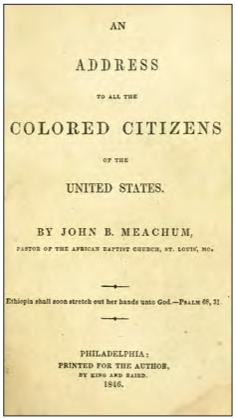
John B. Meachum’s book, published in 1846. 
Black Philanthropy has existed as long as the concept of Blackness as a social identity. From the time African captives were brought to the West, mutual aid projects, a form of political participation in which people take responsibility for caring for one another, was paramount for survival. The ability to carry on, for yourself and others, was a constant reckoning.
Survival, noted theorist Saidiya Hartman says in The Anarchy of Colored Girls Assembled in a Riotous Manner, required acts of collaboration and genius. “The mutuality and creativity necessary to sustain life in the context of intermittent wages, controlled deprivation, economic exclusion, coercion, and antiblack violence often bordered on the extralegal and the criminal,” Hartman wrote. For those living through the founding of enslavement and settler colonialism, freedom was a political project and a material condition.
We can understand the Haitian Revolution, the series of rebellions which bore the New World’s first Black republic, as one of the earliest, and best known, Black mutual aid projects in the West. The insurrection lasted over a decade, beginning in 1791 and ending in 1804 with the establishment of an independent republic. Early Haitians understood, intimately, the ways in which their freedom was tied to those around them. The preservation of freedom from systems of captivity would always be threatened had they not.
Elsewhere across the Americas, emancipation, like everything else, was realized as an individual process rather than a chorus.
But many freed folk rebuked that too. This understanding of freedom is best articulated by Toni Morrison’s oft quoted axiom: The function of freedom is to free somebody.
Whether “purchased” or “given,” many Black people in bondage throughout the New World toiled for years to purchase freedom for themselves, and then others. Southern freedman John Berry Meachum understood, and described the journey in his 1846 book An Address to All the Colored Citizens of the United States:
By working in a saltpetre cave I earned enough to purchase my freedom. Still I was not satisfied, for I had left my father in old Virginia and he was a slave. In a short time I went to Virginia and bought my father. It was a joyful meeting when we met together.
This was in the year 1811. My father and myself then earned enough to pay our expenses and walked seven hundred miles to Hardin county, Kentucky. Here the old man met his wife and all his children. Oh there was joy! In a short time, my mother and all her children received their liberty. Being a carpenter and cooper I soon obtained business and purchased my wife and children. Since that period I have purchased about twenty slaves.
Formal Black mutual aid societies began popping up across the United States and Caribbean in the late 18th century and persisted for long after; they were a revolution in minor key. Created in opposition to the legal and extralegal control and domination of the free black population, networked kinship was an important part of Black life.
Richard Allen, a free Philadelphian minister, writer and educator, was an early Black philanthropist who helped to found the Free African Society. “Originally envisioned as a religious society by the exslaves Richard Allen and Absalom Jones, the Free African Society quickly developed into a nondenominational organization that provided sick benefits to its members, maintained marriage records, and established the first African-American cemetery.”
These groups could be found across the New World. In Cuba, free Black people founded cabildos de nación, mutual aid societies which served as financial and political support, as well as maintaining African religious and cultural ties.
Freed women sought comfort from the pain slavery inflicted and the economic hardships they faced through community networks that stemmed from the African American church. Black women relied on extended kinship institutions such as the church, mutual aid and benevolent societies, which inculcated the doctrine of self-help and solidarity.
Women’s benevolent societies enabled African American women to form an independent power base within their communities. In Savannah-Chatham County, for example, women assumed leadership positions in most female benevolent societies. Between 1865 and 1885, 922 persons served as officers in Savannah’s African American organizations. Women comprised twenty-eight percent of the officers. Ninety-six percent of the officers were ex-slaves.
The number of landowning African American women is significant.
Savannah’s rural-urban economy placed African American men and women in a comparatively good position to accumulate real estate and personal property.
Kinship played an instrumental role in the community network of African American women. Through an “internal land trade,” women gained access to small parcels of land which they equated with economic and personal independence.
In the local arena, much like today, people did what they could to collectively raise funds for the movement. In 1950s Montgomery, Alabama, activist Georgia Gilmore began fundraising through the quiet intimacy of cooking.
“Gilmore organized black women to sell pound cakes and sweet potato pies,” reported NPR columnist Maria Godoy. She called her group, the Club from Nowhere. The money they raised helped pay for the alternative transportation system that arose during the 381-day bus boycott.
In his 1999 book, At the Crossroads: The Proceedings of the First National Conference on Black Philanthropy, Dr. C. Erick Lincoln described philanthropy as “the voluntary transfer of significant values identified with the self.” Dr. Emmett Carson explains further: “When one expands the concept to include giving money, goods, and time; blacks emerge as having a strong, substantial philanthropic tradition.”
When we push against popular notions of philanthropy to include the ways we create spaces that abundantly care for others, no longer asterisked or subsumed, we lean into the spirit of our ancestors.
Cierra Peters is an artist and writer currently based in Boston, Mass. and Brooklyn, NY. She is the Director of Communications, Culture, and Enfranchisement at the Boston Ujima Project and an MFA candidate at Yale School of Art.