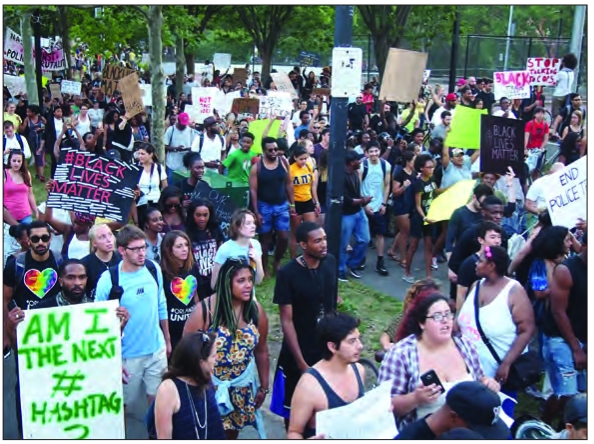
Boston youth march in a Black Lives Matter protest in 2016. 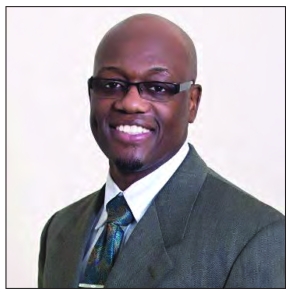
There is an old saying that history repeats itself. For many of us who came of age before the 1980s, that saying no longer feels like a metaphor, it feels like a lived experience. Across this country, and here at home in Boston, we are witnessing the reemergence of policies and ideologies that once sought to exclude, marginalize and silence entire communities.
Today, national leadership is making intentional efforts to turn back the hands of time. Policies that once expanded opportunity and inclusion are being dismantled. Divisive rhetoric is being normalized. Immigrants, many of whom live, work and raise families in our neighborhoods are being targeted as political scapegoats.
These moments are not new to Black communities. We have lived through them before, and we understand what is at stake.
Boston has a long and complicated civil rights history. From school desegregation battles to housing and economic inequities that still shape neighborhoods like Roxbury, Dorchester and Mattapan, this city has been both a site of progress and a place of unfinished work. That history matters, especially now.
The Civil Rights Movement taught us that progress does not happen by accident. It requires organized people, moral clarity and the courage to challenge injustice, particularly when it is embedded in government policy and public systems. Youth were central to that movement; from the Birmingham Children’s Crusade to the leadership of the Student Nonviolent Coordinating Committee. Young people were not waiting their turn; they were shaping the direction of change.
Black History Month is a time to honor that legacy. But it is also a time to ask ourselves how we are actively carrying it forward, especially in moments when progress feels fragile.
Teen Empowerment is part of that living history. Founded in Boston in 1992, during a period marked by the crack epidemic, rising youth violence and deep disinvestment in Black and brown communities, Teen Empowerment emerged from a belief rooted in Black history itself: young people are not the problem, they are the solution. That belief stood in direct opposition to dominant narratives that criminalized youth rather than investing in them.
For more than three decades, Teen Empowerment has worked alongside young people in Boston to build leadership, civic engagement and pathways to systems change. Our approach is grounded in the understanding that youth leadership must be connected to real decision-making power. Young people do not just speak about the issues impacting their lives — they are supported to bring their voices into policy conversations that shape schools, public safety, workforce development and community well-being.
At the Center for Teen Empowerment, we intentionally ground our work in history. Young leaders learn about the struggles, strategies and sacrifices that came before them, so they understand they are part of a much longer continuum of Black resistance and resilience. History is not taught as something distant or symbolic — it is presented as a roadmap for how change happens.
Black History Month reminds us that Rev. Martin Luther King Jr.’s dream remains unfulfilled. Economic inequality persists. Educational disparities remain stark.
Communities of color continue to bear the brunt of policy decisions made without their input. Once again, we find ourselves at a crossroads — one that demands advocacy, organizing and courageous leadership.
This moment calls for intergenerational action. In Boston, as in Selma decades ago, progress requires elders and youth standing shoulder to shoulder to confront policies that divide and dehumanize. It requires institutions willing to trust young people not just as participants, but as partners in shaping solutions.
History shows us that when youth are resourced, trained and respected, they rise to the moment. We see this every day in Boston young people leading campaigns, influencing policy and redefining what civic leadership looks like in their communities.
At Teen Empowerment, we operate from a core value that remains as true today as it was during the Civil Rights Movement: youth have assets and can change communities. But sustainable change requires historical grounding. As Bob Marley reminded us, “We can’t know our future unless we know our past.”
Black History Month is not only about reflection. It is about recommitment to justice, to community and to ensuring that Boston’s young people are prepared to carry forward the unfinished work of freedom.
Happy Black History Month.
Mr. Forrester is the Chief Executive Officer of The Center for Teen Empowerment