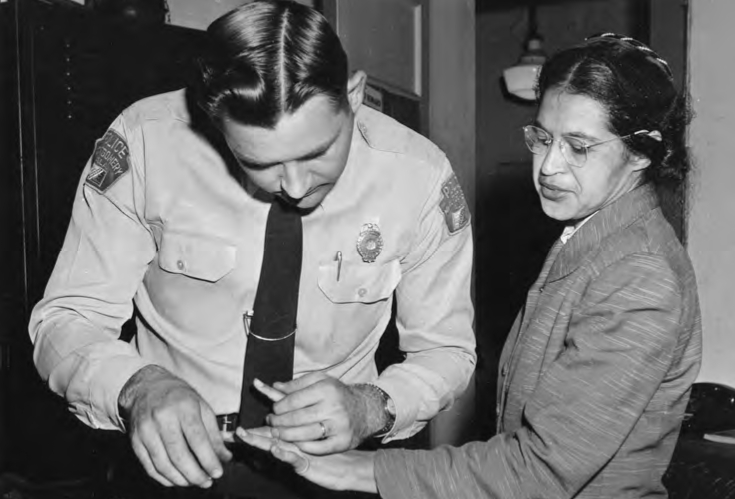
Rosa Parks being fingerprinted on February 22, 1956, by Lieutenant D.H. Lackey as one of the people indicted as leaders of the Montgomery bus boycott. 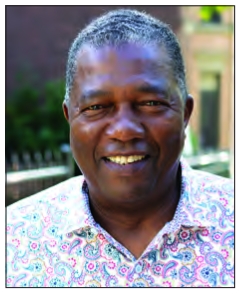
For much of my life, I’ve walked the steps of City Hall Plaza. First as a young person, then an attorney, and later as a pastor. But the day I was sworn in as the District 7 City Councilor, I felt the weight of the moments when I ascended those familiar steps and headed to my office on the fifth floor. I was reminded that those same steps were the very ones where Ted Landsmark was violently attacked in 1976, targeted solely because of the color of his skin.
Today, I walk them to serve my community and confront the inequities that still persist. The distance between that moment and mine measures our progress. The work waiting for me inside reminds me of what still remains. Black history isn’t behind us. It’s alive, unfolding with every step we take and every choice we make.
The history of the Black experience in America is not a burden to carry, but a responsibility to honor. Dr. King spoke of responsibility often. The Beloved Community he imagined was never about perfection. It was about participation. It was about ordinary people choosing responsibility over apathy.
He warned us that a shrinking sense of responsibility for one another is the price we pay when we do not commit to community, even when it is uncomfortable. When we lose that sense of responsibility, we lose our strength. We lose our collective voice. We lose ourselves. It is our responsibility to prevent not only disorder in our streets, but disconnection in our hearts.
Today, that responsibility is ever present. It calls on us to be courageous together and to challenge the status quo, for our work is far from finished. Inequity is easier to ignore now than it was in the Jim Crow era. Some will tell you that because we celebrate Black History Month or have had a Black president, systemic racism is a thing of the past. Too often, it is hidden behind the language of “tradition” or “precedent.” That is why we must take a closer look at the precedent we inherit.
There was once precedent that Black children could not go to school with white children. Then the Little Rock Nine bravely crossed the lines of segregation so that all of God’s children could learn side by side and share in opportunity.
There was once precedent that only white voices were heard in government. Then leaders like Shirley Chisholm and John Lewis broke barriers, paving the way for me to serve on the Boston City Council.
There was once precedent that only white families lived on Seaver Street. Then my courageous grandparents, guided by a dream, moved in and helped to build a thriving Black community.
We must be willing to ask ourselves uncomfortable and difficult questions about whether precedent is upholding justice, or whether it has become a convenient way to avoid confronting deep-rooted inequity. We owe it to the next generation to leave behind a better precedent than the one we inherited. That work cannot be done alone. Knots of systemic inequity are woven into the fabric of our society. It is our responsibility to untangle them together.
The civil rights heroes we commemorate did not move in isolation. They were powered by an entire community. This work has always been collective. There was strength in our ancestors’ ability to mobilize and unify around a shared purpose, a strength I do not believe we are fully tapping into today.
When disagreements over where resources go, what to build on empty land, what projects to support, or who holds which position divide us, we weaken our collective voice. Meeting this moment will require a commitment to place our shared future above individual outcomes. And when the dark cloud of disorder blurs our focus, we must tell the story of Black history—not as memory alone, but as instruction. Because it is more than a story. It is a blueprint.
A blueprint for confronting injustice with courage and persistence. A blueprint for transforming pain into action. A blueprint for organizing our community and strengthening our collective voice. The question now is whether we will follow it.
The future of District 7 will not be built by one person, one office, or one institution. It will be built by a renewed commitment to “we.” With more than forty civic organizations across District 7, we have the opportunity to put our differences aside and mobilize. From Roxbury to Dorchester, from the South End to Fenway, this district has been a place where movements are born, where culture thrives, and where justice is demanded. We already have the talent, creativity, and resilience to move mountains. But to meet the moment before us, we must remember that this work is bigger than any one of us. Not me versus you. Not us versus them. But We the People—standing together, committed and unshakable in our pursuit of a stronger, more just District 7 and Boston.
Miniard Culpepper is the city councilor for Boston’s District 7.