
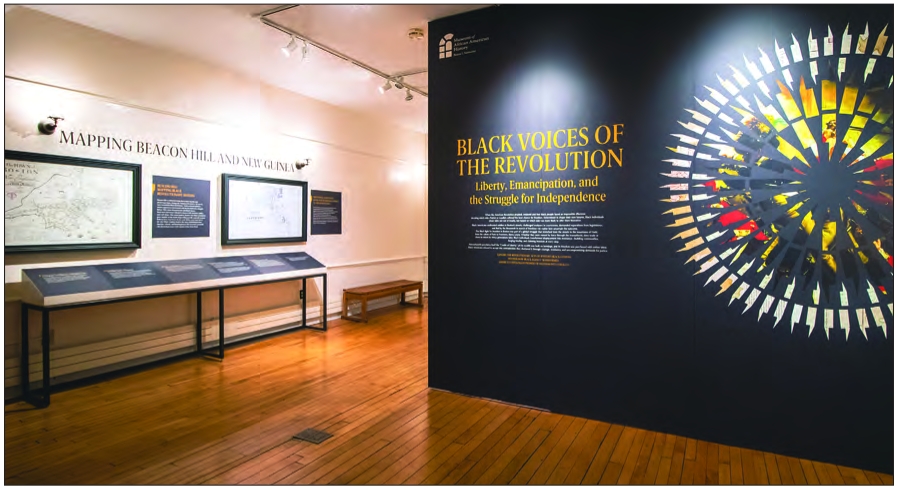
A view of the “Black Voices of the Revolution” exhibition at Museum of African American History. 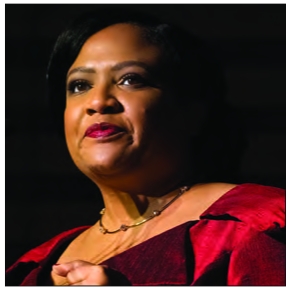
February marks a centennial worth celebrating and defending, Black History Month. In 1926, Dr. Carter G. Woodson established Negro History Week, coinciding with President Lincoln’s and Frederick Douglass’s birthdays. Woodson established a dedicated time to elevate African American history, even as he insisted this history deserved year-round study.
A century later, we’ve witnessed a remarkable evolution.
What began as community gatherings has expanded to include government proclamations, television specials, and the casual phrase “Happy Black History Month” now woven into our February greetings. The scholarly landscape has transformed as well, with generations of Black doctoral scholars in history, Africana studies, and African Diaspora studies building upon the groundbreaking work of Woodson and others.
Yet progress and peril walk hand in hand. Today, we face deliberate attempts to roll back decades of historical research, work that reveals the details of slavery, America’s most peculiar institution; the Harlem Renaissance; the Civil Rights Movement; and numerous other historical eras.
Now we watch as interpretive panels disappear from national parks, raising urgent questions: What comes next? The markers noting where Black communities once thrived? The geographic inscriptions of human tragedy from slave markets to lynching sites to massacres?
This is a concerted effort to whitewash our shared past, erasing generations of rigorous research that proves people of African descent have been integral to this nation’s story from its very beginning.
Last year’s White House executive order “Restoring Truth and Sanity to American History” brought attention to the Smithsonian’s National Museum of African American an iconic building on the National Mall that took generations to realize. Concern for NMAAHC is justified. However, we’re overlooking the institutions that made it possible: the network of Black museums across this country, large and small, preserving the history of our regional experiences.
Established in 1868 and housing over 9,000 artifacts, the Hampton University Museum is the oldest Black museum in the United States. Since that time Black museums, cultural centers, and historic sites have emerged across the country. Many answered Woodson’s call, to demonstrate the presence and relevance of Black history. Now, in this contentious moment, they stand most vulnerable. Some are connected to federal, state, and local governments. Regardless of their status as an independent or governmental institution they all face the same threat: ERASURE.
Black museums are wondrous places, often born from grassroots determination. They emerge when communities galvanize for the preservation of place or their collective history. They are born from enthusiasts conserving family and community objects. They are born from the persistent work of volunteers and formally trained curators who dig through archives and visit homes and churches validating that those cherished heirlooms deserve to be cared for and maintained. Those carefully preserved treasures witnessed history and they matter.
Black museums are imperfect, but as cities transform and communities relocate, they create a public record. They remind the world of who we were, who we are, and who we might become.
I’ve been continually surprised when I discover Black museums and cultural centers in unexpected corners of this country.
Each represents a community’s refusal to let its story disappear.
The Museum of African American History | Boston & Nantucket is one such institution. Few people know that on Beacon Hill and on the island of Nantucket, there were thriving Black communities in the eighteenth and nineteenth centuries. Sue Bailey Thurman founded the museum in the 1960s to preserve two landmark buildings, the African Meeting House and the Abiel Smith School, and capture Boston’s distinctive Black history. Our mission grew to interpret the presence of people of African descent throughout New England. We firmly believe that incorporating the Black experience in New England provides a more holistic understanding of African American history. We joined several of our peers in 1978 to form an organization, the Association of African American Museums, that would support Black museums and Black Museum professionals. In the last year, we have faced challenging headwinds, including the sudden loss and return of federal funding. Yet like our peer independent Black museums, we are still vulnerable. But we are still here.
The threat of erasure is nothing new to us. We welcome allies and support from all quarters. However, the centennial year of Black History Month demands that we remember our roots and come together. Our museums are the product of our community and will survive only with community support. Our failure to do so will ensure that the Black history preserved today will not survive for future generations.
We embrace this moment, steadfast in our belief that Black history is essential. It reflects all parts of our society. As Woodson understood a century ago, this history demands not just a week, not just a month, but constant vigilance and care. The museums preserving it, especially the smaller independent regional institutions, are often overlooked and need advocacy and support now more than ever. They are the guardians of memory in an age of forgetting, and we cannot let them stand alone.
#SupportBlackMuseums
Dr. Noelle N. Trent currently serves as the President & CEO of the Museum of African American History | Boston & Nantucket.