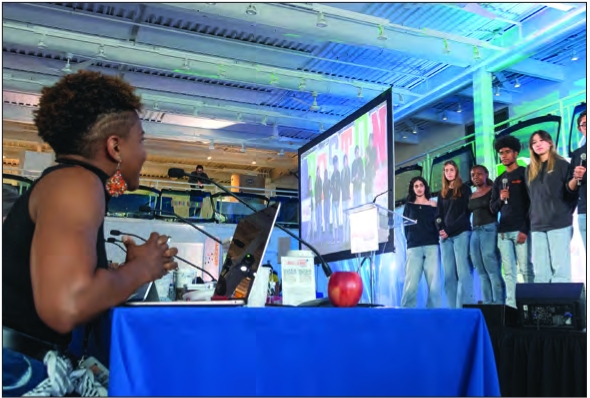
Students from Brighton High School answer questions from judges at the Aspen Challenge Solutions Showcase, April 29, 2025.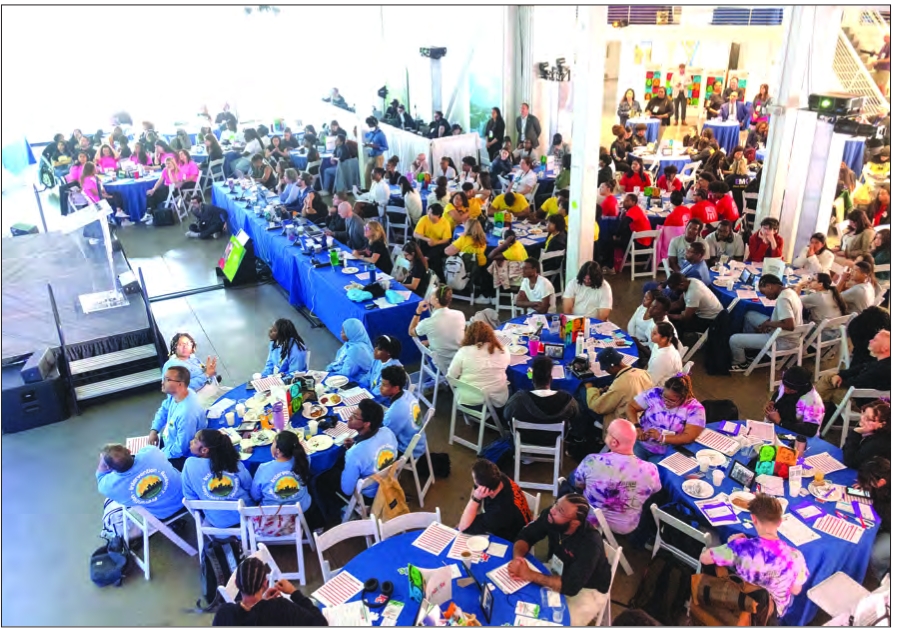
Students gather at the Artists for Humanity building in South Boston for the Aspen Challenge Solutions Showcase, April 29, 2025. The showcase marked the end of a 10-week challenge in which high school students from Boston Public Schools developed and implemented solutions to problems like gun violence, access to green space and youth homelessness.
Youth voices were front and center at the launch of this year’s Aspen Challenge, an annual program that offers high school students a chance to develop solutions to major community challenges.
A crowd of over 100 Boston-area high school students gathered on Feb. 2 at the Artists for Humanity building in South Boston to hear what focus issues this year’s challenge would have them tackle.
“We call these solutions,” said Katie Fitzgerald, managing director for the Aspen Challenge, which is run by the nonprofit Aspen Institute in Washington, D.C. “These aren’t projects; these aren’t after-school fun clubs, or anything like that. These students are challenged to solve the issues that society has presented to them on a daily basis.”
Each year the program is run in one new city and a returning one, and this year marks Boston’s second year. Last year, Boston teams overlapped with teams in San Diego. This year, as the veteran city, local teams will overlap with those from Detroit, who will tackle their own locally focused set of challenges. Being a veteran city also means winners from the previous year participate as mentors during the second year, to their own and the new cities’. That mentorship by previous cohorts is part of the broader focus on youth leaders, Fitzgerald said.
This year, teams representing 13 high schools from Boston and a team each from Somerville and Lawrence will spend the next 10 weeks brainstorming, developing and implementing a solution to one of five challenges. Young people in competition cities voice their priorities to identify subject areas to focus on, after which, the Aspen Challenge team selects experts to develop and issue the specific challenges students tackle. Each team receives $500 in seed funding from the program as well as guidance from a local mentor who serves as “community champion.”
This year’s focus areas include closing perception gaps between youth and adults; reducing use of screens; improving food access; communicating educational opportunities for immigrant families; and reducing community violence.
In remarks to students at the launch, Boston Public Schools Superintendent Mary Skipper called the program a “life-changing experience.”
“This is where you — with your brilliance, with your creativity, with your energy — get to put forward ideas that make a difference to your peers, to the adults in the city and to BPS in general,” she said.
At the end of the 10 weeks, in April, the Boston-area teams will present their work at a showcase. Judges will select two winning teams, who will be joined by two Detroit teams, to attend the Aspen Ideas Festival in Colorado at the end of June.
At the heart of the program is the idea that the young people in each city come to have more answers than they’re given credit for.
“How can some of us young people try to close the gap with some adults?” said one Boston-area student at the launch event. “There’s a lot of adults who say that we need to respect our elders, but they refuse to give you respect.”
Another student said she believed many students had been in situations where adults would ask for their opinion, only to say, “Oh, you’re a kid, you have no idea.”
The expert who helped identify the challenge of trying to close a gap between the needs of young people and adult perception of those needs was Anthony Barrows, executive director of the New York office of LIFT, an anti-poverty organization. Barrows said he understands the students’ frustration.
“It is certainly true that we have information and access that young people don’t, but one thing that they have that we never will is the expertise of their lived experience and being young in this moment,” he said.
For some community leaders, that youth-first approach offers a unique opportunity to deal with pressing problems facing Boston residents in today’s political climate.
“Every program and every organizing campaign that we have has come from youth,” said Alexandra Oliver-Dávila, executive director of Sociedad Latina, a Mission Hill-based nonprofit that works to support Latino youth and families. “I can’t say enough that we really believe that young people play a huge role in solving the issues of today.”
Sociedad Latina was behind the challenge to improve how immigrant families access and trust information about educational opportunities, a focus area that stemmed from the grim political realities — of threats of deportation and limits on benefits they previously enjoyed — being faced by immigrant communities across the city and country.
“These are challenges that we see with the youth we serve,” said Jose Martinez, college and career pathways manager at Sociedad Latina. “[With] what the current administration is doing, how there’s a lot of anxiety and there are very limited resources for immigrant youth, to have [students] think critically about how to support their community is very important.”
In the 14 years that the Aspen Challenge has been held, winning teams have tackled community issues such as youth mental health, climate and the environment, local poverty and health equity.
Last year’s winning teams in Boston were from Excel High School, which created a music video and a “red chair” statement to raise awareness about gun violence; and from Edward M. Kennedy Academy for Health Careers, which set up a free, automated texting hotline to help its unhoused students access support. A third team from Margarita Muñiz Academy in Jamaica Plain also tackled the gun violence challenge by hosting a panel with officials to spark conversations about the issue.
With the program’s emphasis on platforming youth voices and the challenges they prioritize, Barrows said he has faith in the chosen group of competitors.
“I am continually impressed by just how brilliant our young people are,” Barrows said. “The kids are going to be alright.”