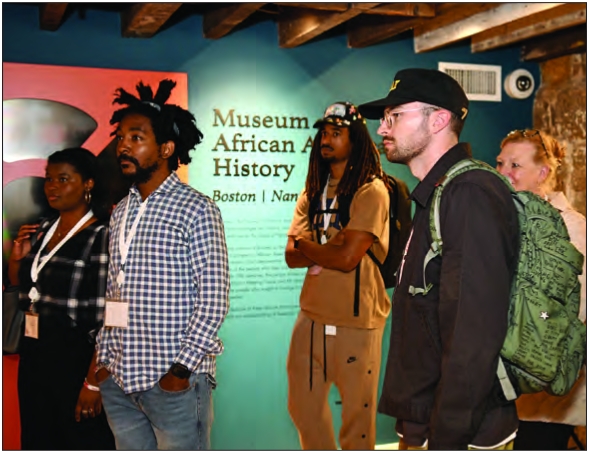
Visitors view an exhibit at the Museum of African American History. This month, the Museum of African American History in Boston and Nantucket will celebrate the centennial anniversary of Black History Month.
The celebration began in 1926 as Negro History Week, a tradition formalized by Black historian and Harvard graduate Carter G. Woodson. February was chosen to align with Abraham Lincoln’s birthday on Feb. 12 and the day Frederick Douglass celebrated his birth, Feb. 14. In 1970 the week evolved into a month and in 1976 Black History Month was federally recognized by President Gerald Ford.
From the beginning, the week included a curriculum and educational theme.
“The whole point of this month is not for it to be a space where we only celebrate Black history, but it’s a space where we uplift Black history more than any other time of the year,” said Dr. Noelle N. Trent, president and CEO of MAAH. “But we’re supposed to be studying and appreciating Black history 12 months out of the year.”
February is always a busy time for MAAH, but this year it has ramped up its programming in celebration of the anniversary. More than a dozen events throughout the month highlight Black history and culture, ranging from an all-levels yoga class at the African Meeting House and a historically informed flower bouquet workshop with Wendy Alexis-Janvier to a film screening of “In Search of Phillis Wheatley Peters” and a Southern-inspired lunch from Larry J’s BBQ Cafe paired with a poetry reading by Amanda Shea.
Many of the events are free, an intentional choice to make these programs as accessible as possible.
“This is not just a history for the Black community, this is a history for everyone, and so it is our intent to make the majority of our programs something that all families, all individuals, can come celebrate and enjoy,” Trent said.
A free program on Feb. 13, “From Ideas to Institutions: The Process of Making Black History” will serve as the museum’s centennial party. The evening begins with a conversation between Angela Tate, chief curator and director of collections at MAAH; Kyera Singleton, public historian and executive director of the Royall House and Slave Quarters in Medford; and educator Jennifer Turner, board director for Communitas. From there, a reception with music and refreshments will celebrate Frederick Douglass’ 208th birthday.
MAAH’s exhibition, “Black Voices of the Revolution: Liberty, Emancipation, and the Struggle for Independence,” is on view all month, featuring rarely seen items from the museum’s 3,000- piece collection. The installation also uses AI technology from TimeLooper to make a holographic, interactive Frederick Douglass that visitors can ask questions.
The museum team hopes these programs will help Bostonians understand and connect with local Black history.
“Although nationally, Black history tends to be a more of a Southern to Mid-Atlantic narrative, we have a rich history all our own that is located right here in Boston, right here in Massachusetts, right here in New England,” said Trent. “And we hope that visitors are inspired by that.”
ON THE WEB
Learn more at maah.org/events