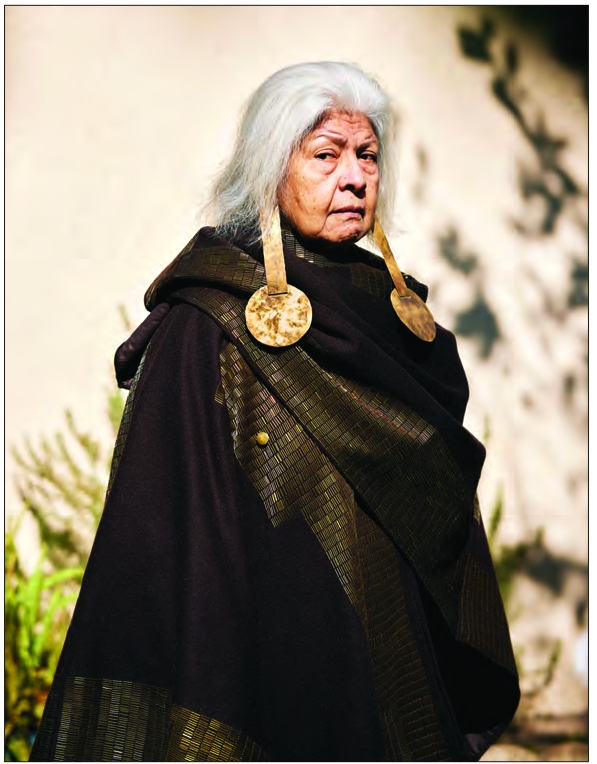
Christian Hernán De Restrepo’s abuela (grandmother), wears a garment created by the artist.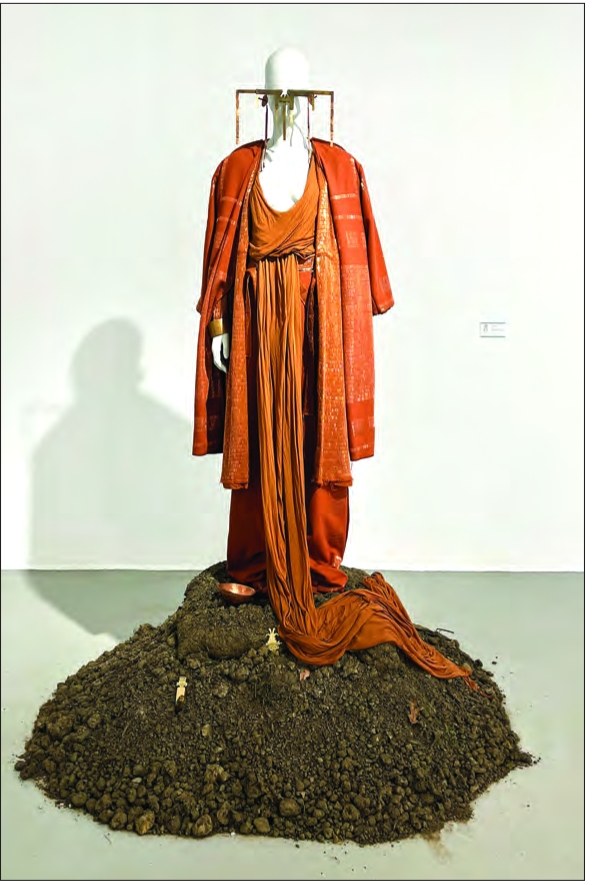
Figures are staged throughout the gallery wearing intricate handmade garments and adornments. Restrepo, a Colombian American artist, imagines what Latin American countries would be like if they had been able to thrive without Spanish colonialism.
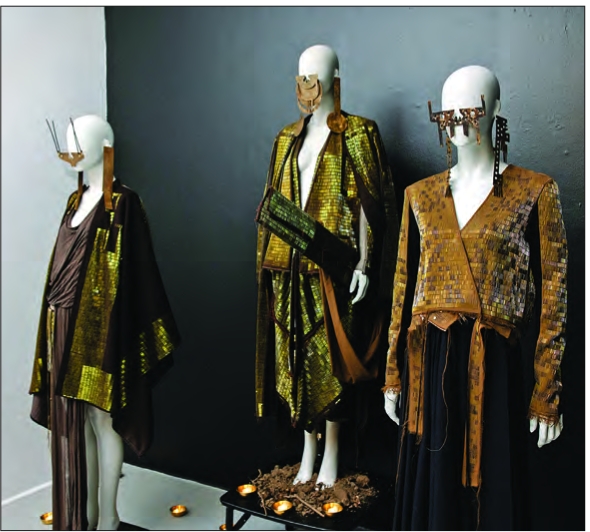
A hush seems to fall over the Mills Gallery at the Boston Center for the Arts when visitors enter the current exhibition “A Él Mismo” (“to himself”) by Christian Hernán De Restrepo. Tall, proud figures are staged throughout the gallery, standing on carefully cultivated piles of earth. The figures wear intricate handmade garments and adornments that feel regal and familiar but not quite within reach. That’s because these figures represent a present that was never allowed to be.
In this exhibition Restrepo, a first-generation Colombian American artist in Boston, imagines what Latin American countries would be like if they had been able to thrive without Spanish colonialism. This conceptualization of an alternate reality was born when Restrepo reflected on his experience in the United States.
“I had begun to suppress my Latino-ness, as a result of feeling a pressure to ‘fit in’ with the white American world I existed in. Following, came the realization that not just me, but my family, and our people’s thoughts, beliefs, ideologies, religion, cultural practices, concepts of beauty, sexuality, gender and language, el español, are all inherited traumas as a result of Spanish colonization,” said Restrepo. “Outside of all of this, who were we? Who was I?”
“A Él Mismo” aims to answer that question. Each piece, or “aspect” as Restrepo refers to them, is inspired by the traditions of the Muisca people, a pre-Columbian civilization in the Eastern Andes, known for their artistry, particularly with gold and emeralds; both materials are used in the exhibition.
To emulate the intense metalwork of the Muisca people, Restrepo uses carefully layered staples to create texture and weight in the aspects.
“Staples, this simple and mundane material that when in repetition, I found looks beautiful and both futuristic and ancient. It has a heaviness and a presence that spoke to me,” Restrepo said. “Material is material, it’s how it’s worked and transformed with someone’s time where its true worth and value is.”
In addition to the aspects themselves, the exhibition includes a number of photographs taken by curator and longtime collaborator of Restrepo, Heather McGrath. McGrath captured Restrepo and his family members, his abuela, his mama, his hermano and others, wearing these garments and embodying this alternate reality. These images bring Restrepo’s vision of a free, Indigenous Latino America even further into focus.
“I would imagine that if Colombia, and the rest of Central and South America had thrived on their own, there would have been natural cultural exchanges, cross influences, blending of customs, evolutions of practices, traditions, philosophies and perhaps out of these rich exchanges new styles in design, architecture, fashion, iconography and art might have come into existence,” he said. “It’s kind of exciting to be building that.”
Restrepo’s work feels both forward looking and ancestral. It’s tactile and rooted in the earth but inspires a spiritual reverence. It reminds the viewer that imagining an alternate reality could create an alternate future.
“A Él Mismo” runs at the Mills Gallery through March 7.
ON THE WEB
Learn more at bostonarts.org/event/a-el-mismo-christian-hernan-restrepo