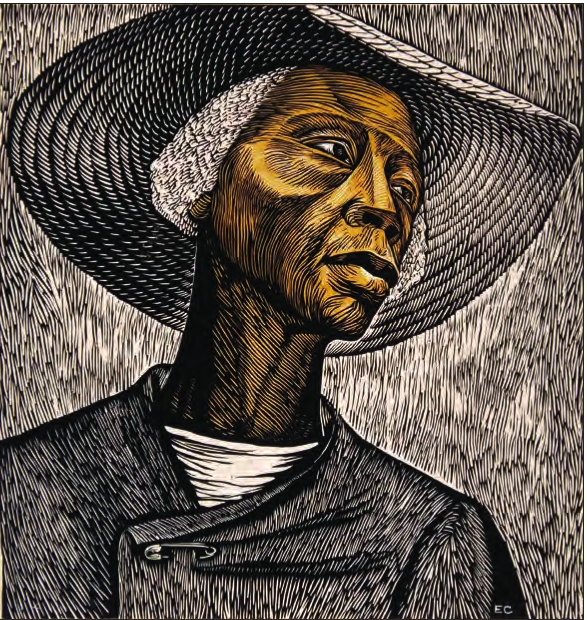
“Sharecropper,” 1952, Elizabeth Catlett (1915–2012), two color linoleum cut. 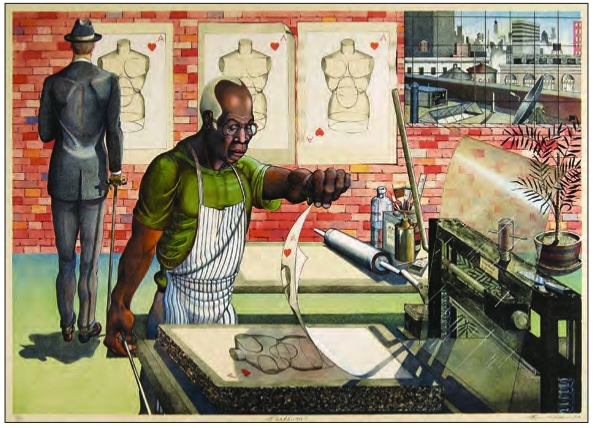
“Blackburn” Ron Adams (born 1934), color lithograph
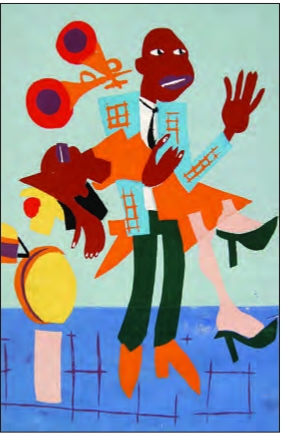
“Jitterbugs III,” 1941– 42, William Henry Johnson (1901–1970), pochoir
Harvard exhibition offers a tour of Black history through the lens of African American printmakers
A not-to-be-missed exhibition of works on paper by African American artists whose images span slavery, the Jim Crow era, the Civil Rights Movement and the 21st century as well as social realism, impressionism and abstraction is on view through June 6 at Harvard’s Alain Locke Gallery of African and African American Art.
Free and open to the public, the Locke Gallery (formerly the Ethelbert Cooper Gallery), is at Harvard’s Hutchins Center for African and African American Research in Harvard Square. The Hutchins Center recently renamed the gallery to honor Locke (1885-1954), whose vision inspired the Harlem Renaissance.
Titled “Renaissance, Race, and Representation in the Harmon and Harriet Kelley Collection of African American Art,” the thematically organized exhibition demonstrates the expressive power and versatility of printmaking as a medium of individual and community storytelling. Prints by renowned artists better known for paintings such as Aaron Douglas, Jacob Lawrence, Romare Bearden, Elizabeth Catlett and Boston-born John Woodrow Wilson and Lois Mailou Jones are displayed alongside works by lesser-known artists that will prompt viewers to explore unfamiliar artists further. Assisting such exploration is a free print and online exhibition guide.
The exhibition also demonstrates the power of collectors to bring visibility to worthy artists who may otherwise be overlooked. Curated by Dell M. Hamilton, interim director of the Alain Locke Gallery, the exhibition’s 117 works on paper — etchings, lithographs, watercolors, block prints, silkscreens and drawings — include 78 works drawn from a traveling exhibition organized by Dr. Harmon W. Kelley (1945-2023) and his wife, Harriet, ardent collectors of African American art, from their Harmon and Harriet Kelley collection.
Other works are from the Hutchins Center collection and private sources.
While bearing witness to Black life in America, these works tell another story — that of the multigenerational community of Black artists whose ascent into the once-segregated art world came about through mutual mentoring and collaboration. Printmaking was core to their rise: the New Deal Federal Art Project established urban art centers with print shops that trained artists, many of whom founded art departments at historically Black colleges and universities, fostering art careers for themselves and others.
Opening the exhibition is an image of gravitas, “Sharecropper” (1952) by Elizabeth Catlett, whom Lois Mailou Jones mentored. Lines of the linoleum print render the weathered creases of the subject’s face.
Hamilton’s artful curation adds Black literary voices. Each section opens with a quotation. A statement by Zora Neale Hurston introduces the lobby’s array of female portraits: “I love myself when I am laughing…and then again when I am looking mean and impressive.” Whitfield Lovell’s “Chance” (2002) is a gentle profile coupled with hand-colored playing cards. Ernest T. Crichlow’s sardonic “Anyone’s Date” (1940) portrays a female with a cigarette dangling from her mouth. Later in the show, another red-toned gouache, “My Friend” (1981) by Mary Reed Daniel is more sympathetic toward its subject.
Portraits continue on both sides of a long ramp. On the left are celebrity subjects, including John Wilson’s spare 2002 etching of Martin Luther King Jr. and poster-size offset lithographs of Barack Obama and Kamala Harris by Shepard Fairey, one of two white artists in the exhibition. The other is Pablo Picasso, whose delicate etching of poet, author and politician Aime Cesaire, a founder of the Négritude movement in French literature, is on the opposite wall. Flanking the Picasso are “Abraham” (ca. 1937) by Dox Thrash, a powerful, dignified closeup of a world-weary young man; and a lithograph by John Thomas Biggers titled “At Risk” (1996), in which various shellfish surround a boy’s face.
The earliest work on view is abolitionist Patrick Henry Reason’s 1836 engraving of Granville Sharp, a British scholar who campaigned against the slave trade.
A gallery featuring Harlem Renaissance giants displays pages from “And the Migrants Kept Coming,” an article in a 1941 issue of Fortune Magazine about Jacob Lawrence’s iconic 60-panel “Migration Series” (1941), narrating the journey of African Americans from the South to the North. Nearby are colorful lithographs, watercolors and collages by Romare Bearden. Inside a display case is the frontispiece by Countee Cullen of his poetry book “The Black Christ,” which juxtaposes the crucified Christ with a Black man hanging from a tree.
Another small but compelling image is an Emma Amos mixed-media print, “Thank you Jesus for Paul Robeson” (1995). A statuesque nude photo of Robeson is coupled with a small-print biography honoring the legendary bass-baritone artist, actor, athlete and civil rights activist; his career was shattered during the mid-20th century congressional political persecution campaign known as McCarthyism.
Also riveting in the section titled “The Black Body and the Figure” are Hale Aspacio Woodruff’s block prints, dated 1931 to 1946, showing Black men victimized by mobs. The images demonstrate the power of the medium to render suffering in contoured lines. In another section, “The South,” Woodruff’s quintet of prints renders closely observed family and community scenes.
A scene of childhood ecstasy is conjured by expatriate artist Walter Williams in his multicolor block print “Thistle” (1966).
Nearby is a joyful watercolor by Alma Woodsey Thomas, “Wind and Flowers” (1973).
“Through color, I have sought to concentrate on beauty and happiness, rather than on man’s inhumanity to man,” Thomas stated in a 2016 catalog. In 1972, at the age of 80, she became the first Black woman to have a solo exhibition at the Whitney Museum of American Art in New York City.
“One of the things we couldn’t do was go into museums, let alone think of hanging our pictures there,” Thomas said in a New York Times interview. “My, times have changed. Just look at me now.”
ON THE WEB
Learn more at lockegallery.fas.harvard.edu