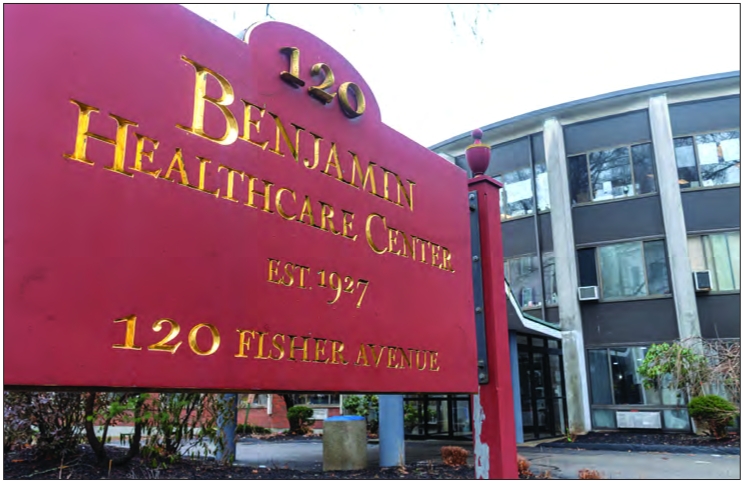
The Edgar P. Benjamin Healthcare Center on Mission Hill, shown March 6. The sale of the Edgar Benjamin to Allaire Health Services was delayed again, as the company finalizes details and the receivership deals with outstanding lawsuits.The sale of the Edgar P. Benjamin Healthcare Center may be delayed but it is progressing, according to statements presented at a Jan. 28 court hearing on the future of the facility.
The sale, as part of a receivership of the Mission Hill nonprofit, was expected to close Feb. 1 but Allaire Health Services, the New-Jersey-based, long-term care facility operator that is buying it has been engaged in some last-minute logistics as part of its due diligence process, attorneys said. Roxbury attorney Joseph Feaster, who is leading the receivership, expects the sale to close sometime in this month.
“Allaire hasn’t shied away, and the receiver hasn’t shied away,” said Timothy Fraser, an attorney representing the receivership. “They’ve been working in a very collegiate manner to bring the transaction to closure.”
What remains, he said, are “nits and gnats,” like who might be responsible for fixing equipment that might break before the sale. Judge Christopher Belezos, who presided over the Jan. 28 status conference, extended the receivership through Feb. 27.
The sale of the roughly 100-year-old nursing home comes at the end of a nearly two-year court-appointed receivership. In February 2024, Tony Francis, the center’s then-administrator, announced plans to close the facility, citing “insurmountable financial challenges.” His announcement prompted pushback by the facility’s residents, their guardians and other members of the Edgar Benjamin community, including elected officials who represent the districts that include the nursing home.
In April that year, and in response to a lawsuit by guardians of two facility residents who alleged an emergency under Francis’ leadership put them and other residents in danger, a judge ruled to initiate receivership of the Edgar Benjamin. The state Department of Public Health and Attorney General’s (AG) Office, both of which had previously refrained from petitioning the court for receivership despite community requests, supported the move.
The receivership forced out Francis and put Feaster in charge of the facility.
In April 2025, Feaster suggested the facility consider a sale to another operator to keep it open. Three months later, the court approved his recommendation to sell the facility and its operations to the for-profit Allaire, which operates 23 facilities in New Jersey, Pennsylvania and Vermont. The Edgar Benjamin will be its first in Massachusetts.
Feaster’s selection of Allaire was met with consternation from some residents and their guardians, as well as a couple of local organizations that were unsuccessful in their bid for the facility.
Funds from the sale will be used to pay off a lien the state placed on the facility to ensure repayment of contentious advances of funds through the state’s Mass-Health program. Those funds regularly pay for residents at the facility, and throughout the receivership, Feaster requested advances on those payments to keep the facility operational. Attorneys for the receivership estimate that after the lien and any remaining debts are paid, there will be roughly $1.5 to $1.9 million in residual funds.
The fate of those funds — and who will manage them — is still an open question. One suggestion from the AG’s office is creating a three-person board that will allocate those funds. That board could help create a new focus for the nonprofit or revive the mission of the Edgar Benjamin — supporting elders on Mission Hill — instead of being responsible for shutting down the nonprofit entity.
But Fraser said finding volunteer board members is proving difficult; few people seem willing to tie themselves to an organization that has faced such public challenges.
In court, Mary Freeley, director of the AG’s elder justice unit, said one proposal her office received from the facility’s receivership was to use the AG office’s authority to establish a board. Even though the AG’s office has broad oversight over nonprofits through its public charities division, appointing a board would be outside its normal scope, she said.
In addition to those open questions, also on the court’s radar are a trio of lawsuits attached to the facility’s former leadership, cases that the court said it would like to see resolved before the receivership ends, although Allaire wouldn’t be responsible for these court cases as part of its purchase agreement.
One is a suit by American Express over unpaid charges that Francis incurred on a company card when he was administrator, in what Fraser called a “regular debt collection matter.”
The second is by former employee Rudis Santos, who worked as a housekeeper and alleges that the facility failed to pay employees in November and early December 2023. After Santos spoke out about the wage issue, he was fired in what he alleged was wrongful termination. Santos filed an emergency motion to be paid his wages through the residual funds. His attorney, who was present at the Jan. 28 status conference, estimated that Santos is owed a few thousand dollars in unpaid wages [he couldn’t produce a more exact figure, as the wage claim has been delayed due to the receivership].
The third case involves allegations by the receivership that Francis embezzled more than $3 million from the facility. Francis is now facing pending criminal investigations in relation to those claims.
The next status conference, where Belezos hopes Francis will appear to resolve outstanding issues to help resolve receivership proceedings, is set for Feb. 24.