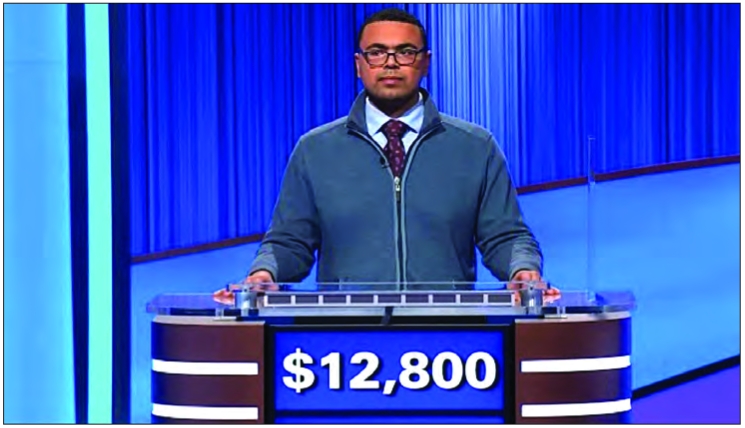
Cameron Berry credits his grandmother Peggy for his love of learning.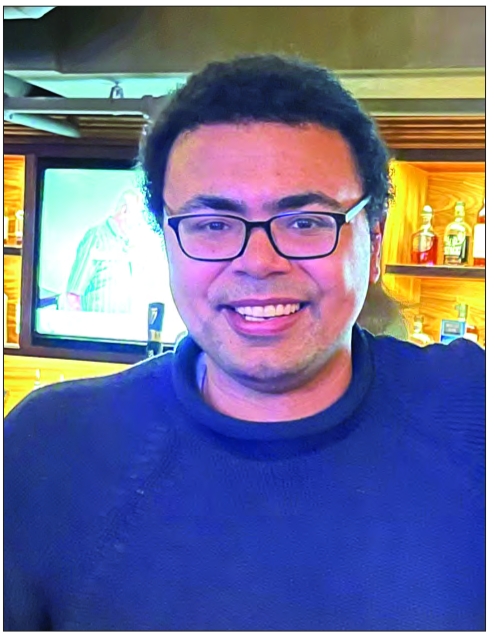
Berry is not only a Boston resident but a proud graduate of Boston University.
On a frigid January morning in Brighton, Cameron Berry was anticipating that evening’s episode of “Jeopardy!” But the 32-year-old data analyst and college administrator wasn’t just a fan of the iconic trivia game show, he was also a semifinalist in the Tournament of Champions (TOC).
By nightfall, the Brighton resident would be back on national television facing the kind of pressure most trivia lovers only experience from their couches.
For the uninitiated, “Jeopardy!” is an American quiz show that debuted in 1964 and has become one of the most recognizable game show formats in television history. Contestants select clues from categories phrased as answers and must respond in the form of a question. The game rewards not just knowledge, but speed, strategy and composure.
Over the decades, “Jeopardy!” has evolved into a competitive ecosystem, complete with returning champions, themed tournaments and a devoted community of players who treat preparation like a second job.
Berry is one of them. Originally from Falmouth, Maine, just outside Portland, Berry said his family moved frequently while he was growing up. He attended high school in Jacksonville, Florida, returning north for college at Boston University.
“I wanted to be in the Northeast,” he said, citing the heat and humidity in Florida as a deal breaker.
Since college, he has lived in the Boston area and now calls Brighton home.
New England has long punched above its weight on “Jeopardy!,” producing contestants known for deep academic grounding and methodical play. Berry fits that mold, but his route to the Tournament of Champions was not a straight run.
The TOC brings together the show’s most successful recent players to compete for prestige and a top cash prize. Unlike regular-season games, where winners return day after day, the tournament is largely single-elimination until the finals.
“All the games, except for the final, are basic games — winner advances,” Berry explained. “And then the final is first person to three wins, so that can go up to seven games.”
Berry’s path to that stage — and the way he carried the personal loss of his grandmother, Marguerite, affectionately known as Peggy, with him under the studio lights — tells a deeper story about preparation, persistence and why “Jeopardy!” still matters.
Before reaching the TOC, Berry also competed in other “Jeopardy!” tournaments with different structures and stakes, including formats where high-scoring non-winners could still advance. Those variations, he said, forced him to rethink risk.
“In the wild card, because of how each round was structured differently, I was really trying to have a pretty modest strategy,” Berry said. If advancement depended partly on cumulative scores, reckless betting could end a run quickly. His goal, he said, was to stay “in five digits” and alive.
One of Berry’s greatest strengths is his command of the buzzer, an invisible but decisive element of the game. Contestants can only buzz in after the host finishes reading a clue, a fraction-of-a-second skill that separates champions from spectators.
“There are two ways to sort of go about it,” Berry said. Some players watch indicator lights on the podium to know when buzzing is allowed. Others rely on the host’s cadence. Berry prefers the latter. “I’ve always gone by ear,” he said, noting that Ken Jennings, the show’s most famous champion and now its host, has said he did the same, practicing by listening closely to former host Alex Trebek’s rhythm.
Berry’s preparation extended beyond mechanics.
He was strategic about what not to study. Sports trivia, he said, changes too quickly to be a good investment. Niche categories like opera also fell by the wayside. Instead, he focused on strengthening areas where he already had a foundation, broadening outward rather than trying to master everything.
That discipline was tested emotionally in the months leading up to his appearance. Berry’s grandmother Peggy died during his “Jeopardy!” journey. He spoke of her as being a core part of his support system, even after she had passed away.
Peggy had encouraged his curiosity from an early age, treating learning as something to be shared rather than assigned. Continuing to play, Berry said, became a way to honor that influence. The loss sharpened the stakes, but it also grounded him. If the lights, cameras and national audience threatened to overwhelm, he could remind himself why he was there in the first place.
That perspective mattered on Jan. 29, when Berry faced elite competition in the TOC semifinals.
The margin for error was thin. Aggressive wagers by opponents forced him to match their pace at times, while other moments called for restraint. He adjusted in real time, weighing category comfort against game context.
The result did not go his way. Berry ultimately lost to Paolo Pasco, a puzzle creator, and did not advance to the finals. But in a tournament designed to separate the best from the very best, reaching the semifinals is itself a marker of excellence.
For Berry, the experience reaffirmed what drew him to “Jeopardy!” in the first place: not just the competition, but the community. Former players trade study tips, debate strategy and dissect games long after they air. “I prepped by just talking to people within the community,” he said, asking what they wished they had studied more.
Back in Brighton, life has returned to normal rhythms — work deadlines, snowy sidewalks, the quiet after a broadcast buzz fades. But Berry’s run adds him to a long line of local contestants who have carried New England-area brains to the national stage.
And somewhere in that lineage is Peggy, watching closely, reminding him — and anyone paying attention — that knowing things is only part of the game. The rest is timing, heart and the willingness to keep buzzing in.