
Developers search for compromise on scrapped Roxbury economic development project
Weeks after Mayor Michelle Wu’s administration announced a sharp turn from a long-standing proposal for an economic development project at Roxbury’s Parcel 3, community members and leaders are grappling with what comes next.
Some see room for a compromise between the city and community’s visions while others are pessimistic that the city will try to reach a balance with local leaders.
On Jan. 12, the city announced that it would de-designate the HYM Investment Group and My City at Peace (MyCAP) as developers of the nearly 8-acre lot of public land, opting instead to pursue the area as a new campus for Madison Park Technical Vocational High School. The development team was originally approved to develop the site through a municipal process in January 2023.
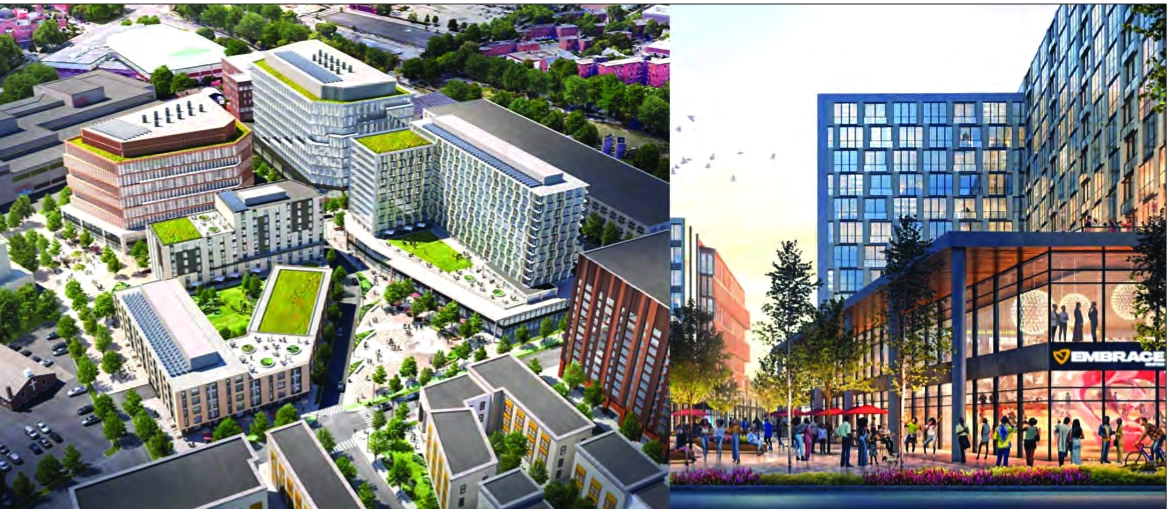
Supporters of the scrapped project described an area with a commercial foothold for Black businesses, an opportunity for homeownership for Black families — a chance to revitalize the area with new jobs, arts and culture.
Imari Paris Jeffries, president and CEO of Embrace Boston, said any disappointment he felt at news of the shakeup has been tempered by optimism that it will still be possible to have a conversation with the city about the space.
“We elected a mayor that is committed to justice, and that’s still the mayor we have,” said Paris Jeffries. The P3 development was slated to include a museum and policy space for the organization, which does work concerning racial justice advocacy.
Paris Jeffries believes there’s an imperative to keep the discussion moving despite disagreement.
“We cannot move forward as a city and a country and pull our chairs back and cancel folks and become archnemeses and move from the table,” he said. “We have to continue in discourse and conversations to advance comment agendas; I think we can continue doing that.”
His optimism, however, is not shared by everyone involved. Rodney Singleton, a member of the District 7 Advisory Council, said he didn’t have hope that conversations with the city would go anywhere, based on previous efforts from the Wu administration that he said were pursued unilaterally, to the detriment of the city’s Black communities.
He pointed to other actions, like Wu’s controversial plan to renovate White Stadium in Franklin Park through a public-private partnership with a professional women’s soccer team and the proposal to relocate the John D. O’Bryant School of Mathematics and Science to West Roxbury. The latter move was scrubbed following community pushback.
“This cannot stand,” said Singleton, who said he views the P3 action by the Wu administration as a racist decision. “We don’t operate like this in Boston.”
Some of that lack of optimism comes from how opponents of the city’s choice say it violates the Roxbury Strategic Master Plan, a 2004 document developed in collaboration with community leaders about what future development would look like in the neighborhood in an effort to address previous actions during urban renewal that displaced more than 5,000 families, according to some estimates.
Singleton said he views the latest action by Wu and the Planning Department as a step that entirely disregards the master plan.
“It’s a very clearly detailed process that the mayor has essentially just thrown in the wastebasket,” he said.
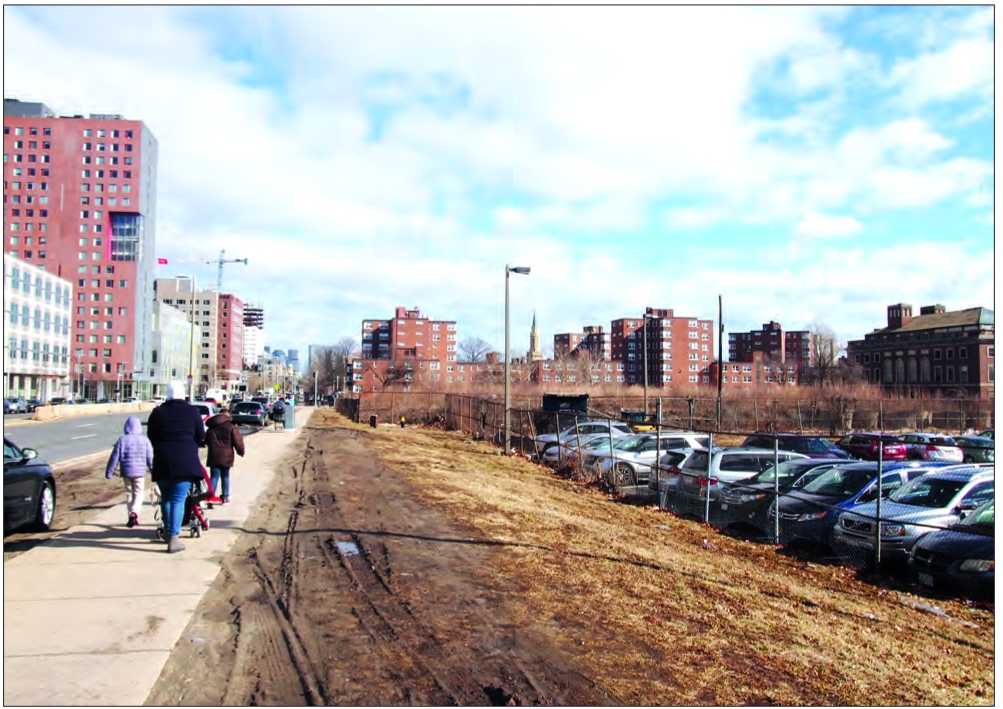
For the community, the parcel holds much potential, in no small part because of the history of the site. The area, once home to residential and commercial buildings, was cleared in the 1960s. At the time, the city sought to build one central high school, and the state sought to extend Interstate 95 into Roxbury.
The city and state seized the land through eminent domain, tearing down homes and businesses. But neither project came to fruition — and the parcel has sat empty since.
“It’s been this big, giant, vacant reminder of history and memory of a harm that’s been done,” Paris Jeffries said.
Chanda Smart, co-founder and CEO of The OnyxGroup Development LLC, said the commercial developer’s vision was a “living, breathing ode to what Black Roxbury used to be.”
The proposal initially included a life sciences lab space as an “economic engine,” which would have provided the financial resources needed to make housing in the area affordable for Roxbury residents.
In Jan. 20 interview on “Boston Public Radio” on GBH, Wu called the plan a “pipe dream,” citing a recent glut of lab space and slump in the biotechnology industry.
“It’s not true that the P3 economic development project isn’t happening because we chose to move forward with Madison Park,” Wu said. “The P3 economic development project was not happening on its own.”
In his own appearance on “Boston Public Radio,” Rev. Jeffrey Brown, co-founder of MyCAP, disputed the mayor’s claim, suggesting that the important element was not the lab space, but rather some new sector that could bring additional economic opportunity to the area.
“It’s true, the project has an economic engine … so that we can pump money into the homeownership and the affordable housing, so that folks would be able to create wealth for their families,” Brown said. “But the economic engine was centered on the life sciences because the life sciences was a hot industry at the time. It doesn’t necessarily need the life sciences; we just need to bring an industry into Roxbury.”
Its construction would have coincided with a broader push to breathe life into nearby Nubian Square. There, a separate development will create a life science training center along with new arts and culture spaces like the pending Jazz Urbane Café. Most recently, Benjamin Franklin Cummings Institute of Technology opened its new campus on the edges of Nubian Square.
For supporters of the P3 project, an updated campus for Madison Park High School isn’t antithetical to the revitalization of Parcel 3. The issue, they say, is it shouldn’t come at the expense of the broader development and associated benefits.
“What we’re asking for is not the school vs. the economic engine — we want both, and we want it at the same time,” Brown said in his GBH interview.
In their Jan. 22 letter to the city requesting an extension of its designation, HYM and MyCAP said they “recognize the importance of thoughtfully integrating a potential new Madison Park High School into the vision for the site and ensuring that any development supports students, families, and the surrounding neighborhood.”
The team’s designation to develop the site officially lapsed at the end of January.
And in a letter to the city’s Planning Department, District 7 City Councilor Miniard Culpepper said he believes the two goals are not in conflict, but doing both will “require intention, humility, and true partnership.”
“Our students deserve the very best — and so do our neighbors,” he wrote. “We can build a future-ready Madison Park while also respecting the voices, history, and leadership of Roxbury.”
In its Jan. 28 meeting, the Boston City Council adopted a resolution in support of more transparency and community engagement regarding the development of the site.
Part of that vision for compromise comes from the scale of the land in question. The P3 space alone is 7.7 acres, adding to that the size of the existing Madison Park campus space and the area reaches the scale of a “micro neighborhood,” Paris Jeffries said.
“There’s too many smart people in town for us not to put our heads together to think about how we create the win-win for both young people in Boston and for enterprise in the city and the community of Roxbury,” Jeffries said.
The city has said that it sees room for both projects in the space, but in her appearance on “Boston Public Radio,” Wu said she believes work around the school has to come first.
“The long story short is that the school and economic development will both happen, and now they have a chance of actually both moving forward to build wealth in our community, to reinforce and make real the dreams of community members who for 60-plus years have been working on this parcel,” she said.
“But it has to happen in the right order now.”
She alleged the presented project by HYM and MyCAP lacked viability. But the move also comes as the city is competing for $700 million in funding through the Massachusetts School Building Authority.
Supporters of the project, however, said they don’t want to see the promised economic development of the P3 project go to the back burner. MyCAP’s Brown called the P3 development a “dream deferred” and asked the city not to delay it further.
“I’m just looking for the mayor to see the importance of this project, the importance of this space, the importance of Embrace and the importance of the school all at the same time,” Brown said.