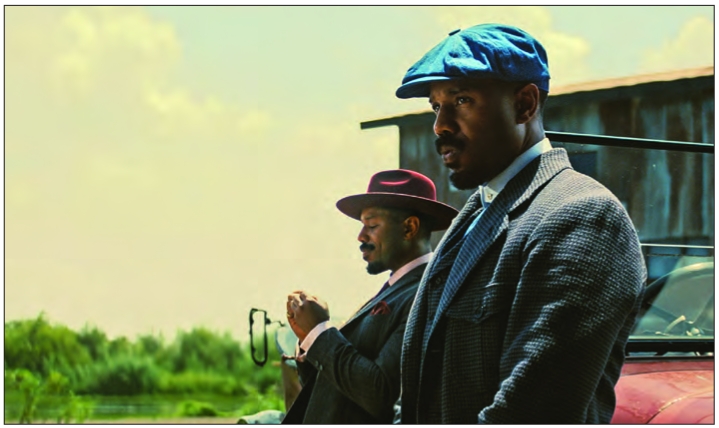
Michael B. Jordan as twins Smoke and Stack in Ryan Coogler’s “Sinners.”As the Academy Awards approaches its 100th anniversary, the question has lingered for decades: when would a Black-centered film — created by Black artists — fully dominate Hollywood’s most prestigious stage?
That long-awaited moment has finally arrived. “Sinners” has made Oscar history, earning 16 Academy Award nominations, the most ever for a single film in the Oscars’ 98-year history. The landmark achievement surpasses the previous record of 14 nominations, a distinction once shared by “All About Eve” (1950), “Titanic” (1997) and “La La Land” (2016).
Beyond the numbers, the achievement represents a cultural shift, one that recognizes Black storytelling not as an exception, but as central to cinematic excellence. Directed by Ryan Coogler, “Sinners” is a bold historical vampire drama that merges genre filmmaking with social commentary, political symbolism and emotional depth. Known for grounding spectacle in human stakes, Coogler once again demonstrates his ability to elevate popular cinema into meaningful cultural conversation. The film’s wide-ranging nominations spanning acting, directing, writing, producing and technical crafts cement his status as one of the most influential filmmakers of his generation.
The film earned a Best Picture nomination for producers Zinzi Coogler, Sev Ohanian and Ryan Coogler. For Zinzi Coogler and Ohanian, it marks their first Oscar nominations, while Ryan Coogler receives his second Best Picture nod following “Judas and the Black Messiah” (2021).
Coogler also picked up nominations for Best Director and Original Screenplay, bringing his career total to five Academy Award nominations; besides his previous Best Picture nomination, he was nominated for Original Song (“Lift Me Up” from “Black Panther: Wakanda Forever”).
In the acting categories, “Sinners” delivered several long-overdue milestones. Delroy Lindo earned his first-ever Oscar nomination for Best Supporting Actor for his commanding performance as Delta Slim, a role many critics consider one of the finest of his career. Wunmi Mosaku also received her first Academy Award nomination for Best Supporting Actress for her portrayal of Annie, a character whose emotional grounding anchors the film’s supernatural elements in lived reality.
Behind the camera, “Sinners” shattered barriers across multiple craft categories. Hannah Beachler extended her historic legacy by becoming the only Black woman ever nominated for Production Design, earning her second nomination after winning for Black Panther (2018). Her work continues to redefine how Black history, imagination and world-building are rendered on screen.
Cinematographer Autumn Durald Arkapaw made history as the first Filipina and the first woman of color nominated for Cinematography, a category that has long excluded women and filmmakers of color. Her nomination marks a significant breakthrough in one of the Academy’s most traditional fields.
With her 2026 nomination for Costume Design, Ruth E. Carter became the most Oscar-nominated Black woman in history, earning her fifth nod. Her celebrated career includes culturally defining work on “Malcolm X,” “Do the Right Thing,” “Amistad” and both “Black Panther” films. With “Sinners,” Carter adds yet another chapter to a legacy devoted to honoring Black identity, history and style through costume.
The film’s success also carries historic weight beyond individual accolades. Ryan Coogler becomes only the third Black filmmaker to be nominated in the same year for producing, directing and screenwriting, following Jordan Peele (“Get Out”) and Spike Lee (“BlacKkKlansman”). He is also the seventh Black director ever nominated by the Academy.
Zinzi Coogler enters the record books as the first Filipina producer and the third Black woman nominated for Best Picture. She and Ryan Coogler become the first Black married couple to earn an Oscar nomination in any category.
The couple met as teenagers, and their relationship blossomed during their college years at Saint Mary’s College of California, where Ryan played football and Zinzi supported his early filmmaking ambitions, famously purchasing essential screenwriting software like Final Draft. Married since 2016, they now operate as a creative and business partnership through their production company, Proximity Media. Their producing partner, Sev Ohanian, also makes history as the first Armenian American nominated for Best Picture, underscoring the film’s broad cultural resonance.
Meanwhile, industry insiders had predicted that Paul Thomas Anderson’s “One Battle After Another” might challenge “Sinners’” record, earning a strong 13 nominations. However, the film missed a widely expected Best Actress nomination for Chase Infiniti. Still, awards-season attention has turned to Teyana Taylor, who many — including this writer — predict will win Best Supporting Actress for her performance.
Taylor recently shared the surprising way she learned of her Oscar nomination during her opening monologue as host of “Saturday Night Live” on January 25. “This week has been very insane,” the 35-year-old told the audience. “I was nominated for an Oscar for ‘One Battle After Another.’ It is a dream come true.” She added with a laugh, “I found out the way every little girl dreams of: getting fitted for a bald cap next to Mikey Day.”
Later in the episode, Taylor appeared in a sketch wearing the bald cap and a fake belly, showcasing her comedic timing and dance skills, with Day appearing as the DJ.
The 98th Academy Awards will air March 15 on ABC following a packed awards season that includes the Grammy Awards on Feb. 1 and the NAACP Image Awards on Feb. 28. Yet across ceremonies, conversations and predictions, “Sinners” has emerged as the undisputed standout.
As “Sinners” reshapes Oscar history, its sweeping success signals a long overdue shift, one that honors Black artistry, leadership, collaboration and imagination at the highest level of Hollywood recognition.