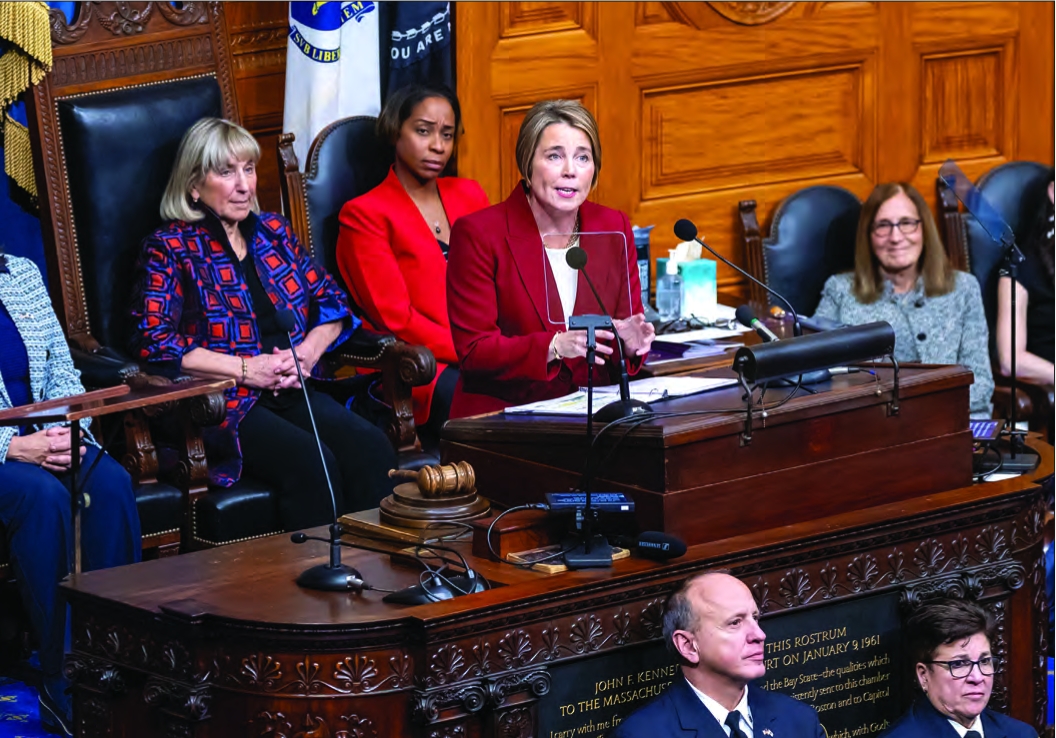
Gov. Maura Healey delivers her annual State of the Commonwealth address at the Massachusetts State House on Jan. 22.In her third State of the Commonwealth address, Gov. Maura Healey pushed back on federal policies from President Donald Trump and touted her administration’s goals in a speech that largely hinged on the hot-button topic of affordability.
“The reality is these are really tough times, people are feeling it,” she said at a joint session of the Legislature on Jan. 22. “Everything is more expensive — groceries, a cup of coffee, the new coat or boots you want, the hot water heater you need.”
In a nearly hour-long speech that covered administrative priorities ranging from housing to health care and energy to transportation, Healey promised new policies that would save dollars for Massachusetts residents. She also pointed to previous and ongoing efforts to stand up to Trump.
Affordability has been a prominent topic in recent months, locally and nationally, with pundits attributing the success of a host of Democrat victories in November to campaigns aiming to tackle the issue.
Trump, meanwhile, has alternatively promoted policies he has said will decrease prices for Americans and called the affordability crisis a “hoax” perpetrated by Democrats. According to data from the U.S. Bureau of Labor Statistics, however, the consumer price index, a measure of inflation, rose 2.7% over 2025; a December report from the Brookings Institute found that in metro areas nationwide, 20% of the middle class can’t afford to live there, even adjusting for local price variations.
During her remarks, Healey announced new policies and proposals around topics like energy, education and housing.
In reference to high energy costs, she said her administration would oppose any large rate hikes by utilities and pointed to an energy affordability bill she filed with the Legislature in May. That bill would limit extra charges and fees on utility bills, would aim to create new guidelines for the creation of power sources like geothermal and nuclear power and would add restrictions to the third-party competitive electric market, which has faced criticism for high prices and predatory business practices.
Additionally, Healey announced that the state will pay utilities to reduce all residents’ electric bills by 25% and gas bills by 10% in February and March.
“Middle-class families need the breathing room — everyone needs the breathing room — and they’re going to get it,” she said.
On the economy, Healey said her administration plans to connect residents to new opportunities through programs like apprenticeships in traditional building trades as well as fields like early childhood education, nursing and advanced manufacturing.
She also pointed to needs around expanded education opportunities, including a 2024 promise to offer universal pre-K in all gateway cities in the commonwealth by the end of 2026.
In her remarks she said she anticipates meeting that goal ahead of schedule.
The governor gave a nod to ongoing discussions about new high school graduation requirements, which the state has been developing after voters elected to remove the Massachusetts Comprehensive Assessment System, or MCAS, standardized tests as a graduation requirement through a 2024 ballot question.
A K-12 Statewide Graduation Council released a report in December with preliminary recommendations focused on a prescribed course of study, a new system of assessments including some tests and an end-of-highschool portfolio or capstone project and a set of additional requirements for post-secondary skills and planning.
Healey said she expects the new requirements, which must be finalized by the council and then go through a legislative process, to be “the best statewide high school graduation standard in the country.” Those recommendations have faced criticism from some Massachusetts teachers for adding new standardized tests to replace a system of standardized tests that voters shot down.
Healey also relayed her administration’s achievements over the past year, including ongoing efforts to increase the state’s housing stock.
In August, the governor’s office said over 90,000 homes had been built or were in development since her administration took office, a number touted while pointing toward a goal of constructing the 222,000 homes that her Housing Advisory Council estimated needed to be built between 2025 and 2035 to meet demand.
Experts have celebrated the progress, but with more caveats. In November, Boston Indicators, The Boston Foundation’s research arm, released its annual Greater Boston housing report card. Although researchers praised the nearly 100,000 units built, they were quick to point out that those units don’t count toward the statewide target, which is a forward-looking number.
Healey also noted increased performance on the MBTA under the leadership of General Manager Phil Eng, whom she appointed in 2023. Under his tenure, the MBTA has eliminated slow zones and expanded ferry services as well as nighttime and weekend services. In March, the state opened two long-awaited South Coast Rail lines. Outside the reach of the MBTA, regional transit systems are now fare free.
While the MBTA has seen gains in recent years, it is currently poised to face a fiscal cliff. The system faces a budget gap of $560 million in the fiscal year beginning in July and a $732 million shortfall the year after.
Healey celebrated her administration’s efforts to push back on federal policy shifts, including the release of extra funds to food banks and food access organizations when the Trump administration sought to freeze Supplemental Nutrition Assistance Program (SNAP) funding during the government shutdown last November.
She said in her remarks that she intended to increase state funding to local food banks to increase food access.
Healey also pointed to steps in September to promote vaccine access, after the Trump administration changed its recommendations about who should, by default, be recommended to receive the COVID-19 shot and other childhood vaccinations. At the time, the Healey-Driscoll administration broadly required insurance carriers in the state to continue to cover vaccines recommended by the state Department of Public Health. A separate standing order from the Department of Public Health allows pharmacies to continue to provide COVID-19 vaccines to Massachusetts residents age five and older.
The address came days after she officially declared her campaign for reelection through a video announcement that struck many of the same notes as her official remarks.
Healey capitalized on the national focus on the country’s 250th anniversary — which officials across Boston, the commonwealth and the country are preparing to celebrate this year — as she called for continued resistance to the Trump administration and its policies.
Healy pointed to Massachusetts residents who spurred the country’s fight for independence.
“Massachusetts has led the way for freedom and progress in this country,” she said. “It’s more than our history; it’s who we are. It’s our DNA.”
In closing her speech, she returned to the topic and referenced the portrait of Revolutionary War figure and early governor Samuel Adams, which she recently installed in her office, replacing an empty frame that hung there for the first three years of her tenure to represent the state’s unheard voices.
She quoted from a letter Adams wrote in early 1776, months before the signing of the Declaration of Independence, in which he told a friend to “never despair” as long as there is a spark of patriotic fire.
“That’s a good motto for this moment, that’s a good message right now,” she said. “The year ahead will bring more challenges, no doubt. It may get worse before it gets better, but we will stand strong. We will work to do the right things; we, together, will make the right decisions for our state. We’ll do what we have to do to make it better. And it will — I promise you — it will get better.”