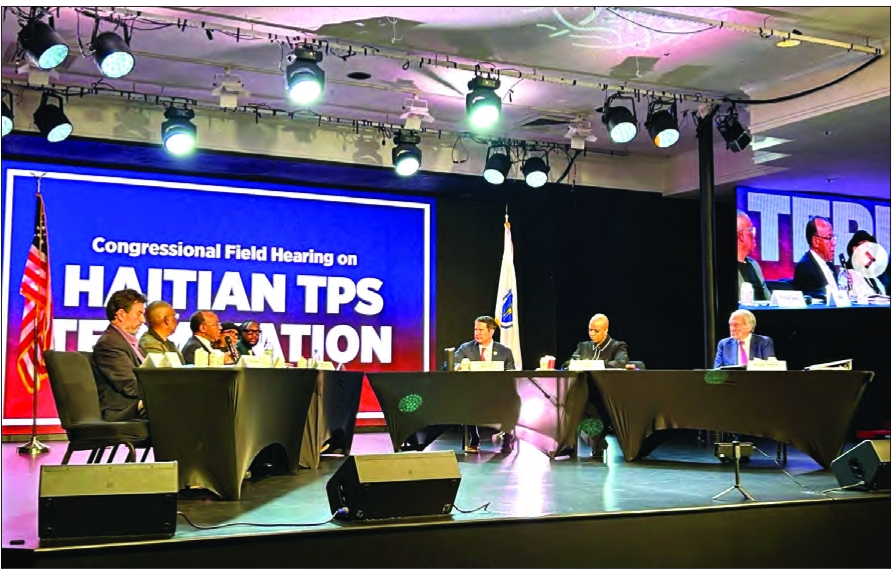
A Jan. 20 congressional field hearing in Boston was hosted by Sen. Ed Markey and Rep. Ayana Pressley. A sweeping federal pause on immigration visas for nationals of 75 countries took effect Jan. 21, intensifying fear and uncertainty across Boston’s immigrant communities under renewed mandates from the Trump administration.
The pause comes from a Jan. 14 State Department memo halting the issuance of immigration visas for nationals from 38% of the world’s countries. The memo states: “President Trump has made clear that immigrants must be financially self-sufficient and not be a financial burden to Americans. The Department of State is undergoing a full review of all policies, regulations, and guidance to ensure that immigrants from these high-risk countries do not utilize welfare in the United States or become a public charge.”
Boston is one of the nation’s most immigrant-populated cities and the policy has landed with particular force. More than a quarter of Boston residents are foreign-born, according to census estimates, with large populations from Asia, the Caribbean, Latin America and Africa. Entire neighborhoods depend on family reunification and immigrant visas, which now sit in limbo.
The directive offers no clear timeline for when visa processing will resume. This pause only affects immigration visas. Nonimmigrant visas like tourist visas will not be affected. The State Department advises individuals to continue to submit applications and attend appointments and interviews despite the freeze.
Bianca Rose, Boston’s Caribbean cultural advisor, who works closely with Caribbean communities, said the fear was immediate and visceral. Most Caribbean nations are on the list with a few exceptions like Trinidad and Tobago and the Dominican Republic.
Rose had a meeting with the city’s Caribbean leaders the night the order went into effect. “You can feel the fear and I’m not used to that,” she told the Banner.
Rose said one elder spoke of their coworkers being detained by Immigration and Customs Enforcement (ICE) agents, another spoke of being overwhelmed and worried. This time, she said, the uncertainty feels sharper because of how abruptly the pause was imposed.
Cape Verdean communities shaken
Boston’s identity has long been tied to migration. Today, Black immigrants make up a quarter of the city’s African-descended population, reshaping cultural, political and economic life. Those realities make federal immigration policy deeply personal at the local level.
Nowhere is that more evident than in Boston’s Cape Verdean community, one of the oldest Black immigrant groups in New England. Cape Verdeans have lived in the United States since at least the 1790s, when sailors and laborers arrived through the whaling industry and settled in port cities in Massachusetts and Rhode Island.
State Sen. Liz Miranda, who is ethnically Kriola and whose district includes Dorchester and Roxbury, said that long history is often overlooked in national debates.
“The Cape Verdean community, for those that don’t know, has had a history with the New England area since the late 1700s. We’re not new to America or to New England. We are deeply rooted here.
It [the immigration pause] was kind of like a slap in the face along with the fear that is coming from ICE,” said Miranda.
Massachusetts is home to more than 65,000 Cape Verdeans, with Boston serving as a cultural anchor. Miranda noted that many families remain transnational, maintaining close ties to relatives abroad while navigating changing immigration rules in the United States. Miranda knows this journey all too well — she comes from a mixed-status family. When she was 18, her father and brother were deported to Cape Verde. She did not reunite with them until she was in her 30s.
“I know family separation firsthand, and I just feel that for immigrants who have made Massachusetts and made the country, they keep seeing messages like they’re a problem that needs to be managed but they’re not that. They’re families, they’re workers, they’re neighbors,” she said.
“And I, for one, believe that our Kriolu community deserves dignity, respect and safety, but also fairness. There’s no reason for [Trump’s] recent changes other than what I call white supremacy and racism. Most of the countries on this list are of-color nations, many of whom have very positive relationships with the U.S.”
Haitian TPS on the brink
While the visa pause has cast a wide net, Haitian immigrants in Boston face a more immediate threat: the potential termination of Temporary Protected Status, or TPS, set to end February 3.
TPS allows nationals of designated countries experiencing extraordinary conditions such as armed conflict or natural disasters to live and work legally in the United States. Haiti has been designated for TPS since the devastating 2010 earthquake, with extensions granted amid continued instability, including the assassination of President Jovenel Moïse in 2021.
At a Jan. 20 congressional field hearing in Boston hosted by Senator Ed Markey and Representative Ayana Pressley, Brian Concannon, executive director of the Institute for Justice & Democracy in Haiti, warned that ending TPS would place thousands of lives at risk. Concannon described perilous conditions and emphasized that deporting TPS holders would not only endanger individuals but also destabilize already fragile systems in Haiti.
“We all know that it is not safe for families to return to Haiti,” Concannon said at the hearing. “Gangs control 90% of Portau-Prince, and large areas elsewhere. The country has the highest murder rate in the world and has the seventh highest Global Hunger Index score in the world.”
He also mentioned the U.S. State Department’s Level 4 travel advisory. It reads: “Do not travel to Haiti due to kidnapping, crime, terrorist activity, civil unrest, and limited health care.” The advisory has not been updated since July 15, 2025.
Boston’s Haitian community dates back decades, growing significantly during periods of political repression and economic hardship. Neighborhoods like Mattapan have become centers of Haitian cultural and civic life, with churches, businesses and advocacy groups forming a dense support network.
Jean Julien, Boston’s Haitian cultural advisor, spoke alongside Rose. He said the threat of TPS ending has forced families into impossible conversations.
“As you can imagine, it’s a very stressful moment. Not just for the folks who will be impacted once TPS ends on Feb. 3, but also for constituents that are Haitian citizens because they have family members who have TPS,” he said.
“You have families with kids that were born in the U.S. who’ve never been to Haiti, now they’re facing this situation where they may have to go back to a country they never knew, that’s unstable,” said Julien.
Economic consequences ripple outward
Concannon also stressed that TPS holders are deeply embedded in the U.S. economy, particularly in essential industries. In Massachusetts and beyond, Haitian immigrants make up a significant share of the workforce in health care, elder care and food processing.
“If TPS ends, hospitals lose workers overnight,” he said during a Zoom call. “So do nursing homes, home health agencies and processing plants.”
He pointed to chicken processing facilities and health care systems as sectors that would feel immediate strain. The impact would not be confined to Boston. Cities like Springfield, Ohio, where Haitian immigrants form a substantial part of the workforce, could also face economic disruption.
Sending people back, Concannon said, would mean deporting workers from stable jobs to a country where they are unlikely to find housing, employment or safety.
Courts and cautious hope
Despite the looming deadline, advocates see cautious reason for optimism. Concannon and Boston City Councilor Ruthzee Louijeune pointed to ongoing litigation challenging the federal government’s authority to terminate TPS.
One key case, National TPS Alliance v. Noem, has previously blocked terminations for several countries including Venezuela. Another case, Lesley Miot v. Trump, will be heard in Washington, D.C., before Judge Ana Reyes. A Boston-based case, Haitian Americans United Inc. v. Trump, remains on hold but could be reactivated depending on how federal courts rule.
“This is not a test of the law or facts, this is a test of the rule of law in the United States. Any judge looking at the law and the facts will determine that there is no justification and that the process is fatally flawed,” Concannon said.
“What people are worried about is the Supreme Court, which has shown a disconcerting willingness to abandon the rule of law, and basically everything I learned about constitutional law in law school.”
Louijeune said the uncertainty underscores the need for local action.
Local resistance and organizing
At the municipal level in Dec. 2024, Louijeune brought forward a resolution reaffirming the Boston Trust Act, which limits cooperation between Boston police and federal immigration authorities. The policy prohibits local law enforcement from detaining individuals for immigration purposes without a criminal warrant.
“We are working in partnership with communities to help people know their rights, which gets ever more difficult with a federal government that is just ignoring what has been established, federal constitutional law,” Louijeune said.
She also advises immigrants to get their paperwork — such as guardianship documents, power of attorney, financial and familial contingency plans — in order to prepare for the worst-case scenario.
At the state level, Miranda is working to advance the Safe Communities Act, legislation designed to curb state and local collaboration with ICE. The bills are led by Sens. Jamie Eldridge, Miranda, Joanne Comerford and Robyn Kennedy, along with Reps. Manny Cruz and Priscila Sousa.
Beyond legislation, community groups have focused on education and outreach. Both Louijeune and Miranda cited organizations like the Immigrant Family Services Institute (IFSI) and the Luce Network for distributing know-your-rights flyers across Boston neighborhoods.
Concannon urged residents to amplify their voices.
“Call your elected officials — including Republicans,” he said. “And encourage employers to call the White House. Everybody just needs to pull whatever levers they can.”
Cultural advisors Rose, Julien and Gladys Oliveros also encouraged immigrants to make use of city resources, particularly the Mayor’s Office of Immigrant Advancement (MOIA). Rose highlighted Immigrants Lead Boston, a program designed to help immigrant residents navigate civic systems and build leadership skills.
MOIA did not respond to requests for comment. IFSI also declined to comment, citing safety concerns.
Miranda said, “I don’t want our community to be as panicked, because when we’re controlled and calm, when we use our fear and turn it into purpose and power we can hold each other together.”
ON THE WEB
To learn more about the city’s immigrant initiatives visit boston.gov/departments/immigrant-advancement