
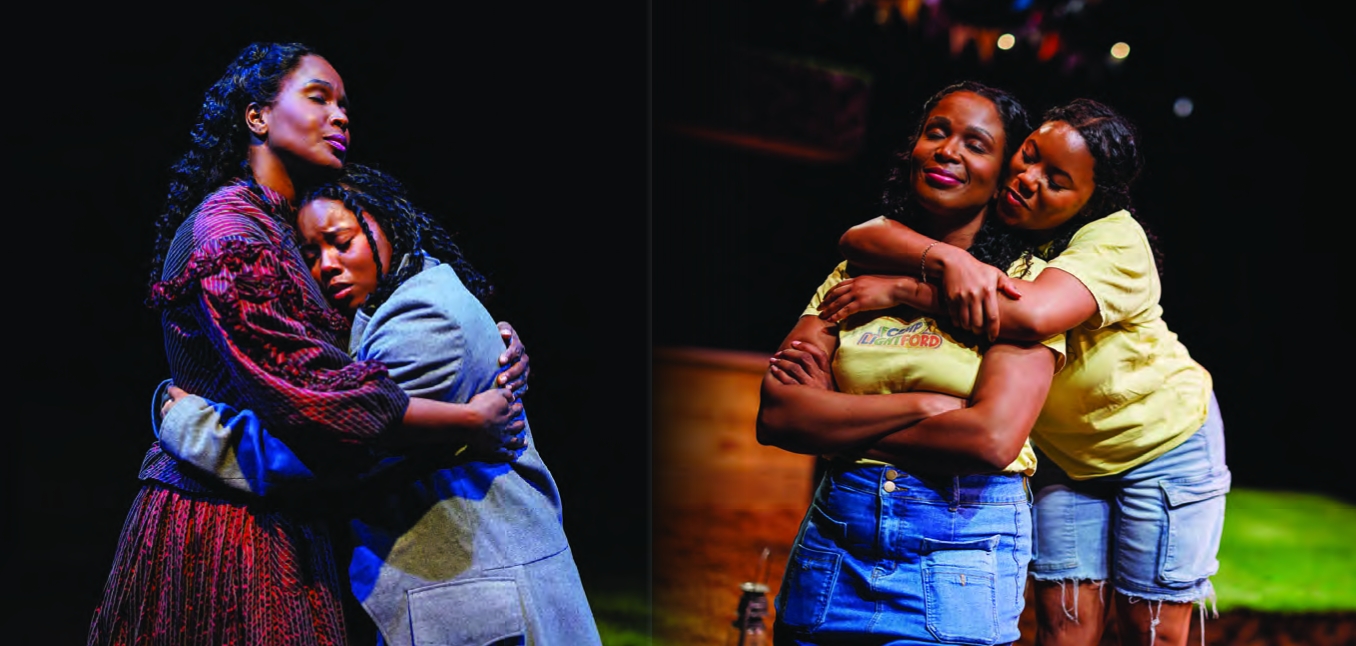
Yetunde Felix-Ukwu and Victoria Omoregie as mother and daughter in the 1830s (left) and present day (right).
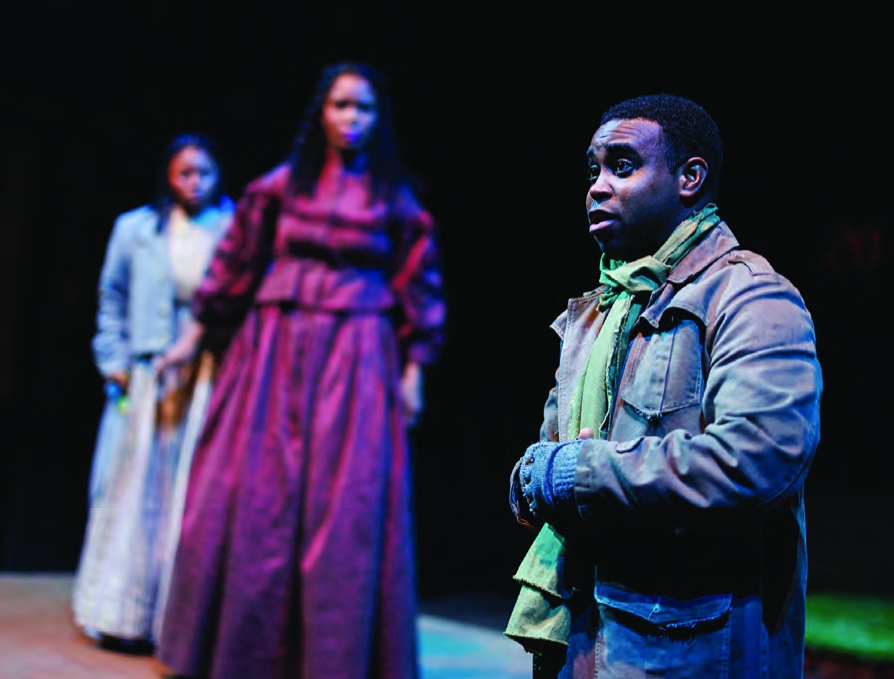
Marc Pierre (foreground) with Victoria Omoregie and Yetunde Felix-Ukwu in “The Great Privation (How to flip ten cents into a dollar).”
The title of Nia Akilah Robinson’s 2024 play, “The Great Privation (How to flip ten cents into a dollar)” distills its theme: the great gaps in justice experienced by Black people in America starting with enslavement and their resourcefulness in rising from these injustices.
On stage through Jan. 31 at the Modern Theatre in Boston with pay-what-you-want tickets, “The Great Privation” is a joint production by Company One Theatre in Boston and Woolly Mammoth Theatre Company in Washington, D.C. Like its title, the play is a model of compression: within an intermission-free 90 minutes, the production spans two centuries — from the 1830s to the present day — and explores how retrieving lost family and community histories can help set things right.
Continuing the storytelling offstage, Company One provides a fine print program of informative essays and invites audience members to explore their own family and neighborhood histories through free events with a host of partners, including the Boston Public Library Community History Department, the Museum of African American History and Everyday Boston.
Like “The Meeting Tree,” by Boston playwright B. Elle Borders, which Company One introduced with a memorable world premiere last summer at the Strand Theatre in Dorchester, “The Great Privation” intertwines relationships between two Black women and their ancestors across two centuries of American history.
Robinson’s play premiered in 2024 at the 64-seat Theatre503 in London and a year later Soho Rep staged its Off-Broadway debut. Woolly Mammoth Theatre presented the play in October and Company One’s staging has the same cast and production team. Directed by Mina Morita, the play unfolds in eight scenes that switch with astonishing speed between three days in 1832 — Oct. 21-23 — and three days in the present time: July 2-4.
The 185-seat Modern Theatre provides an intimate showcase for the production, with audience seating that surrounds the stage on three sides and, despite its name, a warm old-world setting for Gisela Estrada’s timeless, earthbound set. A carpet of brown soil borders platforms of green turf and wooden planks to evoke both the graveyard of an African Baptist church in 1832 Philadelphia and a present-day sleepover camp for children. Versatile lighting by Yannick Godts conjures starry nights, dark mists conducive to apparitions, show-biz lighting to highlight an imagined dance in African heaven and a summer camp in full swing, and with equal dexterity illuminates actors’ faces as they express horror, joy, tenderness, courage and newfound agency.
Athena Parkman’s time-traveling costumes vary from ruffled, floor-length dresses to casual camp garb for the women; and for the men, attire that varies from a gravedigger’s work jacket and a future doctor’s tailored suit to blazingly red party togs.
In both eras, Yetunde Felix-Ukwu is the mother and Victoria Omoregie is Charity, her teenaged daughter. As the play opens, they are in the churchyard standing by the fresh grave of Charity’s father.
Her mother, who runs a candy-making business, has purchased the grave to secure a proper burial for her husband. She tries to quiet and cajole her restless, hungry daughter, reminding her that their three-day vigil will ensure his spirit’s safe return to ancestors in Sierra Leone. But as men from the local medical school arrive to dig up his body, the mother’s intent is clear: after three days her husband’s decomposing remains will no longer be of use for research.
Zack Powell’s John is a medical student with a cool, business-like manner. Marc Pierre’s Cuffee is a janitor at the school, and with dignity states that his goal is to advance science. The mother pays them to leave the graveyard.
In the present, the property is a sleepaway camp that employs Charity and her mother as counselors. Powell’s John, their fellow employee, is a wound-up jokester; and Pierre’s Cuffee is a harried supervisor.
As co-workers, the chemistry between mother and daughter grows along with — an anachronism at a time when a 16-year-old would be considered a woman. In contemporary scenes, Omoregie’s nuanced Charity evolves into a young adult. When an heirloom turns up, triggering revelations and a surreal scene in which past and present converge, Charity holds her own. Although this pivotal passage is underwritten and almost veers into chaos, the actors pick up where the script leaves off and convincingly deliver its wit and wisdom. The play concludes with a satisfying high.
ON THE WEB
Learn more at companyone.org/the-great-privation