Keanna S. Saxon officially launched Kidoogo Productions in 2022. Keeana S. Saxon remembers the feeling that prompted her to switch the channel in the middle of a children’s television show she was watching with her then-toddler daughter. In the show, a main character is an adversary and their sidekicks were colored dark. In other programs as well, Black characters were often side characters or were cast with negative stereotypes of being “silent or sinister.”
Saxon also remembers being devastated when her daughter shared with her that not looking like Elsa from the Disney movie “Frozen” made her sad.
She recalls as well being surprised that the lack of positive representation for Black children was still a problem decades after her own childhood.
“I was only raised on very few shows. And so, I was just appalled that the only thing that had improved was the number of shows, but not actually quality when it comes to seeing representation,” said Saxon.
It was then that she decided, “I’ve got to do something about it.”
In 2022, she officially launched Kidogo Productions. Meaning “little” in Swahili, Kidogo offers “wholesome, educational content for children whose Black
characters wholeheartedly honor the African diaspora, with the goal of
connect[ing] with and have a positive impact on children from all across
the world while affirming Black people and their cultures,” Saxon said.
In
the current programming landscape, “We’re not characters who actually
drive the plot,” she said of Black people. “Or you’re getting really bad
representation, which is stereotypes that would damage our identity.”
In
the instances where those problems don’t exist, it’s rare to find
programming that’s both affirming of Black identity and is high quality
in terms of its educational value, she said.
“You’re
getting one or the other — you’re getting representation, and maybe
because of a lack of resources, the quality is not there for the
production or the educational content.” Or the opposite might be true.
“You are getting educational content, [but] you’re getting [little or]
no representation.”
As
a small creative studio, the company creates live experiences, fun
games and original content (activity books, backpacks, books), along
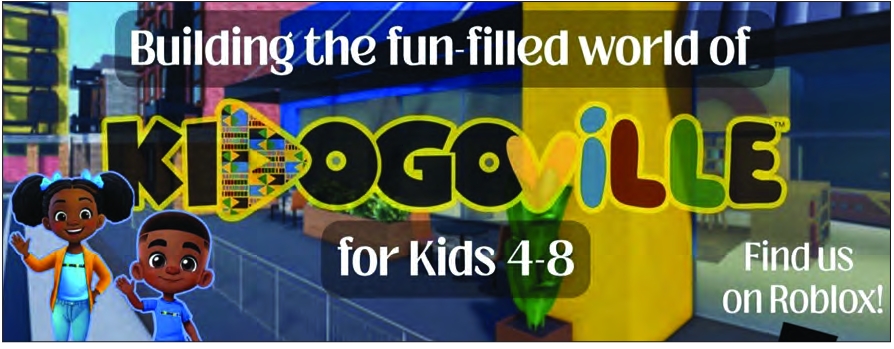
with building a digital world on the online game platform Roblox. Called
Kidogoville, the game is intended to offer a space “where learning is
joyful, culture is celebrated, and every kid gets to see themselves as
the hero of the story,” according to the company’s website.
The
company has hosted live experiences throughout the city at various
events, such as the annual African Festival of Boston and at the Boston
Art & Music Soul Fest Inc (BAMS). It has also held events at the
Museum of Science to help audiences learn more, for instance, about
Black identity and hair.
As
part of its work, Kidogo recently put on a live event to celebrate
Kwanzaa. “We took each of the seven days and we created these
experiences where kids will be able to really get into the principle,
through different processes,” Saxon said. The kids read a book about
Kwanzaa and then as a group participated in an immersive Kidogoville
activity that included music, movement and games inspired by the seven
principles and Adinkra symbols. “The kids just stuck with us.”
That
level of engagement is something that Saxon is constantly looking for
to know if Kidogo’s work is resonating with audiences.
“One
of the things that I’ve said often is that I’m looking for the twinkle
in the eye of the children,” she said. “I think there’s quite a lot of
data out there that talks about achievement gaps, test scores, and the
disparity and resources for different schools…but it really comes down
to whether the children’s eyes will light up when they are experiencing
your content,” she said.
That emotional connection is also why it’s important to have safe spaces that center Black youth, Saxon said.
“Anything
that centers Blackness is torn apart for no other reasons than racism,
bigotry, prejudice and greed,” she said. Taking inspiration from the
past and fighting back however possible against such attacks is crucial
for Saxon. “We need to be able to find a place of safety, of refuge. And
for people like me, who are in this creative and educational space, we
are making sure that Black love and Black education is still [the]
epicenter, and still as high quality as ever,” she said.