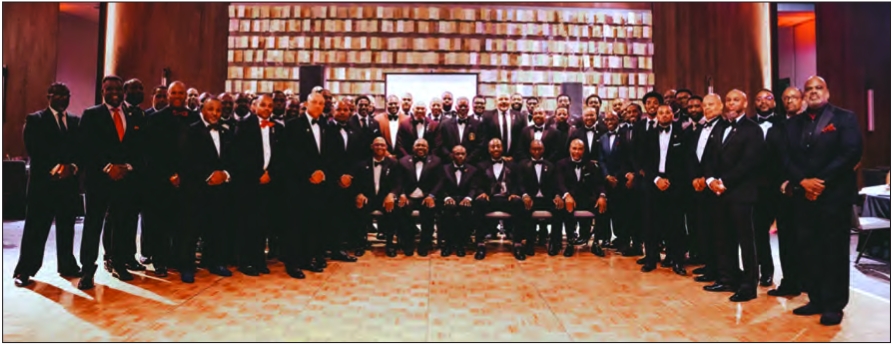
Members of the Boston alumni chapter of Kappa Alpha Psi Fraternity at their 75th Anniversary celebration. This January, Kappa Alpha Psi Fraternity, Inc. hits a milestone anniversary, celebrating 115 years of Black excellence.
The fraternity was founded on Jan. 5, 1911, at Indiana University Bloomington. Despite being formed in a climate of racial exclusion, the Kappa Constitution has never contained any clause that either excluded or suggested the exclusion of a man from membership merely because of his color, creed or national origin.
Famous alumni of this fraternity include Cedric The Entertainer, Marc Lamont Hill, John Singleton, Colin Kaepernick, Stan Lathan, Robert “Bob” Johnson, Lance Gross, Rev. Jamal Bryant and Wilt Chamberlain.
André Morgan is the polemarch, or head, of the Boston Alumni Chapter of Kappa Alpha Psi. He became connected to this fraternity as a member of the Kappa League program as a youth and he also had relatives who were members.
The Boston Alumni Chapter has an active and engaged membership of more than 60 brothers, with additional brothers who support the chapter through varying levels of participation.
Morgan said the celebration of the fraternity’s 115th anniversary is a moment of gratitude and recommitment as it honors those who came before them by continuing the work today and preparing the way for future members.
“One hundred fifteen years represents resilience, relevance and responsibility. Kappa Alpha Psi was founded during a time of exclusion and discrimination, yet it’s endured by remaining committed to excellence, unity and service. So, this milestone is not just about longevity. It’s about impact across generations,” he said.
Morgan credits the fraternity for shaping him into the man that he is today.
“Kappa Alpha Psi has shaped me both personally and professionally by grounding me and a lifelong commitment to excellence in service. Personally, it
has provided brotherhood, men who hold me accountable, support my growth
and remind me that leadership is about responsibility, not position,”
he said.
“Professionally,
[the fraternity] has taught me how to lead with integrity, collaborate
across differences and serve with purpose. Skills [it has helped me]
develop include communication, strategic thinking, mentorship, and
community engagement,” he said. “Kappa didn’t just help me succeed, but
taught me why success matters, and who it’s meant to serve.”
Since
the fraternity’s work is rooted in service and sustained by
relationships, it is heavily involved in community service for the city.
Some
of the community service initiatives the Boston alumni chapter has
hosted include its Kappa League youth program, along with prioritizing
youth mentoring, college and career readiness, voter education and
partnerships with local schools and nonprofits for long-term impact that
helps young people and families throughout the city.
When
asked what he believes his fraternity is known for within the Divine
Nine collective, Morgan said that he feels that they are much stronger
together.
“The [Divine
Nine] collectively, [we are] service-oriented organizations and while
we’re strong individually as organizations, we’re much stronger
together. …We create opportunities for communities, we offer services
and programs and we do the work that uplifts our communities instead of
keeping our community stagnant,” he said.
He also said what he believes the fraternity’s legacy will continue to be in the next 115 years.
“The relevancy will continue.
I
think the issues that give rise to Kappa Alpha Psi — access, equity,
leadership development [and] community uplift, they still exist. They
will likely continue to exist, and our relevance comes from evolving
while staying grounded in our core values. We prepare men to lead
ethically, serve faithfully and engage thoughtfully in a complex world.
And I see that continuing for the next 115 years,” he said.
Dylan
Bell is president of the Theta Iota Chapter of Kappa Alpha Psi
Fraternity, Inc., which includes members from the Massachusetts
Institute of Technology (MIT), Harvard University and Tufts University.
He became connected to this fraternity as a legacy; his father crossed
at the University of California in spring 1989.
“Kappa
has been in my life for as long as I can remember. I remember being a
little kid and my dad always had his cane right in the front of the
house and I would walk by it every day, just stare at it, and then go to
class, go to practice or go to school,” he recalled.
“My dad’s line brothers and other brothers that he met were very, very instrumental figures for me. I called them my uncles.”
Bell
said his father encouraged him to make the decision to join the
fraternity for himself. He credits the members at his school for drawing
him in.
He also said
celebrating the 115th anniversary of his fraternity is particularly
special to him as he had the opportunity recently to go to the Bahamas
to celebrate the National Founders Day convention, where 200
undergraduate leaders across the fraternity were given sponsored trips
to be with the Grand Chapter Leadership, the highest level of leadership
in the fraternity, for a week, along with a leadership summit.
“So
it was a special challenge day for me, not only being the 115th, but
also being able to experience the inner workings of fraternity in a
different way and grow as a leader and both celebrate, have fun, have a
good time, but also mature and learn valuable things for my career [and]
for my personal life,” he said.
Bell also credits the fraternity for helping him to become the man that he is today.
“It
helped me grow up and really change my life. When I was a sophomore, I
was applying for internships and the person who interviewed me, took a
chance on me, was also a fraternity brother,” he said.
“So
just having that opportunity and then having to also live up to the
expectation [of] someone sticking out their neck for me was very
formative at 19. You have to honor the commitment you made and also
honor the fact that someone’s sticking up for you,” said Bell.
Some
of the community service events his chapter has held include the Kappa
League youth mentorship program, work with the Paul Robeson Institute at
Northeastern University, a line dance-a-thon workshop with the Tufts
University African American Foundations and Roots Organization, the
Tufts National Society of Black Women in Medicine, Tisch College and the
Resilient Sisterhood Project of Boston to raise awareness about
reproductive justice, medicine and Black maternal health.
When
asked what he believes his fraternity is known for within the Divine
Nine collective, he said it would be its achievement, which he believes
drives his fraternity.
“Our
fundamental purpose is to encourage honorable achievement in every
field of human endeavor. So, when we think of achievement, it doesn’t
have to just be accolades or things of success, it’s achievement as a
community member, as a student, as a businessman, achievement in
whatever thing that we deem fathomable and possible,” he said.
“That’s
the thing I think helps us continue to drive as we work with other
members of the Divine Nine organizations, just the idea of achievement
at the highest level. I think that’s what we’re always striving towards
is to be the best we possibly can be, not for ourselves, but for the
betterment of other people.”
Bell said he believes innovation will inform the fraternity’s legacy during the next 115 years.
“Just
innovation from Kappa. I think that’s the great thing about [the
fraternity] is there’s not one right way to be a Kappa. There’s not a
monolith, so everyone’s kind of welcome to bring what they’re good at:
their talent, their strength, bring that into the organization and allow
that to continue to grow [the] organization,” he said.
“So hopefully in the next 115 years, we’re continuing to serve our communities at an even higher level.”