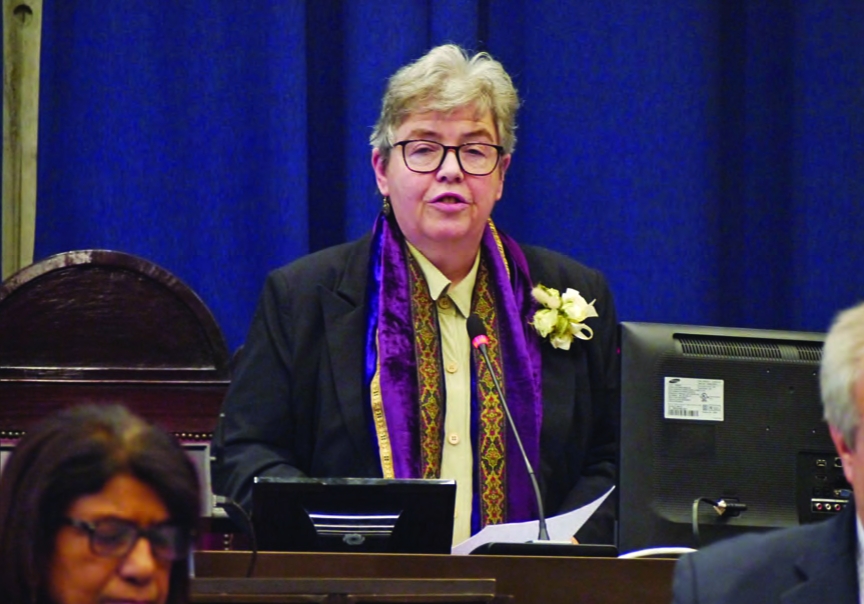
District 9 Councilor Liz Breadon addresses the Council after being voted in as president of the body Jan. 5 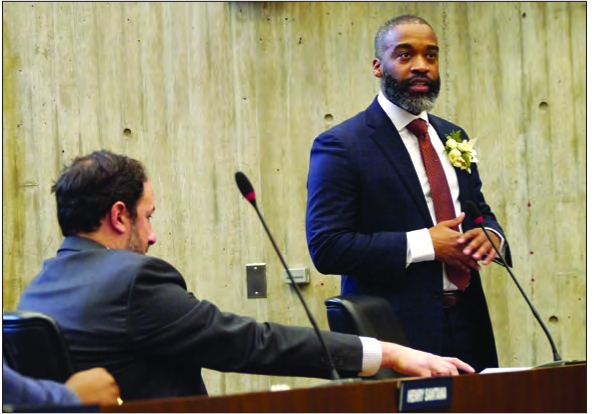
District 4 Councilor Brian Worrell addresses his colleagues during the body’s Jan. 4 meeting as councilor Ben Weber looks on.
Contests for the council presidency have often been contentious, and this year was no exception. Shortly after the Nov. 4 election last year, District 1 Councilor Gabriella Colletta-Zapata announced she had the seven votes necessary to secure the presidency of the 13-member body. But her announcement, in retrospect, was premature.
At the same time, District 4 Councilor Brian Worrell began meetings with each of his council colleagues, seeking their support for his candidacy. He made no public pronouncements, but by the eve of the Council’s Jan. 5 first meeting of the year, Worrell had secured seven commitments. He called Colletta-Zapata, who then publicly announced she was withdrawing her candidacy for the post.
In the hours that followed, a cadre of councilors loyal to Michelle Wu orchestrated a coup that saw District 9 Councilor Liz Breadon secure a majority of votes.
Standing before her Council colleagues in the Iannella Chamber Jan. 5, Breadon made an admission that raised eyebrows among the spectators filling the seats there.
“I didn’t know I’d be standing here this time yesterday,” she told her colleagues, in effect admitting that she had not planned on seeking the Council presidency.
What happened?
According
to councilors and Council staff, District 5 Councilor Enrique Pepen and
District 8 Councilor Sharon Durkan, both of whom left the Wu
administration to run for their seats and were supported in their
candidacy by Wu, came to Breadon’s Brighton home on Jan. 4 and asked her
to run for the presidency, pledging their support.
While
Worrell had amassed support from a broad range of councilors, including
Pepen and councilors who often clash with the Wu administration —
District 2 Councilor Ed Fynn and at-large Councilor Erin Murphy — Wu’s
supporters on the Council sought to solidify support for Breadon and
sideline the mayor’s critics.
On
the Council floor Jan. 5, at-large Councilor Julia Mejia called on her
colleagues to assert a degree of independence from the mayor, cautioning
them that they are widely perceived to be a rubber stamp.
“It’s
all about political courage at this point and an opportunity for us to
demonstrate what type of body we’re going to be,” she said. “The fact
that Councilor Breadon just announced that she just learned that she was
going to be up for this position should let us in behind the veil in
terms of how politics is getting done in this day and age. If that does
not alarm you as you decide what vote you’re going to make today —
all eyes are on us. Are we an independent body willing to take a stand
and speak up or are we going to continue to let other people make
decisions for us.”
Despite
Mejia’s plea for independence, Breadon won the vote, supported by
Pepen, Durkan, District 6 Councilor Ben Weber, Coletta Zapata and
at-large councilors Henry Santana and Ruthzee Louijeune. Backing Worrell
were Flynn, District 3 Councilor John FitzGerald, District 7 Councilor
Miniard Culpepper, and atlarge councilors Mejia and Erin Murphy.
While
the vote did not at all split along racial lines, it did underscore
differing visions councilors have over the mayor’s influence on the
body.
“It was a bad
look all the way around,” said political strategist Doug Chavez, who sat
in on last week’s Council meeting. “Regardless of who’s in the mayor’s
office, you need checks and balances. You need a council that’s going to
keep the mayor in check.”
What’s at stake
When
Michelle Wu ran for mayor in 2021, she ran on a progressive platform
which included support for police reforms, giving the Council the power
to make line-item changes to the city budget and a hybrid
elected/appointed school committee. While the Council remained committed
to that agenda, Wu drifted into more centrist positions that brought
her into conflict with the council.
During
the 2023 Council election, Wu backed candidates who were more closely
aligned with her centrist positions including Santana, Pepen, Durkan and
Weber. Added to that cadre of councilors Louijeune and Coletta-Zapata
frequently vote with the mayor on controversial issues.
In
the coming year the council will likely wrestle with the city budget
and the challenges posed by declining commercial real estate tax
revenue, the ongoing Boston Police Department collaboration through the
Boston Regional Intelligence Center (BRIC) with federal agencies many
say have been weaponized in the Trump administration’s push to deport
immigrants and Wu’s push, outlined in her inaugural address, to limit
busing — a move education activists fear may lead to greater segregation
and inequality in the city’s schools.
Observers are questioning whether the Council will serve its role providing checks and balances to the mayor’s administration.
“On
the City Council, like in Congress, people are supposed to represent
the people that elect them,” said Garrison Trotter Neighborhood
Association President Louis Elisa. “There should be a more symbiotic
relationship between the Council and the people who elect them than
between the Council and the mayor.”