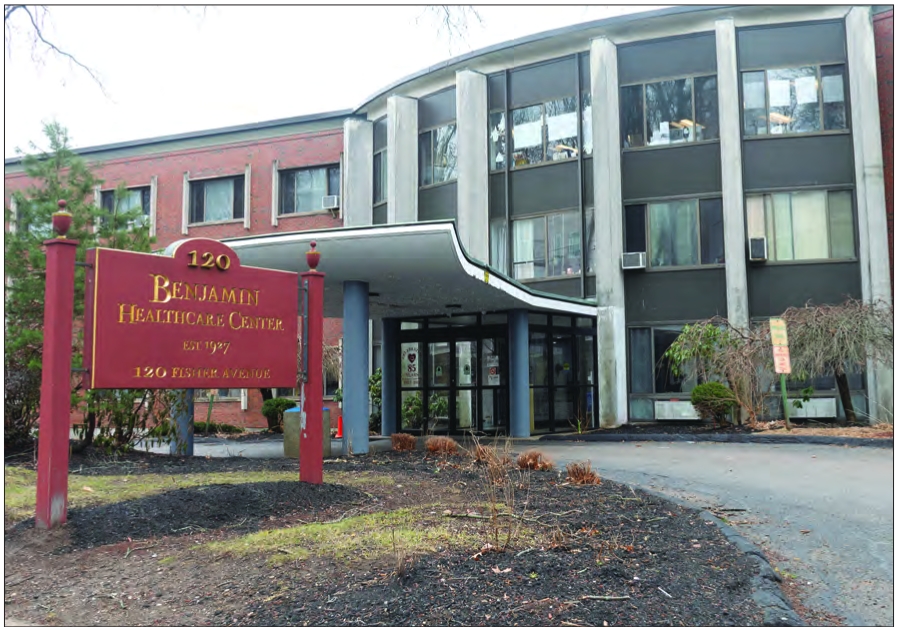
The Edgar P. Benjamin Healthcare Center on Mission Hill, shown March 6.
Benjamin
Healthcare Center in Mission Hill. The sale of the Edgar Benjamin to
Allaire Health Services is expected to close Feb. 1, even as some
community members have continued to raise concerns about Allaire’s
suitability to take over operations.
After nearly two years, the sale of the Edgar Benjamin Healthcare Center to Allaire Health Services is expected to close by Feb. 1, according to attorneys for the receivership overseeing the Mission Hill nursing home.
“I understand we’re getting close to the end,” said Justice Christopher Belezos, who presided over the Jan. 9 status conference in Suffolk County Superior Court.
The court-appointed receivership, which has overseen operations of the facility since April 2024, is expected to terminate Feb. 9, marking the end of a protracted legal process that prevented closure of the facility.
That receivership has been headed by Roxbury attorney Joseph Feaster, since the Mission Hill nursing home’s then-administrator was forced out amid allegations of mismanagement that left staff without pay.
Feaster announced his selection of Allaire Health Services, a for-profit long-term care company based in New Jersey, in late July. He first announced in April that he was considering a sale of the facility and transfer ownership to an outside organization as a strategy to keep it operating. Allaire operates 23 facilities in New Jersey, Pennsylvania and Vermont.
One lingering question is what will happen to any money left over from the sale?
According
to a document filed with the court in August by Feaster, when he
officially recommended Allaire take over ownership and operation of the
facility, the New Jersey company proposed a bid of $6.5 million.
Much
of that money will go toward paying off previous financial obligations
of the facility, including a lien placed on the property in November
2024 by the state Executive Office of Health and Human Services to
ensure it recouped any funds the court required it to advance to the
facility through MassHealth during the receivership.
But
at the Jan. 9 conference, attorneys for the receivership said they
expected somewhere between $1 million and $1.5 million remaining after
those payments.
Who will be responsible for the money — and what will be done with it — is still in flux.
“Who’s going to get that [money]?” Belezos said at the conference. “Who owns the building?”
Normally
a board for the Edgar Benjamin nonprofit would be responsible for
dealing with the residual funds and winding down the organization as
ownership of the property and operations transfer to Allaire, but at the
time the receivership was announced, the board was composed of three
members, including the ousted former administrator Tony Francis.
With
no current active members of the board, the receivership and the
Attorney General’s Office, with oversight by the court, are left trying
to decide who will be responsible for those funds and how they will be
used.
At the status
conference, Freeley said the Attorney General’s Office had proposed that
Feaster seek three independent members to constitute a new board that
can oversee the use of the funds and wind down the organization. That
board would also be responsible for attending to existing lawsuits in
which the center is involved, including a lawsuit against Francis
alleging he stole and embezzled at least $3 million from the Edgar
Benjamin.
Attorneys
for the receivership said that Feaster had begun to search for volunteer
board members but so far had little luck. Instead, they floated the
idea of a new receivership that would be responsible for the dissolution
of the nonprofit entity.
It
was a solution Feaster said he supported — believing it would be more
effective and efficient to have one person handling the
issues, not a collective board that might have to hire someone to handle
the administrative pieces — but one that Belezos didn’t want to
endorse.
“What we
don’t want is another receivership,” Belezos said at the status
conference. “If we have to, we have to, but that is not an ideal
solution.”
If no other
solution is found, the attorney general’s office said it could petition
the state’s Supreme Judicial Court to involuntarily dissolve the Edgar
P. Benjamin Healthcare Center nonprofit. If approved, the court would
authorize the administration of the remaining funds to other similar
charitable purposes.
As
the sale marches to its conclusion, Oren Sellstrom, an attorney
representing the guardians of residents who originally sued for the
receivership, filed a statement with the court on Jan. 8 announcing that
an agreement had been signed by Allaire at the end of October, stating
the company would not unilaterally displace any current residents of the
facility. Sellstrom, in his capacity representing families at the
facility, has long voiced his desire to see written protections for
residents throughout the sale process.
Throughout
the receivership, the process has often been contentious, as Feaster
and his team butted heads with various other players — with the Attorney
General’s Office, which often pushed for more oversight of the process;
with Delicia Mark, whom Feaster hired as the center’s administrator in
May 2024 and who later raised her own allegations of mismanagement
against Feaster and his executive assistant Dianne Wilkerson [Mark left
her role heading the facility last year]; and most recently with the
Mattapan Community Development Corporation and Kenya Hanspard, who has
served as the center’s medical director.
The
Mattapan CDC and Hanspard, along with others, filed a competing bid to
purchase the center that Feaster ultimately rejected. They alleged in a
motion to intervene in the proceedings in October that the bid process
was mishandled and that a sale to Allaire could harm residents at the
facility. Justice Anthony Campo, who was overseeing the case at the
time, rejected their motion.
The
receivership is facing new criticism by guardians of residents at the
facility, who expressed frustration that the sale to Allaire, though it
went through a public comment process, felt like it was treated as a
“done deal,” said one guardian, who requested not to be named due to
concerns of retribution against their family member who resides at the
Edgar Benjamin.
Guardians
also raised concerns about the suitability of Allaire to operate the
Edgar Benjamin, expressing worries that it would mean a reduced quality
of care for residents.
“My
concern taking it from nonprofit status to for-profit status — and even
just a budget line within a larger corporation — is that that’s all it
becomes: How can we squeeze money out of this?” the Edgar Benjamin
guardian said. “They lose sight that there are people in here, people
with needs.
They lose sight that this is a historic institution.”
In other states, facilities owned by Allaire have faced complaints and violations.
In
Vermont, three facilities Allaire acquired at the end of 2024 faced
problems in recent months, including resident neglect, medication errors
and staffing shortages, according to an October report by nonprofit
news outlet VTDigger.
That
article, citing a state inspection, reported one Allaire facility, St.
Johnsbury Center for Living and Rehabilitation, was found to have
violations at the level of “immediate jeopardy” due to neglect cases and
instances of “widespread system failure.” That state inspection, from
July, identified staffing shortages, a lack of systems for care planning
and medication management, breakdowns in communication and an instance
where the director of nursing reported having heard about an incident in
which a certified nursing assistant allegedly slapped a resident across
the face that was never reported to the state.
A
report assembled by the Dignity Alliance of Massachusetts, a nonprofit
that advocates for older adults and people with disabilities, also
identified penalties levied against Allaire facilities in New Jersey for
widespread staffing violations and legally mandated admissions freezes.
Facilities owned by the company have faced several civil and malpractice lawsuits in recent years.
In
a statement, a representative for Allaire said the company acknowledges
the reporting from VTDigger, but said the facilities they took over had
been
previously underperforming. According to the VTDigger report, the three
owned by Allaire were part of a group of nine owned by Genesis
HealthCare, a nursing home operator that faced its own concerns and
settlements. The ratings those facilities received, he said, “reflect a
point in time — not the pathway to improvement.”
“We
are following things with The Benjamin very closely, and we are
completely confident in our ability to engage with the resident
community and broader market to elevate performance and patient/
resident experience within and through the facility,” he said in the
statement.
Feaster, in an interview, said he stood by his recommendation of Allaire to take over operations of the facility.
“If
you tell me that there’s a nursing home in this country that doesn’t
get violations, or [immediate jeopardy findings] from CMS and all of
them, I want to find that nursing home operation,” he said.
Since November, Alex Ringkamp, an interim administrator affiliated with Allaire, has been running the facility.
During
that time, a second guardian of a resident at the Edgar Benjamin
alleged interactions with leadership at the facility had turned hostile.
The guardian said they were told they should feel lucky their family
member was at the facility and that if they didn’t like how things were
being run, they should leave.
The
first guardian said that in conversations with staff she had heard that
the facility’s leadership was discussing intentionally limiting the
amount of some supplies like incontinence pads.
But,
with declining openings in nursing home beds, and few that have a
reputation for cultural competency — the Edgar Benjamin was first opened
to serve Black residents in the 1920s when they might have been shut
out of other long-term care facilities — the guardians who spoke with
the Banner said leaving is neither easy nor appealing.
“That’s
one of the reasons why this home exists, to have something in our
community,” the first guardian said. “It is the last African
American-owned and operated home in New England — not just Boston or
Massachusetts, but New England.”
With
the sale set to close in less than a month, the guardians said they
aren’t fighting to stop the transfer, but rather to keep the Edgar
Benjamin’s new owners accountable.
“This is about dignity for vulnerable elders,” the second guardian said.