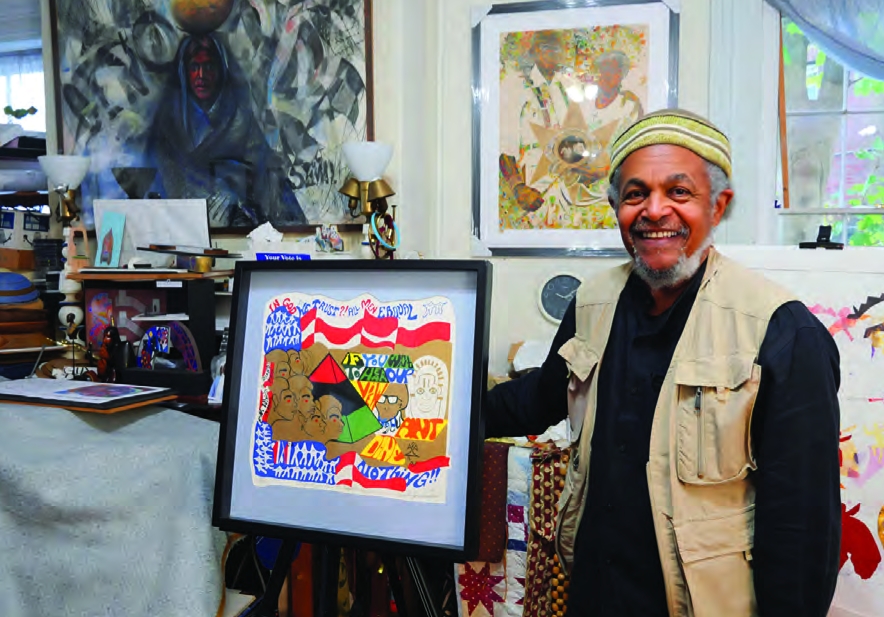
Napolean Jones-Henderson at his home studio in Roxbury, Mass.Napoleon Jones-Henderson was born in Chicago, Illinois, in 1943, to Minnie Maxine Washington and Woodrow Lewis Henderson. From his earliest days, he was enveloped in the warmth and resilience of family, growing up in the historic Bronzeville neighborhood on Chicago’s South Side.
As the family grew, Napoleon became the eldest of eight siblings. During his teenage years he worked at his grandfather’s store, learning entrepreneurship and self reliance. Later, when his mother married John Unger, he became the oldest of thirteen siblings, carrying that role with steadiness and heart.
Napoleon’s artistic talent shone brightly from a young age. While attending George Washington Carver High School he was introduced to weaving by an art teacher. After high school, he received a scholarship to study at the Sorbonne Student Continuum-Student and Artist Center in Paris, France, where he was immersed in an independent study program in French art history and figure drawing. Upon returning to the United States, he pursued his passion at the Art Institute of Chicago, earning his bachelor of fine arts in 1971.
In 1968, amid the height of the Chicago Black Arts Movement, he became a founding member of the artists’ collective AfriCOBRA (African Commune of Bad Relevant Artists). This groundbreaking group championed revolutionary, uplifting art that celebrated Black identity and heritage through bold “Kool-Aid colors,” expressive text, and community-centered visions.
In 1974, Napoleon and his former wife, Annette Jones (deceased), moved to Boston’s historic Roxbury neighborhood, for a teaching position at Massachusetts College of Art. The two welcomed their cherished daughters, Mamemaeli and Lylana—names woven from the loving threads of grandparents, great-aunts, and aunts, embodying the family’s profound bonds.
Settling in Boston, Napoleon established deep roots in the local art scene. He formed key alliances, including with Edmund Barry Gaither, director of the National Center of Afro-American Artists, where his monumental AfriCOBRA-inspired woven tapestries were exhibited, and admired the works of Roxbury artist John Wilson. In 1979, amid the flourishing Black arts renaissance in Boston, Napoleon—together with eight other visual artists— became a founding member of the Boston Collective. Guided by the esteemed Allan Rohan Crite, the group formed a multigenerational and multicultural community rooted in politically and spiritually charged figuration. Their work helped spark a profound resurgence of Black visual arts in Boston throughout the 1980s, echoing Crite’s vision of cultural continuity across time, place, and ancestral lineage. The Collective’s impact extended far beyond the city, gaining regional, national, and international recognition, and culminating in a major exhibition in China in 1986.
Napoleon pursued advanced studies with excellence, earning credits toward graduate work at Northern Illinois University and later completing his master of fine arts in Interdisciplinary Arts from the Maryland Institute College of Art in 2005. His dedication to teaching spanned generations, profoundly influencing countless students and artists and has served in various academic positions at several institutions: Malcolm X College in Chicago; Massachusetts College of Art and Design; Emerson College and Roxbury Community College in Boston; Vermont College of Norwich University in Montpelier; and an associate professor of fine arts at Benedict College in Columbia, S.C.
He was honored with artist residencies at institutions including Towson University, Syracuse University, the McDonough School, and most recently at the King School Museum of Contemporary Art in Portland, Ore. Napoleon also served in lecture residencies, as a visiting artist, juror, and curator for countless exhibitions and panels. His accolades recognized both his masterful artwork and his tireless community outreach and curatorial advocacy for Black art worldwide. He was honored by the National Conference of Artists with the Award of Excellence and by the Massachusetts State Senate with an “Official Citation for Cultural Excellence.” Among other distinctions, Jones-Henderson received the Boston Foundation’s Brother Thomas Fellowship, the Merit of Honor Award from the Walters Art Museum in Baltimore, the Award for Outstanding Recognition from the Museum of Science and Industry in Chicago, and most recently the Center for Art, Research, and Alliances Fellowship.
Napoleon had a deeply rooted connection with Roxbury Community College. In 1987, he created an extraordinary enamel-on-copper-on-mahogany installation called Nyame Birbi Wo Soro for the doors of the RCC Library. Even after the renovation of the library, his artwork still has a place of honor at the entry to the library, welcoming all who enter and serves as a daily reminder of his brilliance and generosity.
He was also an active participant in the college’s recent 50th Anniversary Celebration. Napoleon along with Stephen Hamilton created a 40-pound art piece called “Vibratory Spirits and HooDoo Rhythms | The Seer,” which was unveiled at the 50th Anniversary Gala. Now also on display in the library, the artwork represents perspectives of both Napoleon and Stephen on the Roxbury community and its rich history. Napoleon was named one of Roxbury Community College’s 50 Pioneers and he also received the 2025 Lifetime Achievement Award from the college for his remarkable, long-term support.
His artwork is in the collections of the DuSable Museum of African American History, Schomburg Center for Research in Black Culture, Southside Community Art Center, Hampton University Museum, Brooklyn Museum of Art, Museum of National Center of Afro-American Artists and Studio Museum in Harlem. In addition, his artwork is in distinguished private collections and numerous public art commissions. In October 2025, he was sworn in as a member of the City of Boston Art Commission.
Napoleon cherished his time between Roxbury and Statesboro, Ga., where he and his beloved life partner of 25 years, Dr. Fayth Parks, found peace in the slower pace of life and the warmth of genuine southern hospitality.
Napoleon’s true joy was his granddaughter, Krymson, who assisted him on countless commission installations, by carefully arranging and affixing enamel sections so they were ready to be mounted and digitally documenting his work. He cherished the small, ordinary afternoons with Krymson, watching movies and sharing tortilla chips topped with goat cheese or crumbled feta cheese. Those simple moments, full of laughter and tenderness, now stand as the truest testament to a life devoted to art, family, and the passing on of creative spirit. He leaves behind a legacy of creative courage, intergenerational care, and a city forever shaped by his vision.
Napoleon Jones-Henderson is survived by his beloved daughters, Mamemaeli Jones-Henderson and Lylana Jones-Henderson (Roxbury,); granddaughter, Krymson Jones-Henderson (Roxbury, MA); devoted life partner, Dr. Fayth Parks of (Statesboro); brothers: Woodrow L. Henderson (Manhattan, NYC) and Glenn Henderson (Rockford, Ill.); sisters: Mazal Green (Netivot, Israel) and Cheryl (Chicago); stepsisters: Johnetta Cocroft (Oak Park, Mich.), Pearlie Unger (Chicago), and Ola Unger (Detroit).
He was preceded in death by his father, Woodrow L. Henderson; mother, Minnie Maxine Unger; stepfather, John Unger; brothers: Seth Ibrahim, Frank Henderson, and Howard Henderson; stepbrother, Alvin Unger; and stepsister, Barbara Unger.
His legacy reaches a multitude of nephews, nieces, great-nieces, great-nephews, relatives, extended family, and a vast community of artists and admirers bound by his passion. Napoleon’s impeccable spirit will endure, inspiring generations.
May his memory be a blessing, and may his creative light guide all whose lives he touched.