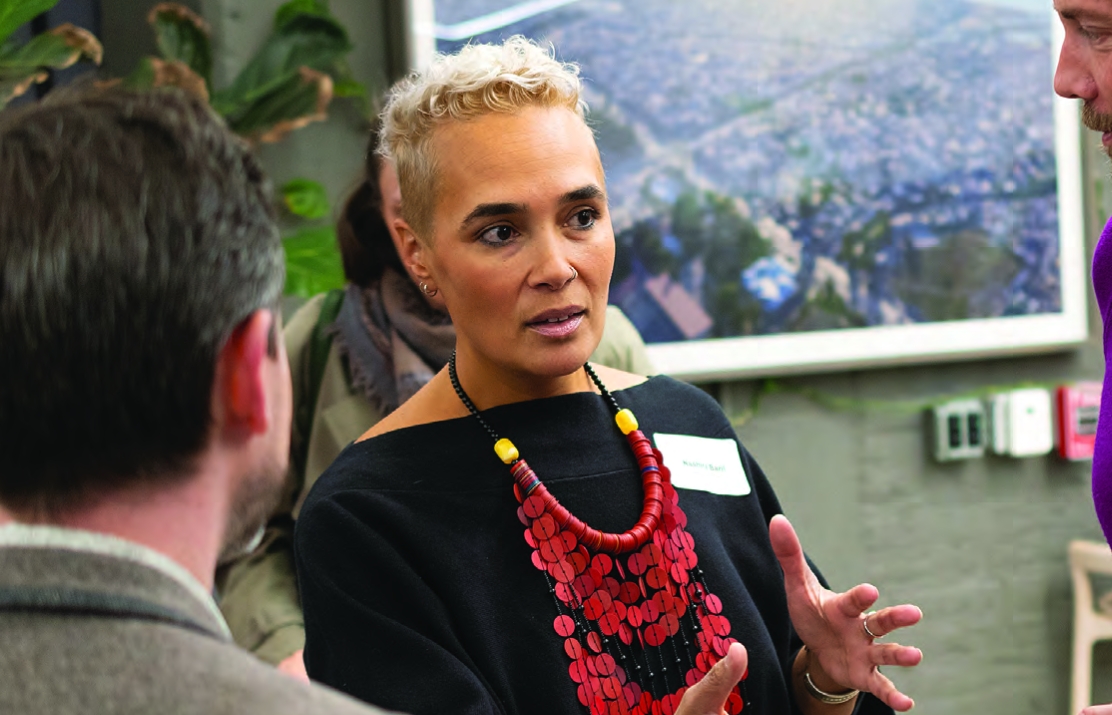
Nashira Baril, founder and executive director of the Neighborhood Birth Center, speaks with supporters at an event hosted by the group, Dec. 11. A proposal from the organization, which is looking to build a freestanding birth center in Roxbury, was approved by the Zoning Board of Appeal at a public hearing, Dec. 16.
A detail from a quilt sewn for the Neighborhood Birth Center, at the quilt’s unveiling, Dec. 11. The organization’s proposal to build a freestanding birth center in Roxbury was approved by the Zoning Board of Appeal at a public hearing, Dec. 16.
After denial in February, smaller scale project given go-ahead
After years of organizing, planning and public debate, the Neighborhood Birth Center is closer to becoming a reality. The Boston Zoning Board of Appeal unanimously approved the project at a public hearing on Dec. 16, clearing the way for construction at the intersection of Winthrop Street and Kearsarge Avenue in Roxbury.
Just days earlier, supporters gathered at the South End offices of MASS Design Group, where a vibrant quilt — stitched together from colorful fabric panels created by Roxbury community members — was unveiled in honor of the long-envisioned birth center.
Taped across the floor in crisp white lines was a to-scale diagram of a proposed birthing suite, transforming years of advocacy into something newly tangible.
The approval, which included a proviso that the variance for non-residential use only applies to the birth center project, comes after the zoning board denied a different proposal in late February.
For Nashira Baril, executive director of the Neighborhood Birth Center, the zoning board’s approval is a “really significant step” that finally allows the organization to make forward motion.
For nearly a year the group has been doing policy work at the State House as well as engaging the community through efforts like the quilt, but has been unable to provide the birthing services and midwifery care that they have long aimed to offer.
“It feels like momentum,” Baril said in an interview.
Any next steps are pending a zoning board appeal process. Once the official decision is filed with the city’s Inspectional Services Department, a 20-day clock begins in which abutters — property owners within 300 feet of the site — can appeal the decision, said Joseph Feaster, a Roxbury attorney representing the birth center’s zoning process.
Such an appeal would go before either Housing Court or Superior Court. Any further steps around permitting and design would be put on hold until a decision in the appeal was made.
The approval was met with strong emotion from supporters. Peaches Cobb, a neighbor who lives on Winthrop Street, said she was “elated” and cried tears of joy when she heard.
At a watch party held at her home, Jo-Anna Rorie, a nurse midwife at Boston Medical Center who has been working on efforts to open a birth center in Boston for 40 years, sobbed with joy when the decision was announced.
If the decision stands, the project would move into further design phases and permitting for the two-story, nearly 7,000-square-foot facility. The birth center would span three parcels on Winthrop Street, a one-way, largely residential street that spills out onto Warren Street, five minutes from the heart of Nubian Square.
Baril said it’s early to try to pin down a specific target date for opening, but she’s hoping for the summer or fall of 2027.
While a medical facility, the birth center will be designed to feel more like a home.
“It was really important to find property that was just a few minutes transfer to [Boston Medical Center] as well as Longwood [Medical Area], and that allowed us to create a neighborhood-based sanctuary for low-risk birth and care,” Baril said at the hearing. “This is really a third option between hospital and home birth, and the key word being sanctuary.”
Amie Shao, a principal at MASS Design, the architecture firm working with Neighborhood Birth Center, said that as the project moves forward, the next steps will include designing specific details, like how to incorporate medical equipment in a way that is easily accessible but not jarring.
Plans submitted to the zoning board showed three birthing suites on the first floor, with a family room that would later be transformed into a fourth birthing suite. It will offer a homelike set-up with a living room, kitchen and solarium.
The second floor will house clinical and outpatient space, with four exam rooms, staff offices and a conference room.
For its supporters, the promise of what the birth center will bring is closely tied to a broader maternal health crisis that has inequitably hit Black women.
A 2023 report from the Boston Public Health Commission found that Black infants were twice as likely to be born with a low birth weight compared to their white counterparts and nearly twice as likely to be preterm. The Black infant mortality rate is more than three times that of white infants.
The Massachusetts Department of Public Health found that severe complications during labor and delivery nearly doubled over the previous decade, with Black women at highest risk.
A study published in 2023 in the journal Health Services Research found that women receiving care from midwives at free-standing birth centers tended to have lower rates of cesarean section surgeries and low-birth rate admissions to neonatal intensive care units.
The goal to build a birth center in Roxbury scored significant support from elected officials, including some whose districts don’t include the proposed site.
At the zoning hearing, representatives from the offices of At-large City Councilor Ruthzee Louijeune and Dorchester’s District 4 City Councilor Brian Worrell voiced support for the proposal, as did staffers for U.S. Rep. Ayanna Pressley and state Sen. Liz Miranda.
State Rep. Chynah Tyler, whose district includes Winthrop Street, spoke against the proposal in remarks at the hearing, stating that she believes “a ton of more work needs to be done in making this possible.” A representative for At-large City Councilor Erin Murphy also voiced opposition.
Throughout the hearing, comments for and against the birth center often fell on opposite sides of a line drawn between a focus on needs around public health and needs around zoning.
For residents who voiced opposition, their concerns tended to be rooted in the birth center’s potential impacts to the neighborhood — like parking and driving challenges, an ongoing need for more housing and the potential to bring other non-residential uses to the block.
“This is a zoning issue; it is not a health care debate,” said Nadine Riggs, a neighbor on Winthrop Street. “If they’re allowed to have this project, it opens the door for anyone else who can come in, buy a building, tear it down and put in commercial space. It’s not fair.”
The zoning board’s decision to permit variances for the Neighborhood Birth Center doesn’t officially set any precedent for future construction in the area, nor does it permanently rezone the current parcels.
Many said they weren’t opposed to the birth center generally — and that they supported expanded maternal care efforts — but that they felt their largely residential street, zoned for three-family homes, was not the right place for it.
“We’re not against the birth center, we’re against it being in the wrong place,” said Carl Todisco, a neighbor on Winthrop Street.
But for many of the project’s supporters, calls in favor of the development couldn’t be separated from the public health benefits it proposes to bring.
“It’s wakening to the dignity of life for all human beings, giving a woman a chance to have a choice,” Cobb said. “That’s why I was so excited.”
Baril, whose background is in public health, said she sees the two discussions as part and parcel.
“In some ways, you couldn’t quite uncouple the health from the zoning piece,” Baril said. “There was some education of, certainly of the community, but also of the zoning board and even the electeds in this process to be like, ‘What is it that you’re trying to build, and why does it have to be there, and why is it important?’”
The project faced similar concerns in February. At that time, the proposed construction was about 10,000 square feet, with about half of that built space dedicated to the birth center.
The other half of the building would have been community gathering space and offices for five nonprofit organizations — a deal which Baril had described as an important step to make the birth center financially feasible and able to serve Mass-Health patients.
Neighbors who opposed the project described that design as an “office park,” a description Baril has rejected.
In the months since its denial, the updated design removed the community space and the offices, dedicating the whole building to the birth center and expanding the green space.
Those partner nonprofits — still joined with the birth center in a broader coalition they call “Community Movement Commons” — are looking for an alternative space in what the team is calling an “archipelago” model. Baril said they have another spot in mind — still in Roxbury — but that process is in its early stages.
In response to community concerns about how additional cars coming to the center would impact neighbors, the birth center’s redesigned plans include three new parking spaces, for a total of 14.
After neighbors worried about the need for housing, the updated plans maintained one of two houses on the four parcels as a residential building. The initial design would have torn down both.
Baril said the team plans to make some needed updates to that home, which has been sitting vacant, and get heat and water running again before renting it out.
But for some neighbors, the changes represented a misunderstanding of their concerns.
“We didn’t ask for more parking, we didn’t ask for outdoor space and we didn’t ask for a smaller footprint,” said Cheryl Spence, who lives on nearby Montrose Street. “It’s still a commercial space in a residential area.”
The most recent redesign was not the first time the proposal had been reduced in scale. An earlier proposal, presented to the community in 2023, featured a four-story plan, with nearly 20,000 square feet of built area. It was reduced in scale when the team heard feedback looking for a shorter building with a smaller footprint and more green space.
The changes in the newest plan were acknowledged by Shamaiah Turner, the zoning board member who moved to approve the project.
“Thank you for the revisions that you made, I understand you greatly reduced your project to fit into a more residential setting,” she said at the hearing.
Ahead of the hearing, supporters said they felt optimistic about the team’s chances at the zoning board, given the scope of revisions it went through.
“Being that they did all that, I really had a good feeling that it was going to be approved,” Cobb said.
Back at the MASS Design headquarters, the week before the zoning hearing there was a thrum of excitement in the air as people examined the reds and golds and greens and blues of the quilt, searching for the blocks they may have contributed. The quilt was assembled by textile artist L’Merchie Frazier out of pieces of fabric collected and marked by over 100 community members in Nubian Square and at events like Open Streets Roxbury.
Baril said having the finished piece is a reminder of the community they’re hoping to support with the birth center.
“It feels really nice to have one physical thing,” Baril said.
While currently the only physical piece of the birth center, with the zoning board’s approval it’s poised to be just the first in what Baril said she hopes will be a “love letter to the community.”
“I think we’re trying to kind of go, ‘This level of care is possible and can be covered by insurance and can be in the community,’” Baril said. “It’s why I felt so steadfast that this was the location and why I’m so pleased that we have a pathway here.”