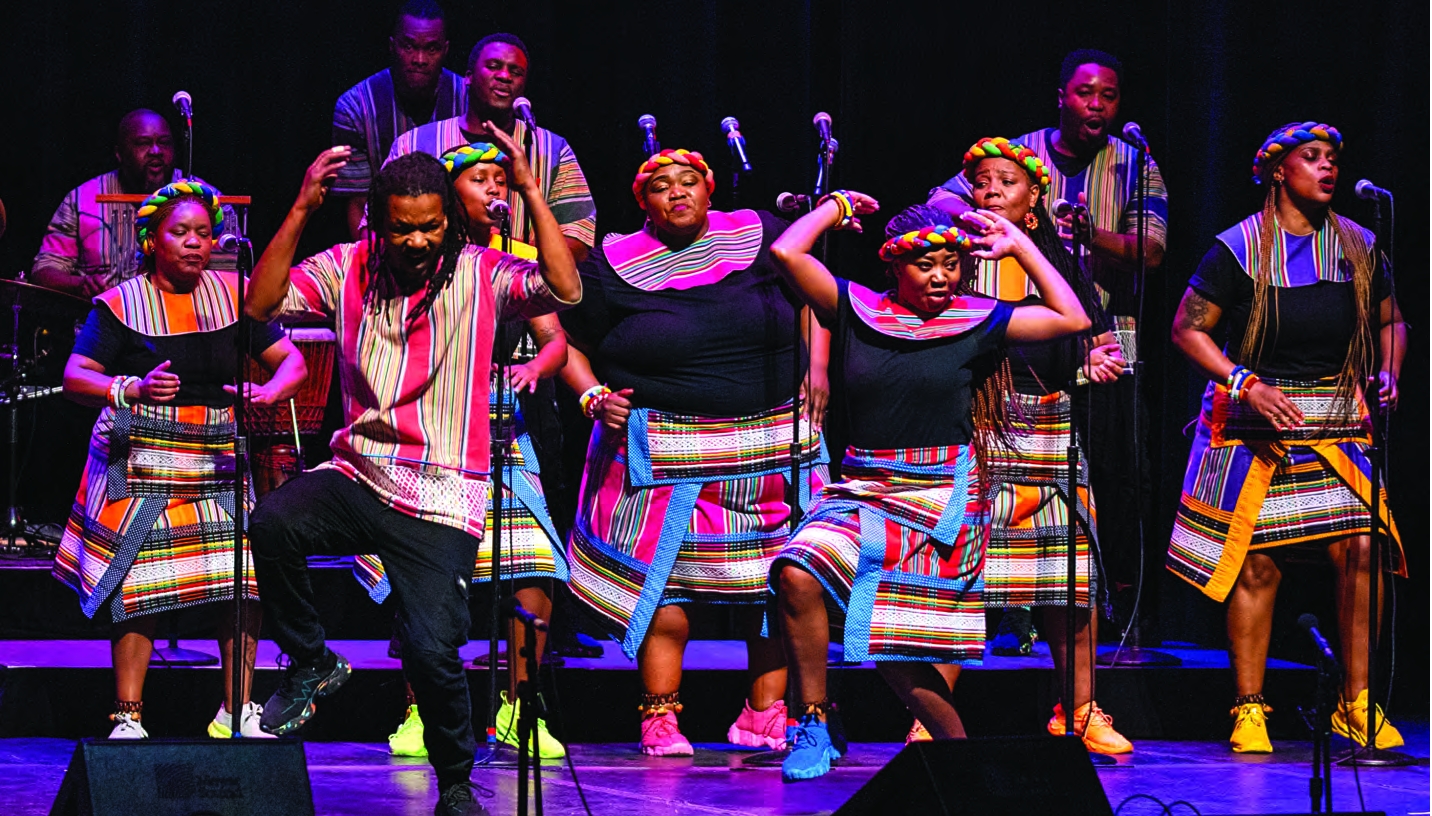
The award-winning Soweto Gospel Choir brought their collective voices the Berklee Performance Center for a powerful evening of traditional South African music and Christmas carols.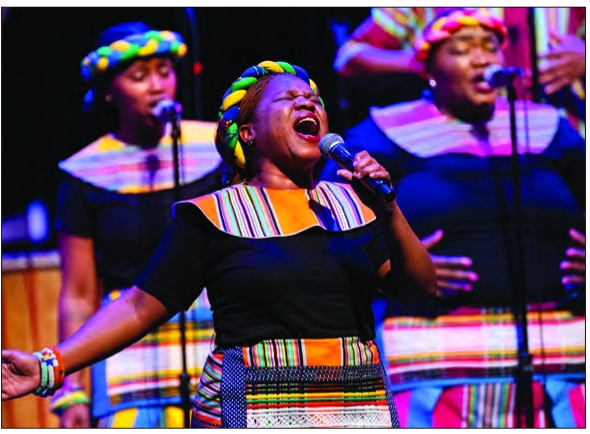
The Soweto Gospel ChoirThe Soweto Gospel Choir brought its program of traditional South African music and Christmas carols to the Berklee Performance Center on Sunday, Dec. 6, with polyrhythmic song and dance that gave the audience the unfamiliar — songs in South African languages — and transformed the familiar — Christmas hymns and carols — into something new. Titled “Peace,” the 90- minute, intermission-free program was presented by Celebrity Series of Boston, its seventh time hosting the choir since 2005, when the ensemble was just three years into gaining global prominence and a host of awards.
Recipient of three Grammys, an Emmy, two American Gospel Awards and the inaugural Tower Music African Gospel Award among many other honors, the Soweto Gospel Choir has performed in such venues as Carnegie Hall, Sydney Opera House, Royal Festival Hall London and the Nelson Mandela Theatre in Johannesburg. They have collaborated with such artists as Aretha Franklin, Stevie Wonder, Beyonce, U2, Diana Ross, Jimmy Cliff, Angelique Kidjo and Hugh Masekela.
Formed in November 2002 at the start of South Africa’s post-apartheid era, the choir draws members from the churches in and around the Black township of Soweto (SOuth WEst TOwnship) outside Johannesburg that is the home of Nelson Mandela and of South Africa’s democratic movement. On both sides of the Atlantic, gospel music has been a form well suited to furthering a democracy with its grounding in the power of individual and collective voices. The choir has brought the reach and power of gospel music to major historical events in the new democratic South Africa, performing on many occasions for former President Nelson Mandela and Archbishop Desmond Tutu as well as at the state funerals of both leaders.
At Berklee, the 19-member ensemble was a vision of unity — with the women in uniform striped skirts of yellow, green and tan stripes, tops with wide collars and small woven headdresses standing in a stage-wide row. The uniformity of their outfits actually served to heighten their individuality. As soloists, their voices were as astonishingly varied as their physical appearance. Male members stood behind them on a platform, and behind the men were the evening’s two instrumentalists, percussionist Sipho Ngcamu and keyboardist Sabelo Mtshali.
The choir wasted no time summoning its full power. Soloist Mary Mulovhedzi stepped forward to sing, chant and exhort in one of the six official languages of South Africa the choir sang in that night — Zulu, Xhosa, Sotho, Setswana, Pedi and English. A woman with a voice of great strength, she demonstrated that in a gospel choir, power is gender-free, and with her body as well as with her muscular voice she reached into the audience, leaning forward and extending her arms toward us as if in blessing while summoning spirits of ancestors as well as all seated before her.
Accompanying her was a sonic wave of nonverbal, crisscrossing rhythmic texture — ululating voices, shakers, vocal clicks, birdsong-like whistling and clapping — sounds that evoked a primeval forest, backed by Ngcamo’s pulsing beat on djembe hand drums.
The choir behind her also joined her in movement, their arms extending forward in unison to form geometric patterns. While encompassing the audience in an irresistible canopy of sight and sound, the choir made it plain that their performance was beyond mere entertainment.
Over the course of the program, the row of women broke into various formations — trios, circles or snaking lines. A man leapt forward into a breakdancing solo and later reappeared in a green cape carrying a staff — conjuring a figure of myth.
The first segment presented South African music, including gospel songs and freedom anthems. They included Masekela’s “Sechaba” from the 1992 movie “Sarafina” about the student-led Soweto Uprising that opposed installation of Afrikaans as the language of instruction in schools. During “Rolihlahla Mandela” (translated from Xhosa as Troublemaker Mandela), choirmaster Shimmy Jiyane spoke in English to praise the father of his country.
In the second part of the program, the choir performed an array of familiar American hymns and ballads, including “O Holy Night,” “Joy to the World” and “We Wish You a Merry Christmas.” Their polyrhythmic vocals and slow tidal waves of harmony peaked in “Silent Night,” as Jabulile Mola stepped forward and delivered a solo with an unfathomably deep voice. Singing above and below the melody, he and his choir transformed the old carol into a mesmerizing musical experience. As he stepped back into the ensemble, his singular voice remained audible as a deep undertone to the unison vocals.
Following a somewhat dirgelike rendering of “You’ll Never Walk Alone” from the musical “Carousel” and before their concluding song, Leonard Cohen’s “Hallelujah,” the choir delivered an exuberant South African folk song, “Shosholoza” (Zulu for “push forward”) that turned the concert into a house party. Originally a work song for miners and now an anthem of hope and resilience, the song has become an unofficial national anthem of South Africa.
ON THE WEB
Learn more about the choir at sowetogospelchoir.co