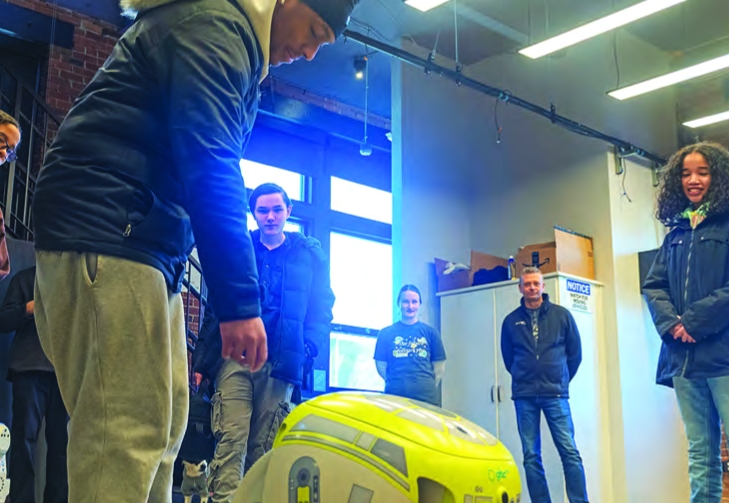
Students from Boston Public Schools Holland High School of Technology interact with a Gita robot at the Piaggio Fast Forward headquarters in Charlestown. BPS students and youth staff from nonprofit used bookstore More Than Words visited the Boston-based robotics company at an open-house event, Dec. 12, to mark the company’s 10th anniversary.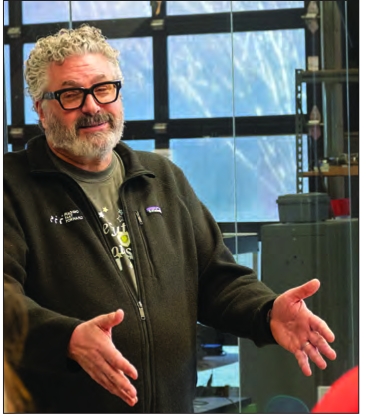
Greg Lynn, CEO of Piaggio Fast Forward, talks with visitors at the robotics company’s open house.
Inside a brightly lit room at an old industrial brick building in Charlestown, a group of high school students from Dorchester watched a cluster of short, stout, barrel-shaped robots and followed along as the machines snaked their way across the room, chirping as they went along.
In an adjacent room, a different group followed the motions of a woman in a black suit studded with white dots as a computer recorded her movements in an attempt to train robots on human movements.
The two groups were gathered at the headquarters of robotics company Piaggio Fast Forward as part of an open house for young people from around Boston to learn about science, technology, engineering and mathematics career opportunities.
The event was part of a 10-year anniversary celebration of the company, which makes cargo-carrying robots designed to make errands and other tasks easier.
“We really wanted to connect with younger people and let them know that they can have a career in robotics,” said Greg Lynn, Piaggio Fast Forward’s CEO.
For the 10 young people — students from Dorchester’s Holland High School of Technology and young staff from the nonprofit bookstore More Than Words — the outing was a chance to see what a career in robotics might look like.
It was one that the group seemed to embrace enthusiastically, jumping in to interact with the robots and asking a host of questions of the staff working at the robotics company. Jonathan Chery, a robotics teacher at the Holland School who led the field trip, said the kind of exposure a visit like this offers is an important part of how he aims to run his robotics classroom. That kind of activity can open their eyes to new opportunities. “They haven’t seen an environment like this before,” he said.
Chery pointed to his own experience.
Until he was in college, he had only ever dreamed of being a teacher or a social worker — the jobs of his parents. It wasn’t until he got to college that he was exposed to the idea of doing something like computer science.
“I had a theory here, which was, ‘How often does that happen with many of our students — where it’s because of a lack of exposure and what they see is what they know — how much does that affect their career choices?’” Chery said.
One reason that exposure can be important is to help students understand that robotics doesn’t have to mean just coding or engineering, two areas that can be daunting and therefore put off students who might otherwise have joined the field. Staff from Piaggio Fast Forward addressed this potential barrier, reminding the group of multiple pathways into the robotics industry. Piaggio does need engineers and coders to make its robots run, but it also needs people who understand human physiology, marketing or graphic design, Lynn said.
“I think there’s no degree better than a liberal arts degree for robotics. There’s no better degree than a finance degree for robotics. There’s no better degree than political science,” Lynn said. “The industry has a lot of room for people that bring greater knowledge than just a purely narrow technical focus.”
It’s something that Chery also tries to share with his students. Beyond hammering down technical skills, he tries to teach robotics as a way to grow other, broader skills. “Robotics is a tool we use to reinforce the importance of working together, critical thinking and communication,” Chery said.
And so, at the open house, students met with staff from Piaggio Fast Forward who not only work directly on creating or programming the robots, but also with staff from the marketing team and other disciplines that are less focused on science and engineering.
The company spun out of the same Italian group that manufactures the Vespa scooter. The robot they created and that the students observed is called the Gita — named after the Italian word for a short outing or day excursion. A small, two-wheeled box with rounded edges — much like a rolling suitcase — the device follows its owner around on errands and can be used for storage. The robots are distinctly un-humanlike but are intended to “understand” and respond to how humans interact with the world.
For instance, the company runs studies to better understand how two people might interact if they’re walking down a sidewalk, a narrow hallway or through a doorway at the same time. The goal is to train the robots to follow general etiquette and social awareness if they were rolling alongside their owner in public spaces.
Where other robots that get within two meters of a person might be designed to stop, the sweet spot where Piaggio’s robots operate is between 35 centimeters and two meters of a person, Lynn said. “It means we really have to understand a lot of things [about how people move] that other robot companies don’t,” he said.
The company is now working on a larger, flat-bed version, called the Kilo, that is intended for use in businesses and warehouses.
Such tools may be a novelty now — a Gita retails for nearly $3,500 — but Lynn imagines a future where that sort of tool is much more commonplace. In the meantime, he said he’s hoping to host open houses with other Boston-area schools that couldn’t attend the first one.
“Ten years from now, there will be many more robot companies like us,” Lynn said.