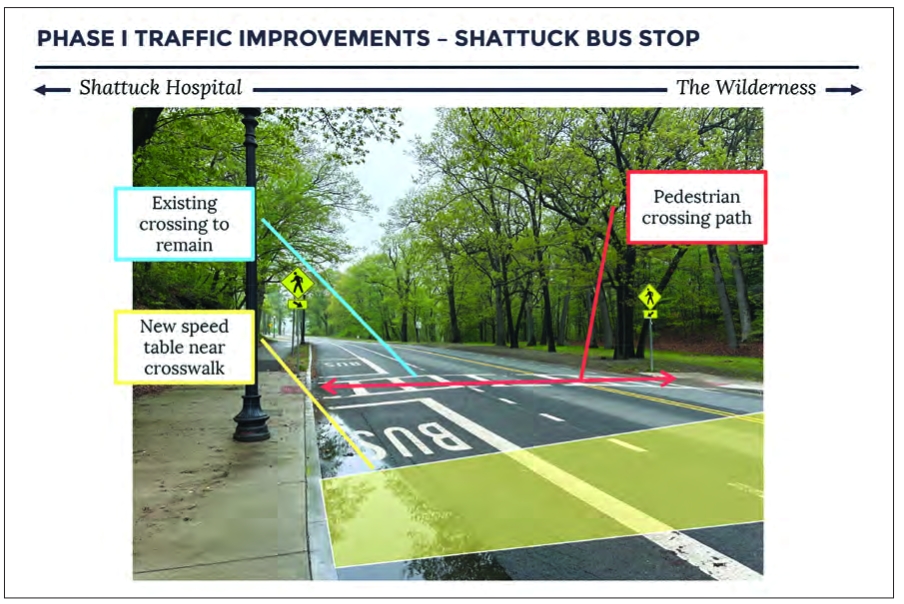
A diagram illustrates the City’s traffic improvement plans for part of Circuit Drive.On Boston’s map, diamond-shaped Franklin Park is nestled within three neighborhoods:
North Dorchester, Roxbury and Jamaica Plain. Surrounding the park is Circuit Drive, which has come a long way from its humble roots as a farm road in the late 1800s to the car-heavy thoroughfare it is today. With its speeding cars and many intersections that are confusing to bicyclists and pedestrians alike, overhauling safety on Circuit Drive has been part of the Franklin Park Action Park since it was proposed in 2018 by then-Mayor Marty Walsh.
At a Nov. 13 meeting, city officials shared the latest in their plan for the storied Circuit Drive, part of the larger Franklin Park Action Plan.
One of the initial priorities, based on community feedback, is slowing down traffic. Traffic studies conducted by the City of Boston in March and June found that the average speed of drivers on Circuit Drive was nearly 10 miles an hour higher than the 25-mph speed limit, according to Madeline Augustine, a transportation engineer with Nitsch Engineering, which is consulting on the Action Plan.
And so, beginning next spring, the plan is to construct 10 speed tables along the 1.5-mile-long road.
Installing speed tables would be better than the alternative of issuing speeding tickets, said Amy Linné, a project manager on the plan, noting tickets would increase the already high demand for Boston Police officers. A design solution, she hopes, would provide better results “24 hours a day.”
Another priority of the project is to make Circuit Drive safer and more accessible for pedestrians and cyclists. A small survey of community members found that 81% listed improving pedestrian crossings as a major improvement that the project ought to prioritize. And nearly 200 of the 303 respondents said they primarily used Circuit Drive for walking or running.
As a result, part of the plan now is to install seven new pedestrian crossings.
Discussion during the meeting once again turned to closing Circuit Drive altogether, a proposal that led to some heated argument during a May community meeting about the project. But as first reported by the Banner, Boston ruled out road closure before the Circuit Drive project even began.
Moreover, Linné cautioned against “drastic change” in favor of incremental steps to test the strategies.
Still, Circuit Drive and Franklin Park are no strangers to such changes. When Frederick Law Olmsted designed Franklin Park, he had hoped urban dwellers could find moments in nature in the midst of their hectic lives.
The “crowded condition of a city,” Olmsted wrote in 1885, makes “the sight of merely uncrowded ground in a park the relief and refreshment to the mind that it is.”
Bicycles and carriages ruled the streets during Olmsted’s lifetime, but in 1925 — a mere 37 years after Circuit Drive opened in 1888 — the street saw its first automobile traffic. Almost 50 years after the introduction of cars, the average weekday traffic load of Circuit Drive, which was reserved only for cars, was roughly 11,200 vehicles (that figure today is about 14,000, according to the recent traffic studies).
But a planned zoo expansion that began in 1973 closed the zoo grounds and Glen Lane, which was used for “walking or biking to and from the Playstead area,” according to the plan. For Franklin Park’s first four decades, Glen Lane had also linked streetcar stations on Washington Street and Blue Hill Avenue.
“Once the Zoo grounds are closed off, these people will be forced to travel along Circuit Drive or Seaver Street, both of which are heavily traveled roadways,” the plan read, foretelling a problem that still exists and that the Circuit Drive plan aims to fix.
Still, it would be another 22 years before Mayor Thomas M. Menino would lower the speed limit on Circuit Drive from 30 mph to the 25 mph it is today.
Undoubtedly, the changes to Circuit Drive will infringe upon how people access Franklin Park, the biggest of Boston’s public spaces and the largest of the Emerald Necklace parks. Instead of being “induced to pass while following their ordinary occupations and without serious hindrance or inconvenience,” as Olmsted theorized in 1875 about the value of parkways, urban expedience may instead mean that people don’t double back for the many scenic views.
That may be, but Circuit Drive, as the main connector of the city’s urban core to the Emerald Necklace Parkway, is of essence to car drivers. In the 5th Suffolk District to the east of Circuit Drive, 54% of commuters drive. That figure is similar among the commuters of Holmes’ 6th Suffolk District to the southeast. In the 15th Suffolk, largely Jamaica Plain to the west, 33% of commuters drive.
Even with upcoming changes to the commuter rail service — such as the Fairmount Line’s upgrade to electric trains in 2028 — and the improved frequency of Orange Line trains, the automobile is king for the foreseeable future. Travelers may slowly shift their commuting habits, but they will probably first look for parking.