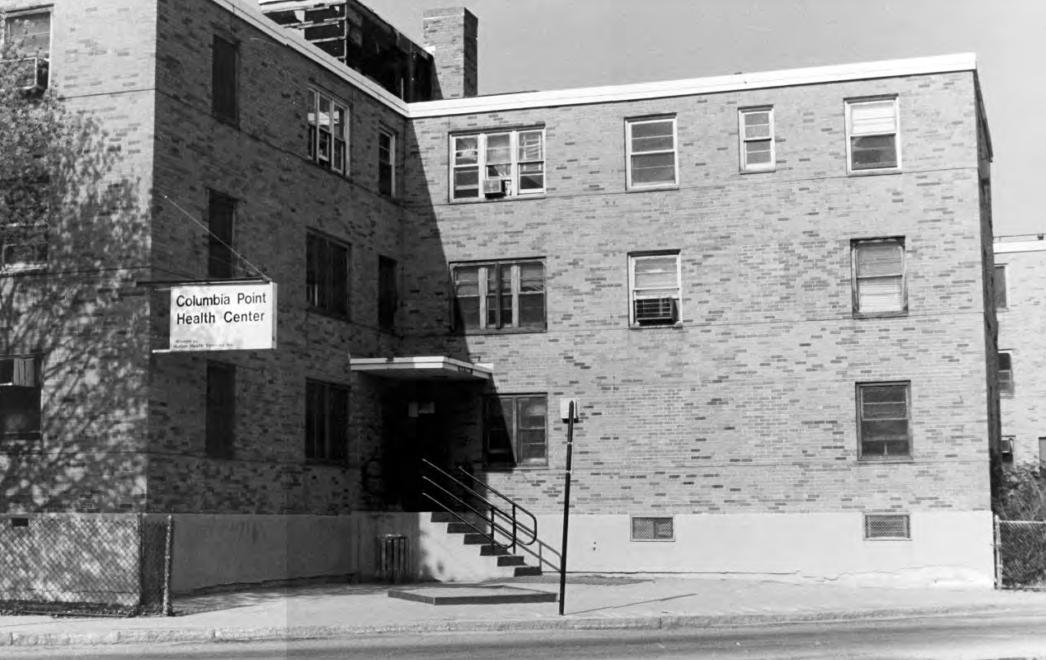
Columbia Point Health Center was the first community health center in the U.S., opening in 1965. 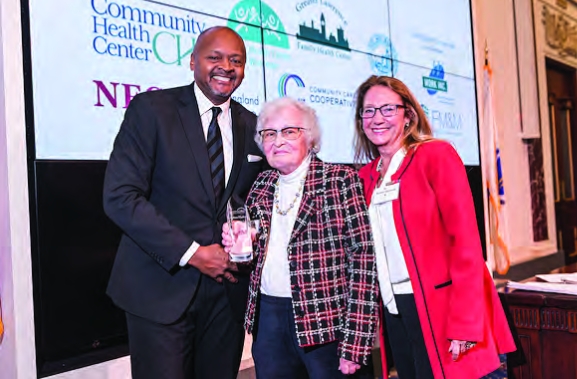
Michael Curry, president and CEO of the Massachusetts League of Community Health Centers, joins other dignitaries for the League’s 60th anniversary event held Dec. 11.
When the country’s first community health center opened its doors in Dorchester’s Columbia Point Neighborhood in December 1965, it marked the start of an effort to bring improved medical care to the country’s urban and rural areas that have previously lacked access.
It was soon joined by another center in Mound Bayou, Mississippi, and marked the start of a health center movement that has since expanded to include 50 organizations with more than 285 facilities in Massachusetts and more than 17,000 delivery sites nationwide.
Those facilities serve more than 1 million patients across Massachusetts and up to 52 million patients nationwide per year.
For patients who rely on community health centers, that access to improved care services impact hits close to home, said Caroline Mullin, medical director at the Geiger Gibson Health Center, the current name of that first health center in Columbia Point.
During the COVID-19 pandemic, Harbor Health, which operates the Geiger Gibson Center, had to temporarily shut down the facility to in-person appointments. When it stopped serving patients, they felt abandoned, she said, having relied so closely on the center.
“To have lost it was a huge loss in the neighborhood, Mullin said. “It has felt very meaningful to reopen these walls and have people come back and tell me the stories of getting their pregnancy care there, decades ago, or what the doctors were like who helped care for their children when their children were growing up.”
It reopened about a year ago, in mid-November 2024.
The push to open the first centers came as part of the Civil Rights Movement, as advocates worked to bring equity and equality to all facets of American life.
“Folks were thinking about, ‘Okay, we are working to integrate schools, desegregate lunch counters. But what about health care?’” said Michael Curry, president and CEO of the Massachusetts League of Community Health Centers. “Sixty years ago, in 1965, hospitals were segregated in this country. That is not a long time ago, that’s a historical minute ago.”
According to federal data, in 2024 community health centers offered over 3.6 million patients care for hypertension, diabetes care for more than 2.2 million patients and preventive cancer screenings for about 10 million patients.
A 2018 study from the journal Health Affairs found that Medicaid patients who used community health centers were more likely to have access to primary care and rely less on emergency rooms.
A 2009 report from health care consultant Avalere Health found that community health centers provide more cost effective care.
Conversely, a 2025 study in the journal Health Services Research found that mortality in counties that lost a community health center rose by 3.54 deaths per 100,000 people, with the highest increase among patients dying from cancer.
Central to the mission of community health centers is a focus not just on clinical care, but on social determinants of health — factors like access to housing, food and health insurance — that keep patients healthier before they come in to see a doctor.
“It’s one thing to change access for people able to come in and get medical services, but if you’re really focused on changing the inequities and the health outcomes, there is so much in terms of the social determinants of health that need to be improved,” Mullin said. “A community health center is a place that people can come to get medical care, but also to be lifted up in those other aspects of their lives.”
But, community health centers are facing continued challenges and increased financial instability due to changes in federal policy.
New federal policies bring challenges
The Trump administration’s budget reconciliation package, referred to as the “One Big Beautiful Bill,” included changes to who can access Medicaid and how.
Those shifts included a new work requirement — under the law, Medicaid recipients must work or volunteer for 80 hours per month to be eligible — and for legal immigrants receiving the benefits restricts access to only some “qualified” immigration statuses.
One estimate by the Kaiser Family Foundation found that nationwide, the new work requirements alone could cause millions of patients to go uninsured and result in $326 billion in reduced federal Medicaid spending over 10 years, the largest reduction by any one provision. The total Medicaid funding cuts were estimated at $911 billion.
Reduced Medicaid spending means less money going to health centers. In 2024, according to data from the Kaiser Family Foundation, nationwide Medicaid funding made up 45% of revenue sources for community health centers, the largest of any source. In Massachusetts, it made of 34% of revenue, still as the largest source.
Those impacts are likely to be compounded by changes in who can continue to pay for other forms of insurance under the Affordable Care Act, with expanded subsidies on insurance premiums, which were implemented during the COVID-19 pandemic, potentially set to expire at the end of the year.
“We are at a time where many folks in the commonwealth feel very threatenaed in terms of their ability to continue to access, one, the care that has been a big part of their lives, and two, the care that they want to continue with,” said Mullin, who said she has been reminding patients that regardless, health centers will provide care and figure out payment later.
Curry said the health center movement, too, has faced challenges as the Trump administration has targeted programs that promote equitable access to resources and care as it looks to restrict access for immigrant communities and other groups like gay and trans communities.
“Now we’re being told that DEI is a bad word and inclusion isn’t something that benefits all of us, and therefore they’re being challenged with these programs put in place to, quite frankly, serve all Americans,” Curry said. “I would argue that if you want to make America great, then you need all Americans to be able to reach their fullest potential.”
Funding challenges aren’t new for health centers, said Dr. Kyu Rhee, president and CEO of the National Association of Community Health Centers. For example, in the 1980s, potential funding challenges under the administration of President Ronald Reagan led to advocacy from health centers to preserve the same kinds of federal support they had been receiving.
But, just as health centers have faced and overcome challenges before, Rhee said he expects the system to survive these challenges, too.
“There have been other moments throughout our history — almost every decade — that are significant challenges, where we’re challenged with policy that might directly affect our funding and the workforce,” Rhee said. “I would suggest that when we face those moments, we’ve been able to push forward, show our value to both sides of the aisle, show our value to the public and the private sector, and often demonstrate the importance of the work we do.”
Historically, community health centers have received bipartisan support — health centers tend to benefit both urban communities that lean Democrat and rural communities that lean Republican — and Rhee said that, as a national organization he has had positive conversations with the Trump administration regarding support for the health center movement.
Curry said he finds hope in seeing the work that community health centers in Massachusetts are doing.
He pointed to efforts like pushes for mobile health care in which centers retrofit vans to bring care directly into communities. Or he’s hopeful about how health centers are using new technology such as remote monitoring devices to track metrics like blood glucose and A1C or heart rate or artificial intelligence for note taking, so doctors can spend more time face to face with patients.
Rhee, too, said he was anticipating greater use of artificial intelligence to streamline how health centers operate, especially making sure those changes happen equitably.
“I can see firsthand that health centers are already high-trust, but we’re not yet high-tech,” he said.
Curry said that, despite the challenges health centers are facing, he feels confident the more than 50 facilities across Massachusetts will work with policymakers to continue to support the patients who need quality care the most.
“Out of that tradition, out of that resilience and commitment, we come,” Curry said. “Now, as we face new challenges, I feel we’ll do the same. We’ll meet the moment.”