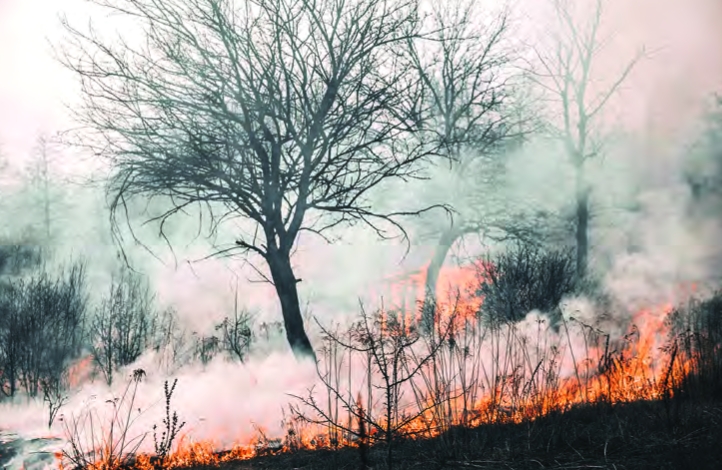
Massachusetts experienced a record 1,300 wildfires across the state in 2024. No county in Massachusetts has been spared from climate disasters in the last 13 years, according to a new report released Dec. 10.
“Every single county in Massachusetts has suffered a major climate event from 2011 to 2024,” said Amy Chester, director at Rebuild by Design, the nonprofit company that produced the Massachusetts edition of the report, called the “Atlas of Disaster.” The organization brings together experts on global and local scales to find solutions for some of the biggest problems facing the world, including climate change, and was founded as a result of a design competition held by the U.S. Department of Housing and Urban Development in the wake of Hurricane Sandy in 2012.
The report found that between 2011 and 2024, there were 11 federal declarations of climate disasters in Massachusetts, putting the state as part of the 80% of the United States that experienced 10 or more such disasters during that time period. Suffolk and Bristol counties experienced most of these, while nine of the state’s 14 counties experienced at least five disasters in that time span. In total, those disasters cost taxpayers more than $541 million.
Because it only counted those storms that led Massachusetts to petition the Federal Emergency Management Agency (FEMA) for an official disaster declaration, the report’s scope is limited, said Chester. The 11 declarations included in the report are “only for the worst disasters,” she said. “There [are] actually plenty, plenty more that don’t reach the threshold” for a FEMA response and access to funds for rehabilitation, which are therefore not counted in the “Atlas of Disaster.” Events that are smaller but still potentially significant aren’t counted. Nor are heat waves and heat emergencies, which aren’t eligible for FEMA disaster funding.
That narrow scope is also a result of how states tend to have a limited record of climate impacts and disasters; Chester recalled having to manually go through the New York governor’s press releases for disaster declarations to compile that state’s “Atlas of Disaster.”
That dearth of information is one of the prominent reasons Rebuild by Design decided to start producing the reports, Chester said.
Other findings in the report include how Massachusetts experienced a record 1,300 wildfires across the state in 2024 and how, during the June 2025 heatwave, 848 out of every 100,000 Massachusetts residents visited an emergency room for a heat-related illness.
The impacts of that, she said, aren’t limited to people who live in a flood path or who face a forest fire, nor are they limited to economic loss. One chart in the report, for instance, emphasizes how downstream effects of climate disasters range from the immediate — exposure to floodwaters and destruction of buildings — to the more distant such as infections and chronic health problems caused by toxic runoff in stormwater or harmful residue in the environment from forest fires.
“When we think about a disaster and we think about the response that the federal government gives, it’s usually [the] dollar amount that is set,” said Chester. “What we don’t see [are] the cascading effects.”
Chester pointed to impacts on her own family, who lived through Hurricane Sandy in New York.
She said that every time she sees them, they tell her about the temperature of the ocean or instances of sunny day flooding, where high tides cause seawater to spill onto streets even when there are no rain or stormy conditions.
The report also emphasizes that despite how statewide the disasters may have hit, the impacts were unlikely to have been felt equitably. The report cites previous research on how historically redlined neighborhoods tend to face higher flood risks and are nearly 5 degrees Farenheit hotter, on average, during heat waves. That figure goes up to 12 degrees Farenheit for low-income neighborhoods during heat waves.
Flood-exposed homes tend to sell for 7% less than their counterparts, the report says, which could particularly affect how low-income families build generational wealth. And communities of color tend to see a 31-point drop in credit scores following even medium-sized disasters — which Chester pointed to as an important determinant of insurance rates — compared to only a four-point drop in white communities.
But not all may be lost, as the report outlines mitigating steps the state is already taking and advocates for other potential solutions. The 2018 Environmental Bond Act, for instance, authorized $2.4 billion for climate adaptation, environmental protection and infrastructure upgrades across the state. The state also allocated $6 million to help restore cranberry bogs and other wetlands, which are natural protectors against storm surges.
Chief among the future actions listed in the report is enacting Gov. Maura Healey’s Mass Ready Act, a proposed five-year bond bill that would direct nearly $3 million in capital spending to infrastructure and environmental projects across the state. Another proposal that would add a 2% surcharge on real estate insurance to fund climate infrastructure has the potential to raise $6.7 billion over 10 years, the report says. Yet another option would create a trust fund paid into by the biggest fossil fuel companies.
Still, the report delivers a bottom line: The state can’t wait any longer to mitigate climate hazards.
“Climate change is already here, and our communities are already suffering and we have to do something about it,” Chester said.