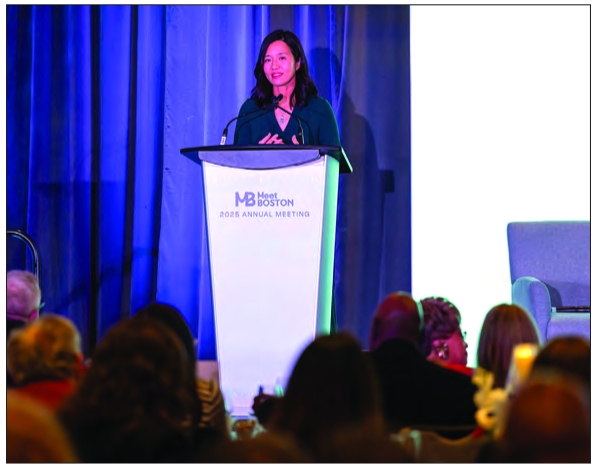
Mayor Michelle Wu offers remarks during the Meet Boston annual meeting held at the InterContinental Boston hotel.Meet Boston, the city’s tourism bureau, held its annual meeting Dec. 2 at the InterContinental Boston, gathering hundreds of industry professionals and policymakers to review a turbulent year in tourism and highlight an ambitious slate of major events poised to reshape the 2026 visitor economy.
The meeting featured a 90-minute detailed presentation of Meet Boston’s annual report, including updates on workforce and supplier diversity through its Promoting Advancement in Tourism & Hospitality (P.A.T.H.) program and a forward-looking plan centered around four major tentpole events: the FIFA World Cup 2026, the return of Sail Boston’s Tall Ships, the rollout of the Michelin Guide in Boston and the commemoration of the 250th anniversary of the American Revolution.
Boston Mayor Michelle Wu, Lt. Gov. Kim Driscoll, Meet Boston CEO Martha Sheridan, and P.A.T.H. program lead Conan Harris were among those who addressed the crowd. They shared their optimism for the year ahead, emphasizing initiatives they hope will position Boston as a “welcoming and inviting city” to international peers, while acknowledging the national political headwinds that affected local tourism in 2025.
A year that fell short of expectations
Meet Boston entered 2025 forecasting a full rebound and the potential to surpass 2019’s pre-COVID numbers, which were over 22 million visitors with about 3 million international travelers. In May, Sheridan said that the industry expected 4-5% growth in international visits, however, early year projections evaporated as the national political climate shifted.
Federal tariffs introduced by the Trump administration in April dubbed “Liberation Day,” along with annexation rhetoric aimed at Canada and increased presence of U.S. Immigration and Customs Enforcement quickly strained cross-border travel.
Boston tourism relies heavily on Canadian visitors, who make up the largest share of its international arrivals, at roughly 800,000 annual visitors. By summer, Canadian travel to Boston had fallen an estimated 20% compared to a 9% drop in overall international visits.
In an attempt to smooth relations between Boston and Canada, Wu mentioned the city’s long-standing relationship between Nova Scotia. The relationship deepened after the 1917 Halifax Explosion, the world’s largest maritime explosion. Every year the Canadian province bequeaths a tree to Boston as a thank you for the assistance provided after the disaster.
“Every single person I met there knew the story of why there’s a tree for Boston and felt a connection to our city,” Wu said, referencing her trip to the region in November. “And every conversation I had was a little bit of a persuasion because they knew they were supposed to boycott and avoid and do their national duty, and I said, ‘Boston’s not part of that. Come visit us, come spend your dollars. Come be part of this community that you’re tied to.’”
The effect of the decrease in international travelers cascaded through the region’s hospitality sectors. According to Meet Boston’s annual report, international visitors — who statistically stay longer and spend more per day — declined sharply between May and September. Retailers around Faneuil Hall, the Seaport and Back Bay reported double-digit revenue declines while museum attendance dipped and several high-profile international conferences canceled or shifted to other cities.
Despite this, the industry is still a significant contributor to the city’s economy, contributing $395 million in state tax revenues and $24 billion in sort of total statewide economic impact, according to Driscoll.
“As a state we’ve worked hard in trying to cultivate the environment where we can enhance the amount of funding we have going into destination marketing and tourism promotion. And, I have to tell you there’s not a better return on our dollar when it comes to making investments to support marketing the commonwealth and Massachusetts,” said Driscoll.
P.A.T.H. program expands: centering Black workers and businesses
As a significant contributor to Boston’s economy, the tourism and hospitality sector provides approximately 59,000 jobs. Statewide that number extends to about 154,000 jobs. The meeting devoted significant attention to Meet Boston’s P.A.T.H. program, a workforce and supplier diversity initiative spearheaded by Conan Harris & Associates that launched in 2023.
The program is designed to increase representation of Black workers in hospitality roles and expand contracting opportunities for Black-owned businesses across the visitor economy.
The P.A.T.H. program does this under two pillars. The first is supplier diversity. Harris is managing the building of an internal customer relationship management (CRM) system that aggregates and organizes all the organizations owned by people of color in the local hospitality industry. He hopes the CRM, which is being built by an Atlanta-based, Black and female-owned firm called NectariQ, will improve the request for proposals process by making it more inclusive.
The second pillar is career development. Harris hosts an annual career fair, which helps connect over 500 job seekers with 80 employers. The P.A.T.H. program also helps participants develop workforce skills to succeed in the industry.
“The goal is to be able to recruit and engage people throughout our city from all different levels of work to be involved in this industry,” Harris told the Banner. “And work directly with HR professionals and executives from the hotel and tourism attractions to be able to recruit and engage and retain people of color in the field.”
While exactly how many Black workers are employed in the visitor economy is unknown, Harris hopes the P.A.T.H. program will increase those numbers and make hiring more accessible and equitable. In 2024, 12 employees were placed in positions in the industry after 51 interviews and 145 job application submissions.
Harris explained the importance of building out an internal CRM that highlights diverse businesses and employees. “We’re making sure that folks have an awareness of what exists. …There’s never a conversation on do these folks exist or not?”
The CRM rollout is planned for Q1 of 2026, where it will start off collecting data in its first year of use and eventually provide data to Meet Boston about the efficacy of its diversity and inclusion efforts.
Harris says Boston is leaning into diversity, equity and inclusion at a time where most organizations are not, touting the commitment of the destination marketing bureau as a rare exception on the national stage. For Harris, this push for inclusion reflects the city as a whole.
“What I’ve noticed in this city is that there’s been a real deliberate move on organizations of color, people of color, to be everywhere.” He added, “I think if you keep being deliberate about building it, and you keep being deliberate about engaging folks, [what] you’ll see is an influx of growth that takes place across the industry.”
2026: A pivotal moment
Though 2025 presented obstacles, the organization is gearing up for what might be considered a historic convergence of tourism opportunities in 2026. The 2026 FIFA World Cup will take place at Gillette Stadium in Foxborough and is expected to bring thousands of visitors to the state, along with global media attention. It is the largest sporting event in the world, creating a once-in-a-generation showcase moment for Boston.
Sail Boston’s Tall Ships festival is returning in 2026 to celebrate the 250th anniversary of American independence. The event is expected to draw millions to the waterfront. In addition to the Tall Ships, many organizations, museums and historic sites are programming events all year to celebrate the anniversary of the American Revolution.
Meet Boston also hopes that Boston — a city with a newly minted Michelin star restaurant, 311 Omakase at 605 Tremont St., Ste G, — will entice foodies to visit the newest culinary hot spot. There were 26 restaurants in total that received Michelin nods as Bib Gourmands, restaurants offering excellent food for a great value.
As the year comes to a close, things are already looking up for the tourism economy. Nik Pereira, Meet Boston’s senior vice president of sales, mentioned a 13% increase in bookings at area hotels with 157,000 room nights and $40 million in guest room revenue.
Airport numbers were also looking up. Although visits from Canadians might have been down, the total number of passengers was not. At the end of fiscal year 2025, Massport CEO Rich Davey reported that nearly 44 million passengers were served at Logan, a 5% increase from fiscal year 2024.
As Driscoll said, “Massachusetts is this extraordinary place, shaped by mystery, always thinking about a really proud past, but an incredibly bright future as well.”