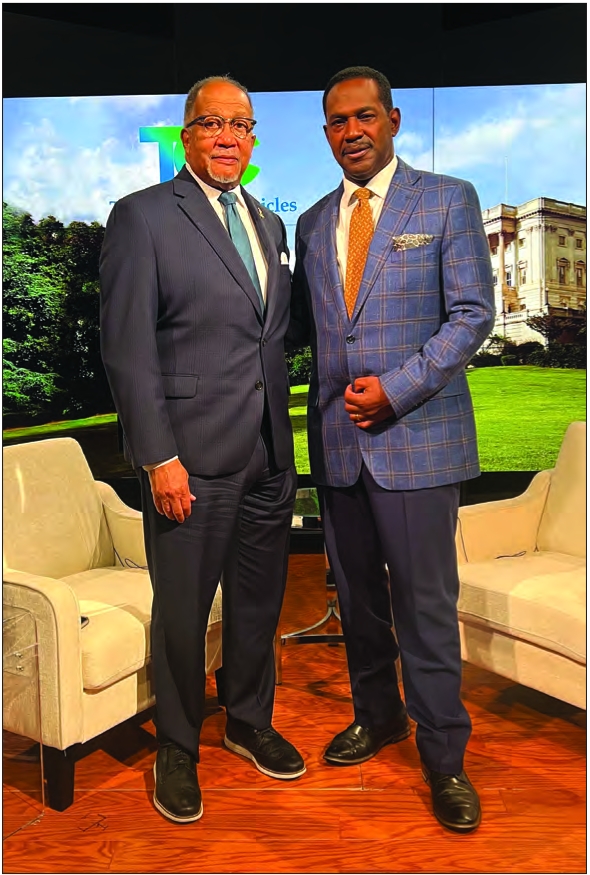
“GBH Amplifies the Bay State Banner” host Ronald Mitchell joined Dr. Ben Chavis, host of “The Chavis Chronicles” for a taping of his NPR television show last month. Dr. Chavis is joining Ronald Mitchell along with Ebony McMorris, ARUN White House correspondent and other national Black journalists for this week’s “State of Black America” forum series/GBH Amplifies taping.On Dec. 11, as part of the Bay State Banner’s 60th Anniversary Forum and the second season of “GBH Amplifies,” publisher and editor Ron Mitchell will host “Democracy on the Line: Black Journalists & The Fight for a Free Press.”
This episode spotlights the alarming erosion of press freedom and the steep decline of Black community newsrooms.
The Banner, established in 1965, has borne witness to a pendulum swing, according to Mitchell, the co-owner of the paper.
Throughout the decades the publication has marked the back-and-forth shift from progress to resistance for Boston’s Black and brown community.
Mitchell described the positive momentum of social and racial progress from the Civil Rights Movement, right up to when President Obama took office. But since then, he explained, that pendulum has swung hard in the opposite direction as the nation has become more polarized and perhaps more conservative, the backlash to progress led to retrenchment.
He remains hopeful about the cycle of progress.
“Our responsibility to our community is not to get caught up in the external hype of what anybody is telling us our messages [are] or anybody telling us our rights,” he said.
The Black press has been essential, Mitchell says, serving as a platform for community information and as documenters of the Black experience over time.
Freedom’s Journal was the nation’s first Black-owned newspaper, based in New York and published in 1827. The publication played a pivotal role in the fight for abolition and provided a counter narrative to mainstream publications that dehumanized the Black community.
Today, the Bay State Banner is the oldest Black-owned newspaper still in circulation in New England, many others having come and gone. There are many challenges to local news sustainability, but much of it comes down to funding and adaptation to new technology.
Mitchell says that despite this, it’s important for the Banner, as one of the few surviving Black papers, to continue to be the voice for the community, showing positive representation and providing people with accurate information.
This week’s forum will highlight the importance of Black-owned papers and Black voices in mainstream media, with a focus on threats to the free press.
According to André Stark, associate publisher and co-owner of the Banner, the urgency of this conversation, and one of the biggest challenges to worry about in the free press, is consolidation and larger companies buying up smaller outlets.
“What is private equity doing buying smaller newspapers? They’re not doing it to enhance the amount of journalism done. They’re using it to constrict the amount of journalism done, and that’s very worrisome to me,” he said.
Stark expressed the importance of Black journalism flourishing in a multitude of areas, such as including Black journalists “in the mix” both locally, and nationally. He also stated that ensuring that these outlets are viable in the future will depend on their ability to embrace digital transformation.
The forum will feature nine national and local journalists, representing a variety media outlets, platforms and mediums:
- Dr. Benjamin Chavis, a prominent activist during the Civil Rights Movement and established journalist serving as executive producer and host of “The Chavis Chronicles” on PBS. Chavis is also president and CEO of the National Newspaper Publishers Association.
- Ebony McMorris, an award-winning journalist from Washington, D.C. who is a White House correspondent at American Urban Radio Networks. McMorris represents one of two Black-owned outlets with dedicated seats in the briefing room.
- Michael Harriot, a columnist for the Grio, a Black-owned media platform that focuses on Black culture and news and founder of Contraband Camp.
- Astead Herndon, host and editorial director of politics at Vox. Herndon is well known for his reporting on the campaign trail at The New York Times and was awarded Journalist of the Year (2025) by the National Association of Black Journalists.
- Philip Lewis, a journalist from Detroit, who is the senior front-page editor of the Huffington Post. Lewis is also president of the Washington Association of Black Journalists.
- Paris Alston, host of GBH News Rooted, a series that focuses on spotlighting underrepresented voices throughout the Boston area, covering a multitude of topics from culture to general news.
- Karen Holmes Ward, former director of public affairs and community services, and former executive producer and host of “CityLine,” WCVB Channel 5 Boston’s weekly magazine program. The trailblazer spent her career dedicated to amplifying coverage on issues in communities of color throughout the Boston area.
- Gary Washburn, sports reporter for The Boston Globe and president of the Boston Association of Black Journalists.
- Brejé Williams, anchor of the Banner’s “Week in Review” and regular guest on WCVB.
The forum will be held at two venues. The first panel will be at GBH Boston Public Library Studio, located at 700 Boylston St., from 12:30 to 1:30 p.m.
The conversation will then move to the Dome Room at the Lenox Hotel, located around the corner from the studio at 61 Exeter St., from 2 to 5 p.m.
Mitchell looks forward to the opportunity to remind people that there are still a number of journalists and news outlets dedicated to truth-telling and providing important information for their communities.
“To remind them that despite you know [what] billionaire dollar media companies might be doing, we are still here telling our message, and they are not going to wsilence us,” Mitchell said. “Our message is not going to be diminished.”
ON THE WEB
For more information, visit baystatebanner.com/state-of-black-america-soba