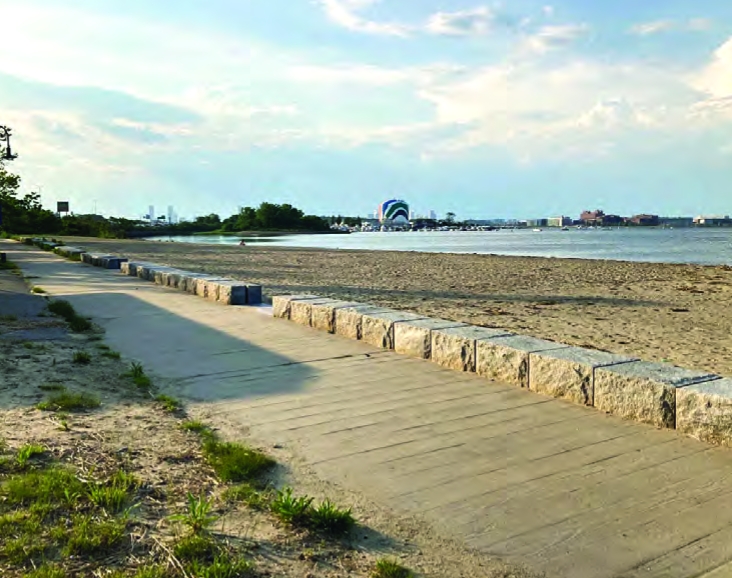
A quiet day on Tenean Beach in Dorchester. A READER ASKS: What climate mitigation strategies are being considered in Boston related to sea level rise? How is funding of these projects impacted by changes in national climate priorities?
A changing climate and rising sea levels mean that our coastal city, one-sixth of which is made up of filled wetlands, needs to raise defenses on its shoreline fast.
Climate resilience work in Boston isn’t new. Almost a decade ago the city launched its Climate Ready Boston initiative, a plan to address multiple needs, including work along the shoreline to buffer against rising sea levels and bigger storms.
Work to address those risks boils down to three main categories on different timelines, said Chris Osgood, director of Boston’s Office of Climate Resilience (OCR), which was formed in August 2024.
The City’s Office of Emergency Management is handling short-term efforts, such as preparing for upcoming storms. This work includes rapid response solutions such as training and education on physical barriers to stop or slow water and community preparedness efforts to equip residents with better information and communication, such as through the Alert Boston notification system, around staying safe during flooding events.
Looking out over the rest of the decade and early into the next, the second strategy involves implementing infrastructure projects specifically for those parts of the city that are experiencing flooding now or are expected to soon.
The city’s third strategy is focused on long-term projects along the coast. That means not only considering just how to protect the city and its waterfront communities, but also how to transform and improve the shoreline.
“What kind of a city do we want to be in terms of our coastal edge?” said Nayeli Rodriguez, deputy director of the OCR. “What economic, social and recreational activities can we explore and lean further into in the next decades, as we’re also planning for risk?”
Part of that work involves looking toward green infrastructure and solutions that use or mimic nature to increase resilience. A 2021 report from the International Institute for Sustainable Development found that nature-based infrastructure is up to 50% cheaper than “gray” infrastructure — more traditional solutions like building a seawall — while offering 28% better value for money than the alternative.
In Boston, that sort of coastal resilience solution might mean restoring and caring for native salt marshes, which are natural buffers against the effects of the ocean, like the city is pursuing at Dorchester’s Tenean Beach.
It could also be like what’s unfolding at South Boston’s Moakley Park, where the city is looking to create raised hills on the edge of the park that mimic naturally occurring New England shorelines.
Green infrastructure solutions offer new protections without creating new barriers between communities and the waterfront, Osgood said. “It is our focus to try to make sure that, to the extent possible, [coastal resilience infrastructure] is enhancing quality on the 364 days a year when it may not be needed for flood protection,” Osgood said.
A changing federal landscape
Much of how the city currently thinks about coastal resilience is based on dedicated planning over nearly a decade.The mission now is to put many of those plans into action, Osgood said. But complicating that mission is a shift in federal priorities under the current administration.
A September analysis from the National Resources Defense Council, for instance, found that the Trump administration had cancelled or frozen more than $29 billion in federal grants for environmental and renewable energy efforts.
Boston wasn’t spared.
When the Trump administration cancelled the Federal Emergency Management Agency’s Building Resilient Infrastructure and Communities (BRIC) program in April, Boston lost more than $30 million — roughly a fifth of the $150 million that Mayor Michelle Wu has committed to climate resilience projects. Some $22 million through the BRIC program had been awarded for resilience work at Moakley Park and $11 million for the Tenean Beach project. Osgood said the city is working to find alternative sources of funding for those projects.
State effort looks to widen the lens
At the state level, too, resilience officials are feeling the squeeze.
“I don’t think it will be a surprise to anyone that we’re not going to be able to make up for lost federal funds,” said Deanna Moran, Massachusetts’ chief coastal resilience officer.
But the federal shortfall is not keeping the Commonwealth from trying. In June, the Healey-Driscoll administration filed its MassReady Act, a $2.9 billion bond bill to address environmental needs across the state over five years. If signed into law, it would direct $200 million toward community-based resilience programs like the Municipal Vulnerability Preparedness program and the state’s ResilientCoasts initiative. This latter program crosses town and city lines to instead delineate 15 “coastal resilience districts” broader regions that share environmental features as well as flood pathways, prominent risks and types of development as a way. In doing so, the initiative brings together communities with similar needs.
“If you’re neighboring communities, you’re more likely to have very similar top climate hazards identified and very similar issues that need to be addressed,” said Van Du, director of environmental planning at the Metropolitan Area Planning Council.
Through its plan, the state is hoping those districts can foster more collaborative efforts — an important step as neither climate impacts nor residents’ lives are constrained by municipal boundaries, Du said.
Regional efforts would also create better mechanisms to make sure municipalities aren’t implementing solutions that clash or duplicating work. Joint efforts could also mean saving dollars on permitting and consulting costs, as well as helping shape which projects are prioritized.
Osgood said Boston is eyeing possibilities of working with municipal neighbors on coastal resilience work. Boston is working with the City of Revere, for instance, to address a flood pathway that impacts both East Boston and Revere.
Moran said that through the ResilientCoast plan, the state hopes to be a leader when it comes to climate mitigation efforts, helping fill gaps that municipalities can’t tackle themselves but nonetheless need to be addressed.
She pointed to steps across state offices and departments like establishing flood risk disclosure and updating state building code.
“Those are the things that the state can do, and that’s going to have an enormous benefit for our coastal communities, but they can’t do that on their own,” Moran said.