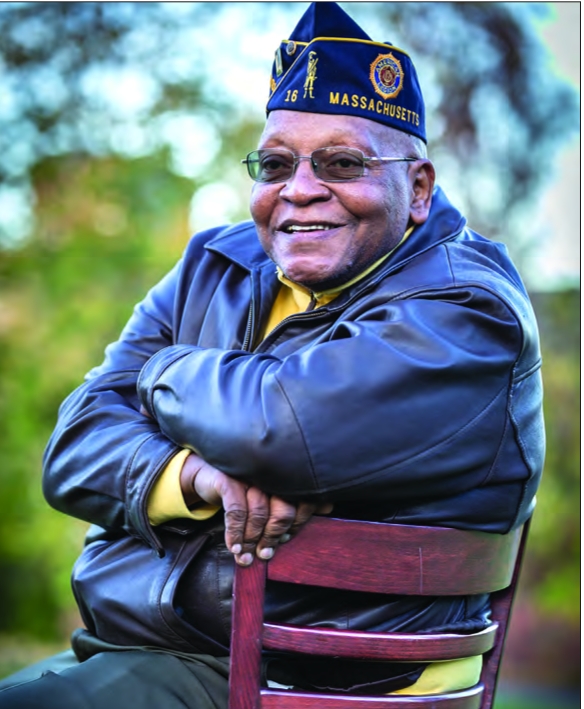
Haywood Fennell Sr., tireless veterans advocate, is the founder of Tri-AD Veterans League. 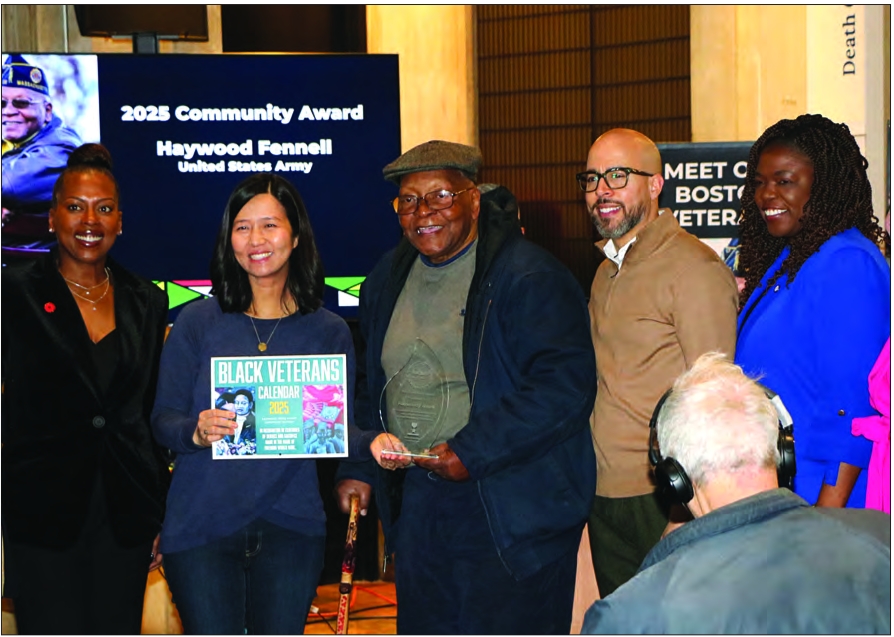
Fennell (center), with Boston Mayor Michelle Wu (second from left), receives a 2025 Community Award.
After serving six years in the United States Army during the Vietnam War, Haywood Fennell Sr. found the transition back to civilian life to be tough.
When Fennell returned home, he had to learn to navigate family obligations while managing the negative impact of some of the more challenging things he experienced in the military — inequity, racism and the contradicting narratives in the U.S. media questioning the war he fought.
Fennell also battled mentally with vivid memories of the bodies claimed by fight. Incarcerations and a substance abuse addiction disrupted his life.
The turning point was a trip to the Veterans Administration hospital, where he took part in a detox program. There he prayed, asking God to help him to get and stay clean, and to begin writing. It was at this moment he began to turn his life around, giving him the dignity, respect and confidence to become an advocate for veterans’ care and services.
Fast forward to the present day where he continues his advocacy for veterans as founder of the volunteer organization, Tri-AD Veterans League. Its mission is to provide veteran-to-veteran support and to tap veterans as a resource to advance community development through public education and empowerment.
As the founder of the organization, Fennell said he is talking to leaders in the community to increase awareness about the fact that veterans of color are still confronted with systemic racism when attempting to access services and care for themselves.
His organization helps “navigate and negotiate for solution-driven strategies regarding health, both mental and physical, that heals the wounded veteran.”
Fennell shared what inspired him to start this organization, which happened while he was attending school in Wilmington, North Carolina.
“I was in school and talking to veterans that were [also] going to school. We really didn’t have a lot going for us. And so, I said, ‘Well, let’s try this. Let’s try advocating for the things that we need.’ Then, I moved to Boston and I was working at Boston University. They had a big flood down in Arkansas,” he said. “I got some guys together, we collected a lot of clothes and sent them down there. Then, we started to formalize and do things in the community for veterans [and started] advocating for veterans [by using] our experience, as we do.”
He calls it “the beyond the uniform strategy,” where he and his group use their military experience and their formal education to make contributions to the community. “Veterans are an overlooked and underused community resource,” he said.
Fennell also shared some of the early challenges he faced when he first started Tri-AD, which included educating the public about who veterans really are and advocating for culturally competent care in the mental health space.
“I remember being called everything but my name in the military, but [that] didn’t stop me. I didn’t feel that I was on that level to respond to those things, because I wore the uniform, I came to protect and help people, [but] ... people didn’t help veterans coming back,” he said. “Veterans came back in bad shape, in very bad shape, mental stress. I was included in there, but I didn’t get recognized as having mental stress issues until later on.”
He has worked with Whittier Street Health Center in Roxbury with its ongoing program for veterans, helping the health center to be sensitive in providing services and care to this population.
“Why would you tell someone how you really feel if you don’t trust them, right? ... I continue to do that work, so that we can better heal and deal with our situations and not succumb to the addictive process thinking that we can save ourselves, be it [through] alcohol, drugs. ... I’m trying to bring the people in, not keep the people out,” he said.
Fennell said he has had a conversation with the city’s Commission of Veteran Services and is planning a meeting with the executive director of the Urban League of Eastern Massachusetts to discuss how to help veterans in the community who have mental health challenges.
“All veterans don’t go to the VA hospital for treatment. We [have] people with dementia, Alzheimer’s and they need to be taken care of. So, I’m trying to work to get that level of involvement between the commissioner’s office and other community-based organizations,” he said.
Fennell, who trained at the Armed Forces Information School at Fort Slocum, New York, as a public information officer, hopes to showcase the presence of African American veterans — who have made a contribution to the United States, from the American Revolution to the present day.
This work includes his serving as chairman for two terms on the Veterans and Friends of the General Edward O. Gourdin Statue Committee, where he helped raise funds for the statue of Gourdin, which was installed in Nubian Square in 2023.
Most recently, Tri-Ad has been working on one of its biggest projects to date, the creation of “Triumph, a Forgotten History,” an exhibition about the under-representation of African American Veterans from the American Revolution to World War II.
Fennell commissioned and paid for this art exhibition, which features 13 inspirational pieces that have been displayed in many places, including the State House.
After the Congressman James McGovern suggested that the exhibition and presentation could inspire a commemorative postage stamp, Fennell and his organization went to work collecting signatures for a petition and worked on the proposal. The project has been 10 years in the making.
“We have a video; we have a petition signed. We have letters of support…and we have the exhibit that hopefully we [can] take and move it into the new headquarters at 24 Court Street of the Office of Veteran Services for the city of Boston,” he said.
Fennell shared where he sees the organization heading in the future.
“Always in a building mode.
We have a radio and a television program at BNN media services for the last more than 10 years. We focus on encouraging people, building a message of hope, because that’s the only way we’re going to make it,” he said.
Fennell is passionate about supporting his fellow servicemen and women. He noted that many of them raised their hands to serve but came back with their hands down, transformed by the experience forever.
“A lot of them that came back, and the eyes would look like a dead fish in the fish market on ice, unable to tell their stories, unable to share, to get rid of that weight that was on them,” he said.
“I’m looking forward to establishing an ongoing process of service and care with dignity. It’s the bottom line, restoration,” he said.
“I am a veteran, but more importantly, I am an American.”