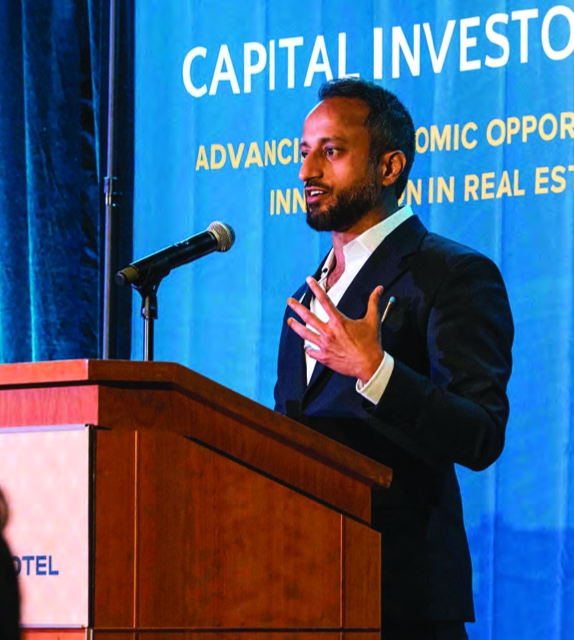
Dave Madan, founder of The Builder Coaltion, at the organization’s inaugural Capital Investors Summit in September. 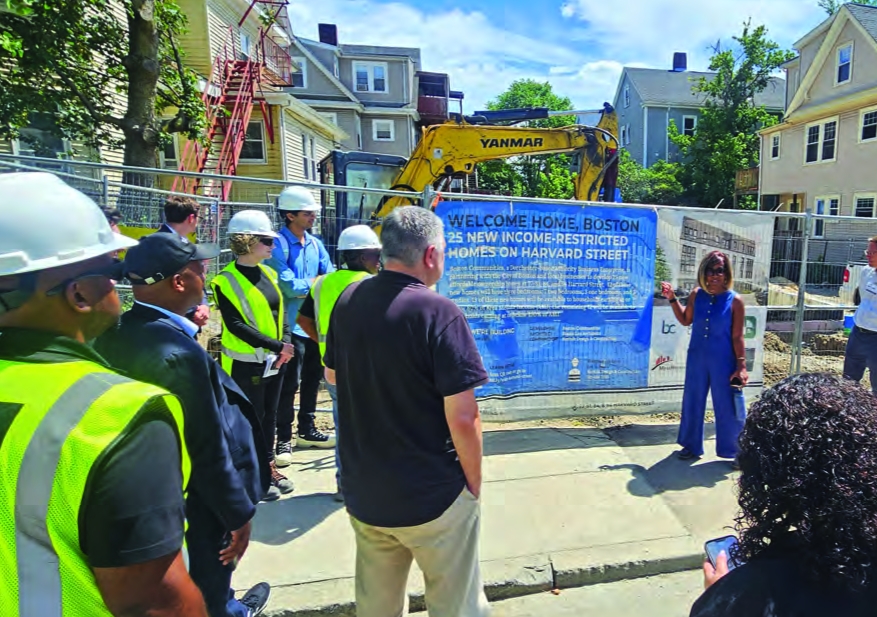
Marie Morriset, principal at Boston Communities and former TBC Fellow, speaks on a site walkthrough.
Dave Madan has a lot to be thankful for this season. The founder and executive director of The Builder Coalition (TBC) was selected as one of Boston Business Journal’s Power 50 this year. The honor is given to individuals who are making positive changes in the Greater Boston area in the realm of business and nonprofits.
Madan, who founded the organization in 2017, has been in the business of making the notoriously clannish real estate development and construction industries more accessible and equitable — with results.
The Cambridge native got into this line of work after years of political and community organizing. Before The Builder Coalition, Madan had founded three nonprofits to tackle food justice and urban farming in Greater Boston.
“I have what I call a bad habit of trying to solve problems and starting these nonprofit organizations,” he joked. The through line of each venture is access to land and economic opportunity.
In between a Madan family holiday brunch and birthday celebrations, The Banner caught up with the entrepreneur over Zoom to discuss topics ranging from gaps in the industry and the legacy of his work.
“Real estate comprises two-thirds of net global wealth,” he said. “I’ve done a lot of political organizing; I’ve worked in a lot of different realms of community development and I’ve come to the conclusion that the changes I want to see in the world around us will only be possible if we help create them.”
The Builder Coalition aims to increase diversity and accessibility in the real estate sector and expand economic opportunities for building professionals.
It does this through two pillars. The first is the TBC Institute, which provides educational and networking opportunities through fellowships and seminars for emerging professionals.
The second is the TBC Innovation Center, a think tank that researches and disseminates information on best practices for creating access to land, capital and education across the United States.
Beginnings
The Builder Coalition began in Madan’s living room. As a managing partner in his family’s development company, Boston Investments, he noted the lack of diversity at industry events. As an Indian American himself, this compelled him to want to connect racially diverse developers, contractors and construction workers with industry leaders like trade associations, financial institutions, government agencies and larger development firms.
“We had the privilege and fortune of a lot of them wanting to come to the table and say ‘Great, how can we be part of this?’” Madan noted that industry leaders often said they didn’t know where to find minority talent to partner on projects. Thus, the coalition formed. Within a few years they marshaled a network of 500-600 people of color in real estate.
A lack of diversity
The real estate sector is not a diverse one. According to the Bureau of Labor Statistics, the construction sector is 5% Black, 30% Hispanic and 61% white. For real estate developers of color, the numbers are even more grim.
A 2023 Grove Impact study identified the dearth of Black and Hispanic real estate developers nationally, calling it a “representation crisis.” Black developers represent 0.4% of the industry while Hispanic developers make up 0.16%.
Together they make up less than 1% of the industry. Despite underrepresentation, many small-scale Black- and Hispanic-owned firms are successful.
Local small-scale developers are typically recruited by Madan’s organization for its six-month fellowship programs through the TBC Institute. To date TBC Fellows have delivered 1,032 new housing units across Massachusetts and managed $507 million in real estate investments.
For many fellows, after two years post-fellowship, builders find they’ve increased their portfolios and their development capacity by 400 to 500%. The first cohort saw their revenue increase 158%.
Madan says the fellowship equips developers and builders with hyperlocal and technical knowledge and mentorship to have the opportunity to scale to a mid-size development entity.
However, for medium-sized developers with annual revenues between $350,000 and $16.9 million, Black developers experience a revenue gap nationally.
Black-owned organizations at this level typically generate less revenue than both their Hispanic and white counterparts. For larger developers with annual revenues between $17 million and $49.9 million, Black developers face a revenue cliff.
Only six Black developers and one Hispanic developer were identified at this level compared to 382 white large-scale developers nationwide. There were no Black-owned developers identified in the range of $50 million or more and only one Hispanic developer compared to an additional 382 white developers in this range.
The study notes that removing barriers for Black and Hispanic real estate developers “would be an important step toward addressing the injustices that have made it harder for many Black and Hispanic people to own businesses and real estate.”
The ripple effects of having more Black and Hispanic real estate professionals “could create more than 50,000 new Black and Hispanic developers, almost two million new jobs, and more than $100 billion in new business revenue.” The possibility of financial opportunity and stability through real estate could spur neighborhood revitalization efforts without much displacement.
Closer to home the data reflects similar trends seen at the national level. When discussing the Boston market, Madan points to a 2024 study by the Urban Institute. The study focuses on large, multifamily housing developers in Boston.
The study identified 113 development entities that had projects with at least 10 active housing units in the city between 2019 and 2023. Of the 113 large developers, only 92 could be identified by race and only 20 (or 22%) were led by people of color. There were just 22 women-led development organizations (or 23%) in Boston.
“Breaking open access to this field is the key source of wealth, and therefore power,” said Madan. “The way people get into the field is so often through existing social networks rather than any kind of open process that allows people to enter.”
Madan explained that there are three key constraints preventing people from entering the real estate and construction market.
“There’s technical knowledge that’s required, which can be very hard to get access to. There’s social capital and social networks that are needed to find people to do business with and to get mentorship about how the field works.
And then there’s the actual financial capital, all of which are incredible barriers to entering and moving through and succeeding in the field,” he said.
A 2022 study by the Brookings Institute found “inclusive prosperity,” or economic growth and development that’s shared by members in a community, to be a driving force in reducing neighborhood poverty without displacement. It’s a concept Madan was well aware of, and in the same year he created the first cohort of TBC Fellows.
Since 2022, there have been five cohorts that include 56 individuals and 42 firms. The first fellowship was centered around the Boston Metro area. Subsequent fellowships have included gateway cities, or midsize cities that were former centers of industry like Brockton, Pittsfield, Lowell and Worcester.
Madan shared stories of success of TBC Fellows who have applied these principles of inclusive prosperity in their upcoming projects.
Grove Hall native and Mattapan resident Dariela Villón-Maga of DVM Housing Partners, is developing BLUME on the Ave, a 30-unit affordable housing complex on Blue Hill Avenue. Marie Morisset and Phillip Cohen, principals of the firm Boston Communities, are building Welcome Home Harvard, a 24-unit affordable housing community in Dorchester. Adler Bernadin, a Mattapan native and a founder of Norfolk Design and Construction, is constructing 20-units on empty lots dotting Geneva Avenue and MacNeil Way in Dorchester geared to first-time homebuyers.
As TBC Fellows’ success grows, so does The Builder Coalition. In September, the organization hosted its first Capital Investors Summit, which connected over 30 capital investors and over 50 developers. It is estimated that $16 million in real estate deals may occur as a result of the summit pairing investors and developers. Now, Madan wants to take his findings and replicate the success of his fellows nationwide.
Growth and change
In 2022 he spent a transformative sabbatical year in Greenville, S.C., a conservative city known colloquially as the “buckle of the Bible Belt.” Surrounding himself with those who have different life experiences and perspectives, he was able to find the bridge connecting people from both sides of the political aisle.
“There is widespread unhappiness right now with the way our society is governed,” he said, “The systems are corrupt in that they’re kind of enabling those who have resources to continue to create structures that allow us to perpetuate and grow that [inequality and corruption],” he said.
He also realized that if he wants to share his findings nationwide, he’d probably have to change some things. The Builder Coalition was originally founded as The Builders of Color Coalition. A few years ago, he sensed the growing national sentiment turning away from DEI. In 2023 the Supreme Court repealed race-based affirmative action; in 2024 his travels in northeast Pennsylvania cemented his decision.
“I bought our [current] domain name Oct. 6, 2024, while I was in Mount Pocono or something,” he said. “We didn’t change our name that day. It was a process over many months, and we had to have conversations with board, staff and a whole lot of our partners.”
He notes that many people he discussed the name change with were very supportive and understanding. Only one person gave him pushback but eventually came around given the current political climate. Madan insists that accessibility and equity to real estate opportunities for underrepresented individuals regardless of background is still the ethos of the coalition.
Madan describes being Indian American in this industry as “sitting in this in-between place.” He chooses to use the in-between to build bridges connecting seemingly disparate worlds with economic opportunity.
“I wish we [Indian Americans] took the resources that we had and realize that we’ve been given an incredible opportunity. Yes, we’ve also worked within that system to create, but we’ve also been given a lot of opportunity, and it is our duty to ensure that opportunity continues to be created for other people,” he said.
He continued, “Particularly those who hustled and struggled and whose liberation process has allowed ours to even be possible. So, I owe it to people. I owe it to bless folks. I owe it to other people.”
ON THE WEB
Learn more about Dave Madan and The Builder Coalition at buildercoalition.com