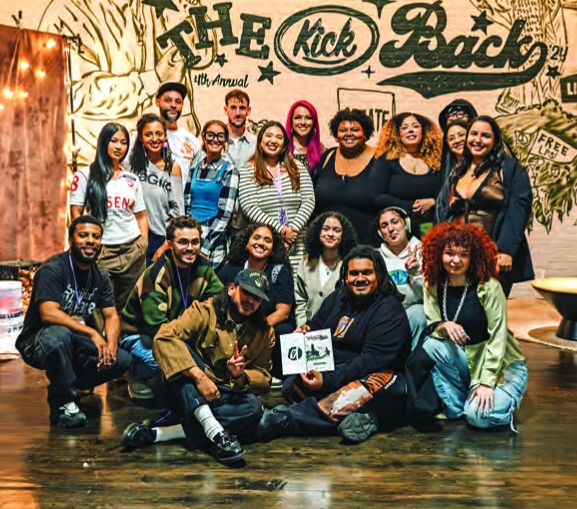
The Elevated Thought team.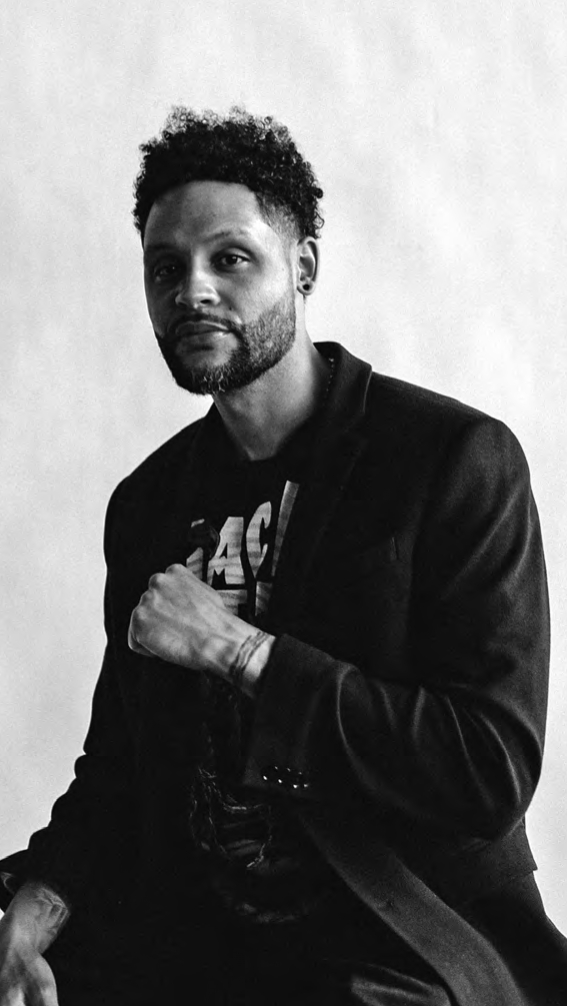
Marquis Victor, founder of the nonprofit Elevated Thought.
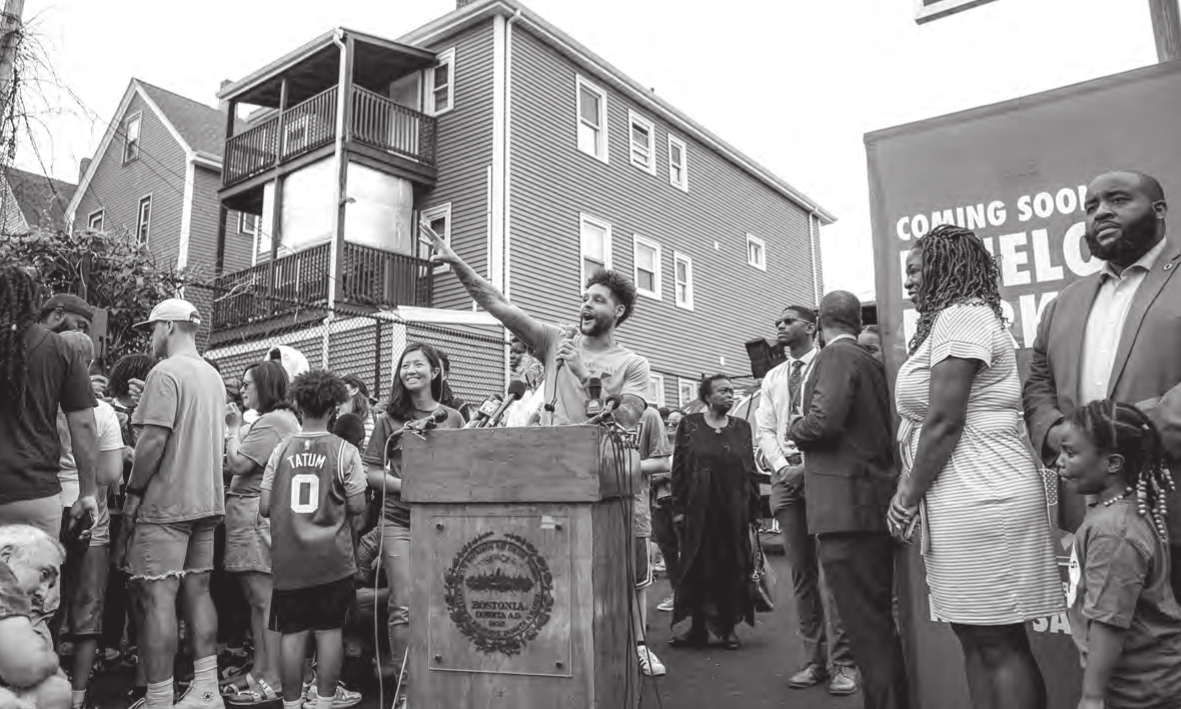
Award recipient Marquis Victor addresses the crowd with Mayor Michelle Wu earlier this year.
As a young teen who moved around often, Marquis Victor would take comfort in his creativity — drawing, writing and exploring — to feel a sense of belonging during his middle school years.
By the end of his sophomore year of high school, he abandoned those artsy inclinations, switching his focus to playing basketball with friends.
His passion for playing ball led to a college scholarship, however, the moment did not last. Victor was expelled just five months into his freshman year and his mother refused to let him live at the family home.
With no place to go, he ended up in Providence, R.I., at a friend of a family member’s home. After some months passed by, Victor found an old notebook and got back in touch with his creative side. He also began searching for answers to big existential questions like, “Who am I and what am I doing with my life?”
As he returned to his love of creating, he also had what he calls “a pseudo internship” at a local Rhode Island school. One day he went into an eighth-grade classroom and saw a teacher and a student swearing at one another. This incident caused Victor to ask bigger questions about society and the systems and structures that we are all born into. He wondered why inequity exists, and how much has really changed since the Civil Rights Movement?
Fast forward to 2008, when one of his friends was doing a mural project in a rented construction warehouse. He joined his friend, writing and creating each step of the way.
As they invited more of their friends to join them in the warehouse, he realized that they were the ones who should create solutions to some of these heavy existential questions using innovation and artistry. They also knew they needed to empower youth, who have always been essential for any social change.
All this led to Victor creating his nonprofit, Elevated Thought, in 2010. Designed with the belief that creativity is a form of liberation, the organization provides youth and artists of color creative access, exposure and opportunities in Lawrence.
He and his staff’s commitment to youth engagement and empowerment has not gone unnoticed as he will be honored at this year’s MassArt Common Good Awards on Saturday, Dec. 6.
The Common Good Awards celebrate artists, educators, and cultural leaders whose work demonstrates the transformative power of art and design in civic life across Massachusetts and beyond.
Victor talked about what motivates him to engage in this work with youth on a daily basis.
“As humans, we should all find our own ways. It doesn’t have to be starting an organization or anything like that, but we should all find our ways to chip away at creating a more human-centric world where more individuals, especially people of color can flourish and self-actualize,” he said.
“It just keeps me going that this is my small part,” he said. “Getting to that point so other people can take this over … move this mission into the future in a way that’s going to serve other generations. That’s a driving factor to keep going and keep me motivated.”
He also said that while he has been able to work with thousands of youth through workshops, programs, public art initiatives, schools and residencies, he does not focus solely on numbers alone, but on the quality of their work and programming.
“I’m more concerned about the qualitative data: the narratives, stories and the impacts that we can’t really track or see, because sometimes it’s a seed that’s planted. Somebody else gets to take that, it blooms somewhere, and then they can give. I’m a firm believer in reciprocal growth. So, we just keep doing the work,” he said. “We keep it authentic, keep the focus on the mission, move with a sense of urgency and impact will be felt.”
Victor also shared why he believes that the arts are important for youth, especially youth of color.
“I think it goes back to my own narrative, where you know creativity is not just about making art, it’s about how you see yourself, how you see the world around you, how you see others in different light, colors, textures, contours,” he said. “Creativity allows [a] deeper sense of possibility and that starts with self. So, when you’re in a space where you can create, you can access those different parts of your brain and those skill sets can open up doors that you can’t readily perceive, if you didn’t have that opportunity otherwise.”
He also talked about how he feels receiving his Common Good Award for his service to youth and artists of color.
“When I first got the award, it’s just you feel a little weird because you’re like, ‘Why me?’ because there’s so many other people that have been doing this work for a long time, so many deserving folks. I’m grateful, but this is really about the process more than a particular outcome of an award, or recognition,” he said.
“With the process comes the people. Without the people, the youth, the artists, the family, community, thought partners — there is no Elevated Thought. So, I’m grateful that this award gives a platform where I can speak on why this is important — why creativity is a form of liberation. That’s dope. It’s just a testament to the process and the people throughout the years.”
One of those people is Daniel Elias Carrero, a former student turned full-time creative writing teaching artist at Elevated Thought. Carrero shared how proud he is that Victor has been “a profoundly, impactful mentor throughout most of his young adult life.”
“I’ve known Marquis Victor since I was 17, a student in his program. Now at 26 I am a full-time member of the staff,” he said. “As a person and as a professional, his dedication to creativity, action and community has set an exceptional example for me to follow.”
“As a leader, the culture he’s created at [Elevated Thought] is truly collaborative, warm, and growth oriented. The most important thing Marquis has taught me is that work and career doesn’t have to exclude purpose and passion.”