
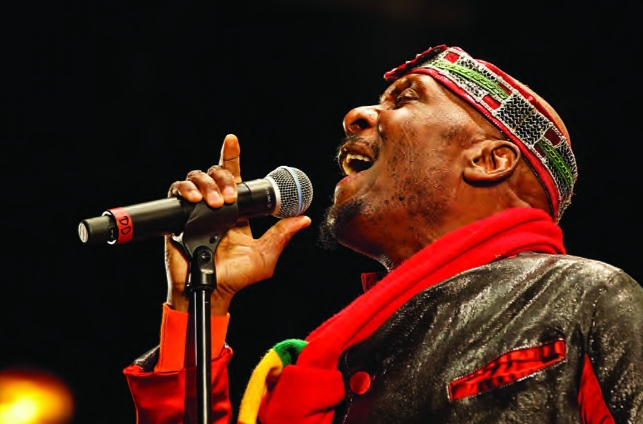
Jimmy Cliff performing in 2012.
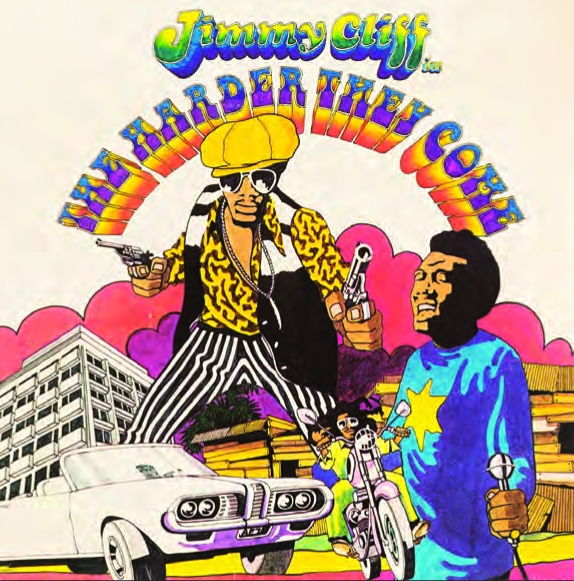
The album cover of the soundtrack to the 1972 film “The Harder They Come.”
Before dreadlocks became a thing and reggae a rite of musical passage, there was Jimmy Cliff.
The calypso and ska-infected 1969 pop hit “Wonderful World, Beautiful People” was the first landing of Cliff’s liquid tenor on the American radio dial — a foreshadowing of the Jamaican singer and songwriter’s future hold on the U.S. soundtrack.
Within a few years, Cliff’s sweet, syncopated melodies and lyrics of hope and resistance would find an eager and early audience in Boston through the landmark 1972 film “The Harder They Come” and its midnight showings at the Orson Welles Cinema in Cambridge.
Cliff, who died Nov. 24 of pneumonia at his home in Kingston at age 81, soon had a cult following that spread far beyond West Indian neighborhoods to launch reggae as a force that has yet to let go of the world’s musical imagination.
Cliff, starring in the role of Ivanhoe “Ivan” Martin, brought to life the story of a musical prodigy who leaves his rural village to seek stardom in Kingston, only to encounter deceit by record executives and abuse from police. While singing songs of defiance and spiritual longing, Ivan becomes a gun-to-ting folk hero in the Jamaican capital, his vengeful rise to short-lived glory accompanied by a score of stirring anthems that became a staple of the early reggae playlist around the globe.
That his stolen song — the movie’s title track — becomes a national hit as he cuts a swath through drug lords and corrupt constabulary only enhances his legend and stirs even greater support among the poor residents of the island’s shantytowns who cheer Ivan’s strikes against police abuse and corporate venality.
The lyric “I’d rather be a free man in my grave / than living as a puppet or a slave” would resonate around the world.
The film found a beachhead in Boston, landing in 1973 at the Orson Welles where midnight shows over nearly a decade drew eclectic audiences who viewed Cliff slashing his way across the screen as a haze of ganja smoke rose to the theater’s ceiling.
The movie struck a chord in a culture reeling from the Vietnam War, rising racial tensions and the collapse of the anti-poverty movement. The narrative of an anti-hero’s resistance to the forces of greed and corruption filled a psychic vacuum. It also emerged as a point of pride for members of the Caribbean community. Cliff’s title track, along with heartache ballads like “Many Rivers to Cross” and “Sitting in Limbo,” evoked emotional longing and marked a stark departure from the folksy compositions of Caribbean songs made popular in the United States by artists like Harry Belafonte.
“Jimmy Cliff was special,” said Robert Wint, president of the Boston-based Jamaican American Community Development Foundation. “His music was not just about cars and girls. It was about a cause — all the things a person cares about. His faith, his family, social justice, his community.”
Wint, a Jamaica-born state health care executive who moved to Boston in the 1990s, said clubs like Cambridge’s Western Front and local radio stations helped build reggae’s audience in the city and spread its popularity through students passing through the area’s many colleges and universities.
Cliff was the vanguard “and then there was Bob Marley, Toots and the Maytals and so many others who found success here,” said Wint.
Other songs from “The Harder They Come” — like Maytal’s “Pressure Drop” and “Sweet and Dandy,” along with “Johnny Too Bad” by the Slickers and Desmond Dekker’s “007 (Shanty Town)” — helped fuel reggae’s growth. The grooves of millions of vinyl albums spinning on record players in college dorms and bedrooms around the country were worn out in tribute to the movie’s score.
While Cliff and other early reggae artists found widespread popularity in Africa and South America, their most passionate following in the United States came from white college students, Baby Boomers and Gen X listeners. Young African Americans would respond more fervently to the second wave of reggae influence as New York DJs, many with Jamaican roots, borrowed from the genre in dubbing and toasting to launch hip-hop and rap.
Jimmy Cliff, born in 1944 as James Chambers, migrated from a rural parish near Montego Bay to Kingston at age 12 and was raised with eight siblings by his father and grandmother in a tough neighborhood in the western precincts of the city. His talent, recognized at an early age, developed in school and church choirs and was shaped by listening to U.S. pop and R&B hits.
“I grew up economically poor, spiritually rich,” Cliff told National Public Radio in a 2010 interview. “So even though I had this condition, that kind of balance made me always take the downside and kind of put an up to it.”
The rising singer, choosing a new surname to match the heights he hoped to reach, achieved his first domestic success as a teenager, breaking into the charts in 1962 with “Hurricane Hattie.”
Appearing at the New York World’s Fair in 1964 to perform in the Jamaica pavilion, Cliff met Chris Blackwell, signed with his influential Island Records in 1965 and moved to London later in the decade. “Wonderful World, Beautiful People” helped build an audience as did “Vietnam,” a searing protest song that Bob Dylan admired.
But his time in England was difficult for the ambitious island singer with a strong Jamaican patois in the class and accent-conscious country. “I experienced racism in a manner I had never experienced before,” said Cliff in an interview.
Back in Jamaica as reggae surged in local popularity, Cliff was an established star when approached by Perry Henzell to take on the lead role in the low-budget production “The Harder They Come,” Jamaica’s first independent full-length film. His rocksteady swagger, electric smile and lean body lit up the screen as he evolved from a raggedy country boy into an outrageously dressed cinematic gangster — Johnny Too Bad come to life.
The movie, Cliff told the Guardian newspaper in 2021, “did so much to bring [reggae] to the world. … It showed the hardship that went with the music and the joy and celebration of those same people. It gave the music depth and got Jamaican music a lot of respect around the world.”
While hailed as the first global reggae star, Cliff continued to evolve musically, leaving Bob Marley, Toots Hibbard, Peter Tosh and others to carry the mantle of the rising genre. Cliff recorded with a wide array of artists and dabbled in other musical forms. Playing with world music stars around the globe, he had hits with covers of Johnny Nash’s “I Can See Clearly Now” carry the mantle — featured in the 1993 film “Cool Runnings” about the 1988 Jamaican bobsled team that competed in the Olympics — and Cat Stevens’ “Wild World.”
Hailed throughout his decades-long career for his music as well as his work for refugees and South African liberation, Cliff was nominated for Grammy Awards seven times and won twice — in 1986 for best reggae recording for “Cliff Hanger” and in 2013 for best reggae album for “Rebirth.” He was inducted into the Rock & Roll Hall of Fame in 2010.
Cliff ’s musical journey ran in parallel to a lifelong spiritual evolution.
Wint noted Cliff ’s progression through Christianity, Rastafarianism and Islam while also studying Buddhism and Judaism before arriving at a kind of universalism embracing all faiths. “He became who he wanted to be, a man who was so many things, who evolved over and over and over again,” said Wint.
Wint, whose nonprofit has been raising relief funds for Jamaican victims of October’s deadly Hurricane Melissa, said Cliff always stood up for the underdog and brushed off criticism from island elites who resented how his music and film career exposed the poverty, violence and despair among Jamaica’s poor.
“I’m from the lower class of society,” Cliff told the Independent newspaper, “and I tend to support them rather than the upper class.”
Cliff is survived by his wife, Latifa Chambers; and their two children, Aken and Lilty Cliff.