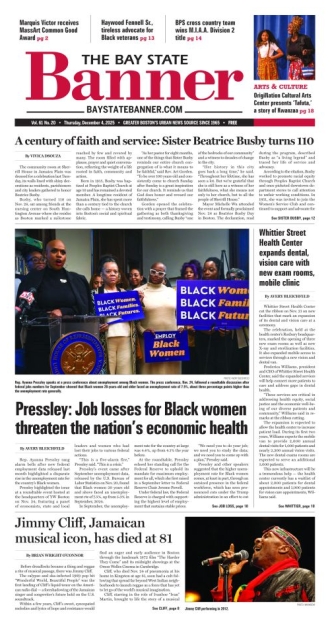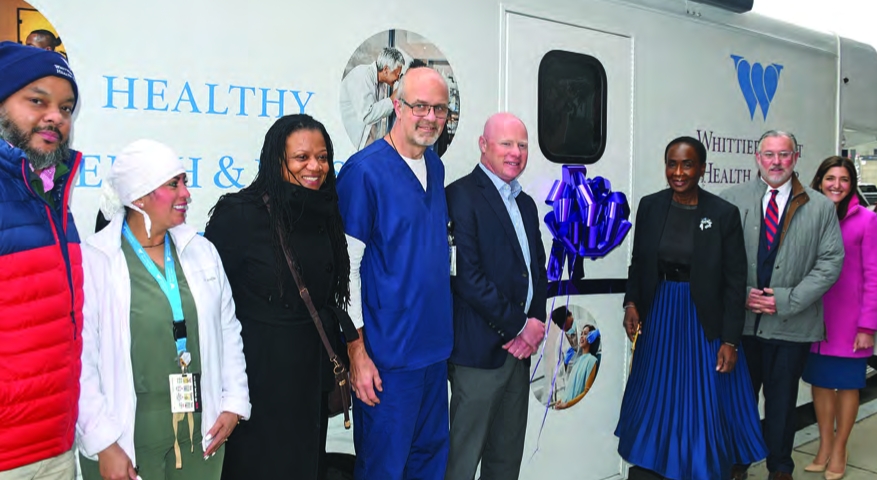
(Above) Leaders and members of the Whittier Street Health Center community stand with representatives from insurance provider Altus Dental at a ribbon cutting for the health center’s new mobile dental and vision care van. The van, along with new exam rooms in the health center’s brick-and-mortar building, mark an expansion in the center’s capacity to provide vision and dental care. (Below) Frederica Williams, president and CEO of Whittier Street Health Center, speaks at the ribbon cutting. 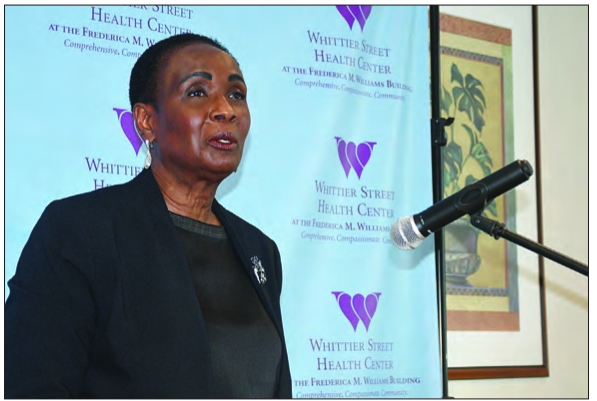
Whittier Street Health Center cut the ribbon on Nov. 21 on new facilities that mark an expansion of its dental and vision care at a ceremony.
The celebration, held at the health center’s Roxbury headquarters, marked the opening of three new exam rooms as well as new X-ray and sterilization facilities. It also expanded mobile access to services through a new vision and dental van.
Frederica Williams, president and CEO of Whittier Street Health Center, said the expanded services will help connect more patients to care and address gaps in dental health.
“These services are critical in addressing health equity, social justice and the economic well-being of our diverse patients and community,” Williams said in remarks at the ribbon cutting.
The expansion is expected to allow the health center to increase patient load. During its first two years, Williams expects the mobile van to provide 2,000 annual dental visits for 1,000 patients and nearly 2,300 annual vision visits. The new dental exams rooms are expected to serve an additional 5,000 patients.
This new infrastructure will be a tremendous help — the health center currently has a waitlist of about 2,000 patients for dental appointments and 1,000 patients for vision care appointments, Williams said.
Those long waitlists make it challenging to get patients to come back for follow-up care.
“We hope to … get them in when they need the care, and make sure we follow up and close the treatment,” Williams said.
According to a 2024 report by the U.S. Centers for Disease Control, nearly 21% of adults between the ages of 20 and 60 years old had one or more permanent teeth with untreated decay. About 50% of children between the ages of six and nine had one or more decayed, filled or missing primary or permanent teeth.
That report found that populations experiencing higher poverty tended to experience worse dental health outcomes.
Drayton said the expansion will mean “the best dental care from a local facility that will give them that one-on-one service.”
Residents at the Alice Taylor Apartments have a long-standing relationship with the health center, she said.
“It’s not like when you go into a dentist’s office when you don’t know anyone,” said Matilda Drayton, chair of the Alice Taylor Apartments advisory council. “Over in Alice Taylor, they do have a relationship with the center. That makes a big difference.”
Dr. Rene Crichlow, chief medical officer at Dorchester’s Codman Square Health Center, said she views the expansion as a demonstration of Whittier Street’s commitment to its community.
“They’re going into the community with what people need,” said Crichlow, who attended the ribbon cutting. “They’re like, ‘We’re backed up in the building. Let’s take dental and eye care into the housing developments; let’s go where the people are.’”
The health center’s new mobile dental and vision clinic expands its existing fleet of five mobile care vans. The health center has been conducting mobile care work since 2018, Williams said.
That kind of outreach can be especially important in the communities Whittier Street serves, she said.
“I believe that for communities such as ours, where people struggle with access to transportation, work schedules, lack of insurance … we’re able to remove those barriers and meet people where they are,” Williams said.
The new vision and dental van will join the current fleet: two vans offer primary care and vaccination services, one is used for infectious disease care and one helps community members access social services and behavioral health care. The vans will service public housing developments, schools and other places identified as hotspots like Nubian Square and Mass and Cass.
“We’ve seen that it is a good opportunity to connect to people who would otherwise be difficult to reach, or who would otherwise have a challenge being connected to care,” Williams said.
For the health center, the vans are also an opportunity to expand economic mobility opportunities.
The federal grant that allowed for the purchase came through the Office of Community Services, which Williams said invests in job creation in low-income communities.
That prompted Whittier Street to work to hire 15 Boston Public Schools students and train them as dental assistants in conjunction with the van.
Crichlow views this as an exciting moment for the expansion of mobile health care delivery, something she attributed to technology getting smaller and more accurate.
“When we go into the community, it’s not just to see if we can do something, it’s to diagnose what the problem is and start addressing it immediately,” Crichlow said.
“It’s an awesome time. The technology and the time that we’re living in — it’s so good for outreach in the mobile environment.”
Codman Square Health Center is in the process of getting its own primary care van, which will be that center’s first, set to arrive and hit the streets in the spring.
For community members, access to dental and vision care where they are, through the mobile outreach, will also be an important step, Drayton said.
“There is nothing better than someone coming to you to provide you with the service that you need,” she said. “There’s a lot of residents in Alice Taylor that need their services.”
Funding for the expansion came through a mix of private dollars and federal funding that scraped in under the wire last year, before the Trump administration took office in January and sought to limit grants and funding.
Whittier Street Health Center funded its in-building expansion with support from dental and vision insurance provider Altus Dental.
Joseph Perroni, president and CEO of Altus Dental, said the funding marks a commitment from the insurance provider to expanding affordable care for anybody who needs access to dental care.
“We want to thank you for the work you do every day to strengthen the community here in Boston,” Perroni said. “We hope that this is just the beginning of a very long and meaningful relationship between Altus Dental and Whittier Street Health Center.”
The mobile van was funded through a nearly $400,000 obligation from the federal Department of Health and Human Services.
The health center hasn’t seen any new federal funding this year, Williams said. The cuts have already impacted the center’s patients, including many who grappled with a freeze in food assistance benefits amid the government shutdown.
Now, the center is looking to connect with corporate philanthropic partners to close gaps and expand support, but Williams said she remains grateful for the federal support that allowed them to get the plan for the mobile dental and vision van moving.
“I remember last July, sitting in my hot office, writing that proposal with our [chief financial officer],” Williams said. “That was an opportunity that presented itself. If we procrastinated, this year would have been a different year, and we wouldn’t have a plan.”